
Exports way down for eight consecutive months
March posts 18.07pc negative growth
Exporters see no silver lining over next months for global turmoil
FE REPORT | Friday, 3 April 2026
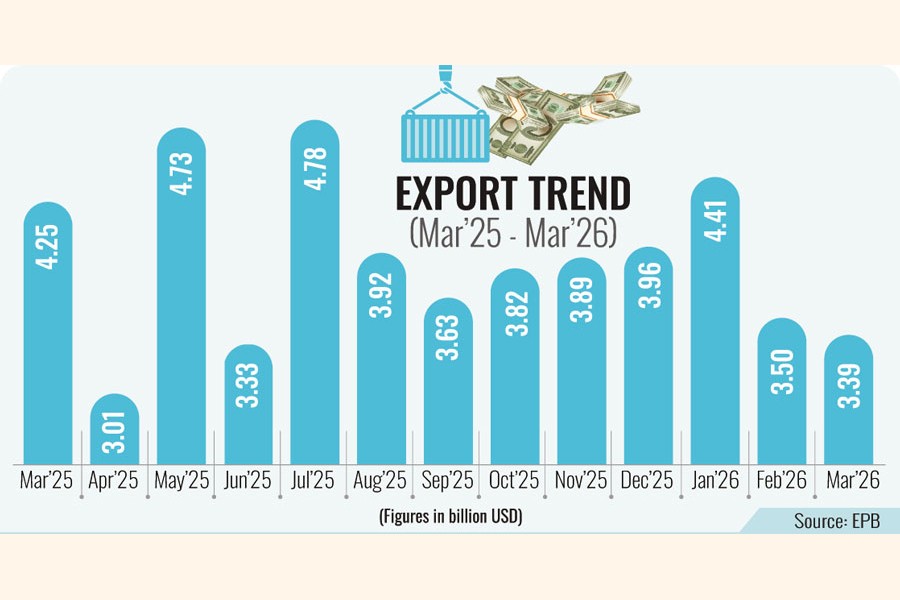
Merchandise-export earnings of Bangladesh have been on a climb-down for eight consecutive months with the single-month tally for last March having registered an 18.07-percent year-on-year negative growth.
In March 2026, Bangladesh received US$3.48 billion in export earnings which was US$4.28 billion in March 2025, according to the data released Thursday by the Export Promotion Bureau (EPB).
Meantime, the overall export earnings during the first nine months of the current fiscal year also stayed on a negative-growth trajectory as main-earner garment shipments to major countries, including the United States, Germany, the UK, Italy and France and other destinations like India, Japan and Australia all contracted.
Bangladesh earned US$35.38 billion during the July-March period of the fiscal year 2025-26, reflecting 4.85-percent year-on-year negative growth against $37.19 billion in the corresponding period of last fiscal.
Exports went into a year-on-year negative growth in August 2025, when the country recorded a 2.93-percent fall.
The climb-down was followed by a decline of 4.61 per cent, 7.43 per cent, 5.58 per cent, 14.25 per cent, 0.50 per cent and 12.03 per cent in September, October, November, December, January and February respectively.
Of the total March earnings, RMG fetched $2.78 billion, logging a 19.35- percent negative growth over $3.44 billion earned in the same month of 2025, the EPB data revealed.
As usual, readymade garments maintained its lead position, contributing $28.57 billion--notwithstanding a 5.51-percent negative growth--to the total export earnings during the first nine months of this fiscal year.
Within this clothing segment, knitwear exports fell by 6.42 per cent to $15.11 billion, while that of woven garments declined by 4.48 per cent to $13.46 billion.
Sources say while the strong performance in July reflects resilience, the slowdown since August highlights challenges for Bangladesh's export sector amid fluctuating global demand and evolving market dynamics.
Exporters, however, attribute the country's negative export growth to weakening global demand, the imposition of reciprocal tariffs by the United States and China's increased focus on markets where Bangladesh has a competitive edge.
They also say cutthroat global competition, rising production costs, and ongoing geopolitical and trade uncertainties have created significant external pressures, contributing to the current challenges in Bangladesh's export performance.
The EPB, however, says among major export sectors, most experienced negative growth compared to the same period of the previous fiscal year, with the exception of frozen and live fishes, leather and leather goods and engineering products which registered a positive performance.
"The overall export performance has been influenced by multiple external factors, including geopolitical tensions such as the US-Israel and-Iran conflict, which has contributed to energy market volatility and instability in the Gulf region, as well as the prolonged Ukraine-Russia war, which has driven inflationary pressures and reduced purchasing power in key export destinations, including the European Union, the United States, and Southeast Asian markets," the EPB says.
These developments have led to slower demand, along with the postponement and cancellation of export orders, it notes in a statement.
Talking to the FE, Mahmud Hasan Khan, President of Bangladesh Garment Manufacturers and Exporters Association (BGMEA), attributed over a week-long Eid holiday to the decline in March performance.
"Export growth started registering negative since last August for a number of reasons while the Middle East war is deteriorating the situation further," he said, adding that they are concerned over the work-order placements by buyers due to the war.
When asked, echoing the BGMEA leader, Mohammad Hatem, President of Bangladesh Knitwear Manufacturers and Exporters Association (BKMEA), said while they are yet to overcome the impact of the war between Russia and Ukraine, the world is witnessing new ones between Iran and the US which would further erode the global demands.
The BKMEA leader apprehends further decrease in export performances in the months ahead and says the continuous negative trend in export earnings "illustrates the reality of the industry that is undergoing tough situation".
"The US tariffs also changed the overall market dimension with decline in sales there and so decrease in placing work orders," he notes.
The July-March breakdowns show home-textile exports declined slightly to $672.62 million down from $677.60 million in the corresponding period of last fiscal.
Leather and leather products earned $878.82 million, up 3.15 per cent.
The agricultural sector saw a 9.21-percent negative growth to $732.70 million.
Jute and jute goods exports tumbled $618.17 million down from $626.29 million, marking 1.30-percent negative growth during the period of 2025-26 fiscal.
Frozen and live fishes recorded 3.71-percent growth to fetch $356.03 million during the first nine months of fiscal 2025-26.
Pharmaceutical exports grew by 3.14 per cent to $170.67 million.
In FY25, Bangladesh exports fetched $48.28 billion, riding on $39.34 billion earnings from RMG.
Munni_fe@yahoo.com