
Mashiur for more frankness in Dhaka-Delhi relations
FE Report | Monday, 25 August 2014
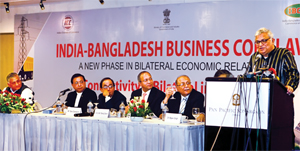
Prime Minister's Economic Affairs Adviser Dr Mashiur Rahman said Sunday India has to have a cooperative approach to enhance both bilateral and regional relationship in South Asia.
He also urged the Indian government to remove para-tariff and non-tariff barriers to help narrow the trade gap between the countries of the region.
The adviser put emphasis on the institutionalization of the existing river and road transit facility between Bangladesh and India as a 'multimodal' one.
Dr Rahman was speaking as the chief guest at the inaugural session of India-Bangladesh Business Conclave held at a city hotel.
The India-Bangladesh Chamber of Commerce and Industry (IBCCI) and the Indian Chamber of Commerce (ICC), Kolkata, co-hosted the conclave with the aim of enhancing bilateral trade particularly with north-eastern states of India that share a large international border with Bangladesh.
India's junior External Affairs Minister VK Singh spoke as the guest of honour at the conclave. Meghalaya Chief Minister Mukul Sangma and Commerce and Industry Minister of Tripura Tapan Chakraborty, Indian High Commissioner in Bangladesh Pankaj Saran, ICC President Roopen Roy, Federation of Bangladesh Chamber of Commerce and Industry (FBCCI) President Kazi Akram Uddin Ahmad and IBCCI President Mohammad Ali also spoke at the conclave. Former IBCCI president Abdul Matlub Ahmad was in the chair.
Dr Mashiur Rahman, while urging the businessmen to talk freely said, "We should be able to tell India that we don't like this approach. India, too, should be able to tell us that they don't like this approach," he said adding: "unless we can reach that level of understanding and mutual confidence, the agreements signed would remain mere conventional documents."
He said there have been a lot of agreements and MoUs (memorandums of understanding) and Bangladesh does not want to see them remain as conventional documents only.
He felt that a new warehouse should be built in the Chittagong port in order to handle export and import of Indian goods through the port.
The PM's adviser said the land ports are not utilised properly, the roads and infrastructure should be developed to increase land trade.
He said currently the two countries have transit facilities for river and road transport, which should be institutionalised as multimodal transit facility.
VK Singh, who fought in Bangladesh's Liberation War in 1971, urged Bangladeshi businesses to explore his government's neighbourhood policy for mutual benefit.
He said government of India was committed to ensuring prosperity in the neighbouring countries.
"Because in your prosperity lies the prosperity of India", he added.
VK Singh said, "Today we have a climate, we have the political will to ensure that things progress in a manner which will be for the benefit of peoples of both the countries."
He said things would only move when both sides find benefit from it. Nothing would move forward if both countries do not find mutual benefit.
Mentioning Bangladesh as India's biggest trading partner among the SAARC (South Asian Association for Regional Cooperation) countries, he said since November 2011, Bangladesh has been enjoying duty- and quota-free access to the Indian market for all items except 25 tariff lines consisting of tobacco, spirit and alcohol.
But Bangladesh's exports to India in the last fiscal year, now valued at US$ 563.9 million, were the highest ever against India's export of over $4.5 billion to Bangladesh, he said.
"Bangladesh's business community has not been able to understand India's markets….that is why you have not been able to fully exploit this duty-free access."
He said his government had decided that north-east India must develop in terms of infrastructure which means rail, road and air connectivity and connectivity with neighbouring countries.
He said Bangladesh has a very strong garment industry. "If the strength of two markets combines, nobody can beat us." "To do so, we need business linkages of both countries and making use each other's strength so that we can benefit mutually out of it".
Meghalaya Chief Minister Mukul Sangma proposed joint investment with his state giving the rich deposit of granite and very high quality of limestone.
He also suggested organising a separate conclave focusing on tourism since Shillong is best known for tourist spots.
He offered a separate Brahmaputra management system participated by Bangladesh and Indian states in the north-eastern hills.
Tapan Chakraborty put forward some proposals that include full operationalisation of Ashuganj port for multi-model connectivity, starting Agartala-Kolkata bus service, allowing use of Chittagong port for Indian goods and strengthening infrastructure at land customs stations on Bangladesh side.
The minister said Indo-Bangladesh trade is tilted heavily in India's favour, with a highly negative balance of trade for Bangladesh. This holds true even for its current trade with the north-eastern region.
"Promotion of Indo-Bangladesh trade in the north-eastern India would be facilitated if Bangladesh trade, business and government are on board and see in it benefits for them as well," he said adding that the trade links via Tripura can be more acceptable and attractive to the partner nation, Bangladesh.
Indian High Commissioner in Dhaka Pankaj Saran also urged Bangladesh's businessmen to be proactive.
He suggested organising road shows, sending business delegations to different Indian states to understand the markets and create linkages with businessmen.
FBCCI President Kazi Akramuddin Ahmed urged the Indian minister to take steps for lessening trade gaps between the countries.
Roopen Roy also acknowledged that both sides have greater possibility of growth.
"We want to revive our historic relationship," he added.