
Mass grave discovered in Malaysia
Sunday, 23 August 2015
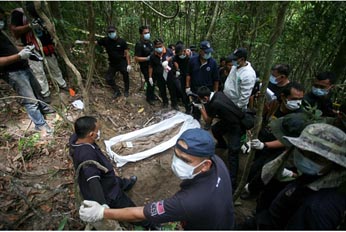
At least two dozen human skeletons – all believed to be human trafficking victims – have been found in Bukit Wang Burma area in Perlis state of Malaysia near Thai border, police said on Sunday. The heavily forested Thai-Malaysia border has been a transit point for smugglers bringing people to South-east Asia by boat from Myanmar (Burma) and Bangladesh. The newly-discovered graves in the northern state of Perlis is close to where authorities in May had found hundreds of bodies in illegal detention camps. An Al Jazeera report says police have uncovered 24 bodies in Bukit Wang Burma. The migrants are often held for ransom in squalid detention camps and according to some accounts face torture and starvation. However, it was not immediately clear if the bodies discovered were those of Rohingya, a minority ethnic group in Myanmar, whose members have fled widespread persecution in that country.
A crackdown by Thai authorities in May drove traffickers to abandon thousands of migrants on rickety, overcrowded boats in South-east Asian waters, triggering a regional humanitarian crisis that saw them land in Malaysia, Thailand and Indonesia after being rescued by fishermen.
On May 26, an abandoned migrant camp used by human traffickers in Bukit Wang Burma jungle outside Wang Kelian was found where 139 suspected graves were discovered which, the authorities believe, were abandoned jungle camps used by human traffickers. The graves were a gruesome reminder of the dire migrant crisis afflicting thousands in South-east Asia. Malaysia’s National Police Chief Khalid Abu Bakar then said “I am shocked. We never expected this kind of cruelty.” That time police found what they believe were human cages made from wood and barbed wire. “We think the migrants were imprisoned in these wooden pens,” Khalid said. “They were not allowed to move freely and traffickers kept watch at sentry posts.” Also found were a pink teddy bear and other children’s items, which led police to believe that children may have been held at one camp. Other items indicate that two of the camps might have been vacated only a few weeks ago. According to international media reports, residents of Wang Kelian knew something wasn’t right. Residents told the media that weak and injured people would stumble into the town’s streets begging for food and water. “They would walk into my shop, with injuries covering their hands and feet. Some were just too weak to even speak properly,” Lyza Ibrahim, who runs a food stall in the town on the northern Malaysian border with Thailand, told Thai and Malaysian newspapers. “One asked me, ‘[Is this] Malaysia?’ Then he pointed in the other direction, said ‘Thailand’ and shook his head to signal that he was not wanted there.” Another resident, Mahyuddin Ahmad, who said he had given the migrants food and clothes, said that he had seen migrants in Wang Kelian for the last two years but has seen more and more in the recent months. “It is a common sight here. We didn’t suspect anything because we thought they just come from Thailand,” he said. “So we are really shocked to hear what the police revealed on May 26 about the grave sites and jungle camps.” More than 3,600 people had landed on the shores of Indonesia, Malaysia and Thailand on May 10. Migrants from Bangladesh and Myanmar flee poverty and conflict, but thousands don’t make it. Some are left to die, trapped at sea. Others, such as those at the camps discovered in Malaysia and Thailand this year, were held hostage, sometimes for months while traffickers extorted more money from their families. A similar discovery was made in early May in Thailand, where 36 bodies were found in 7 abandoned camps.
- biplab