
Mattress money hits record Tk 3.03t amid economic slowdown
SAJIBUR RAHMAN | Tuesday, 26 May 2026
The volume of cash circulating outside the banking system continued to rise in Bangladesh, reflecting a growing preference for holding physical money amid economic slowdown.
Bangladesh Bank (BB) data show the amount of currency outside banks -- often dubbed mattress money -- stood at Tk 3.03 trillion as of March 2026, adding fresh pressure on commercial bank liquidity as withdrawal demand remained elevated.
Bankers say they are still feeling the strain on vault cash.
They also point out that the unexpected change of guard in the banking regulator and amendment to a relevant legal instrument were not taken positively by depositors and market participants, further weakening confidence in the banking sector.
The growing uncertainty has encouraged many people to hold cash outside banks instead of keeping deposits within the formal financial system, according to them.
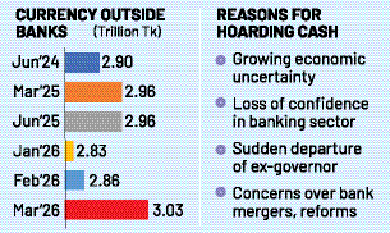
The central bank data shows a clear upward movement in early 2026.
Currency outside banks increased from Tk 2.83 trillion in January to Tk 2.86 trillion in February and further to Tk 3.03 trillion in March, indicating an accelerating cash buildup outside the formal banking channel.
The flow data for FY26 highlights a sharp reversal within a short span.
During July-January of FY26, the flow remained negative at Tk 138.25 billion, suggesting contraction in currency held outside banks.
The negative position narrowed to Tk 100.47 billion in the July-February period, showing an improvement of about 27.3 per cent.
However, the trend reversed in March, turning positive at Tk 65.67 billion during July-March, a swing of about Tk 166.14 billion or 165.3 per cent from the previous month - signalling renewed cash withdrawals and rising liquidity pressure.
The central bank data shows broad money (M2) recorded 10.43 per cent year-on-year growth at the end of March 2026, which was lower than the projected growth of 11.50 per cent for June 2026 and higher than the growth of 9.18 per cent in the same month last year.
M2 rose to Tk 23.35 trillion in March 2026 from Tk 21.75 trillion in the same month last year, marking a year-on-year increase in overall money supply in the economy.
Reserve money (RM) recorded an increase of Tk 40.53 billion or 10.07 per cent YoY at the end of March 2026.
The central bank data shows the trend of keeping money outside banks remained persistently high over the past two years.
Currency outside banks stood at Tk 2.90 trillion in June 2024, rose to Tk 2.96 trillion by March 2025, and remained unchanged until June 2025, indicating sustained cash holding by individuals and businesses.
Bankers say rising currency holdings outside banks reduce lendable resources and weaken liquidity management in the financial sector.
Syed Mahbubur Rahman, managing director and chief executive officer of Mutual Trust Bank PLC, says the recent amendments to the Bank Resolution Ordinance are possibly sending negative signals to the market.
He points out that this uncertainty in the sector may have triggered this situation as customers opt to hold currency outside banks.
"Confidence in the banking sector is wavering," he says.
He notes that negative perceptions surrounding bank mergers and resolution measures have also intensified public scepticism, while the absence of visible development in governance, accountability, and transparency continues to weigh on depositor sentiment.
Rahman further says falling net interest margins are putting additional pressure on banks, limiting their ability to manage liquidity comfortably.
"The government needs to ensure stronger governance, accountability, and transparency to restore public trust in the banking system," he adds.
Dr Masrur Reaz, chairman at Policy Exchange Bangladesh, says persistently high cash outside banks may complicate monetary management for the Bangladesh Bank, particularly in controlling inflation, liquidity, and credit flow in the economy.
It reflects challenges with regard to public confidence in the banking system as well as growing reliance on cash transactions, he says.
He also says higher cash holding limits financial intermediation and constrains banks' ability to support productive investment.
"When uncertainty rises -- whether economic or political -- people naturally prefer keeping cash in hand," he adds.
sajibur@gmail.com