
Medical entrance examination: An Assessment
Tuesday, 13 May 2014
Leaking of examination questions has become a serious problem in our country. Leaking of university entrance examination questions, BCS questions, medical entrance examination questions, and even secondary and higher secondary school certificate examination questions has become a common phenomenon. How to stop leaking of exam questions? To get the solution, we need to know weakness in the system that plagues or causes the real trouble. Perhaps, an economic analysis may illuminate the issue in clearer manner while giving specific guidelines and solutions.
In this paper, we will not focus on leaking of question papers for different types of examinations. Instead, we will specifically analyse the admission test procedure for medical entrance examination. This analysis will help us derive the following facts. First, it will help us understand the question paper leaking possibility. Second, we will show that leaking possibility is intrinsically and inherently linked to making of question papers for medical admission test through a single centralised authority. Third, we will show why it would be beneficial to decentralise the system of administering the medical entrance examination through breaking the centralised control system into multiple authorities belonging to specific medical colleges.
WEAKENESS AND INEFFICIENCY OF THE MEDICAL ADMISSION TEST: The current medical admission test system in our country suffers from two serious problems. First one is the single centralised control system that administers the admission test system. Second one is the allocation inefficiency.
The single centralised system is the real culprit that creates the high possibility of question paper leaking. To understand how a single centralised control system gives incentives to question paper leaking, we can hypothetically imagine a situation in which medical admission test is undertaken under a decentralised system or, more specifically, by the authority belonging to a specific medical school or college. Let's say that there are three medical colleges namely X, Y, and W. The three medical colleges administer their own admission test at some specific time on their own with unique question sets. We assume that three medical colleges will conduct the admission test on the same day. Also say that there is one medical examinee named Z who will take the test to enter medical school. Now also assume that this candidate is not very much confident about his preparation and has some doubt whether he will be able to enter the medical school if he takes the test. Therefore, he is also looking for a way to leak the admission test question paper of any of the three medical colleges.
Now, to leak the admission examination question paper in this decentralised regime of admission test, the examinee Z would have to consider three factors that determine how realistic his attempt to leak the question paper will be. First, he has to calculate information collection cost regarding which medical school authority he/she should target since question papers for three medical schools are completely different now. The more decentralised the system, the higher the information collection costs since information cost is positively related to search cost; the higher the search cost, the higher the information collection cost. In contrast, if there were one single authority to administer the test, then the cost of collecting information as to target who and what would be quite simple since Z need to concentrate or mull over on only one single authority. In this case, cost of information collection is very less. Second, when different medical schools will administer their own admission test with unique question papers, Z has to estimate a probability as to which medical school he should select and try to leak the admission question paper of that school. But if Z were to take the test in a system in which question paper is uniform and same for all with some variation in arrangement of questions in the paper, he is totally free of calculating such probability since there is no uncertainty as to which medical school to select. What was the probability in the case of decentralised system becomes complete certainty in the case of centralised system. Therefore, his expenses and efforts to leak question papers are dramatically reduced under the centralised admission test system. Third, since each of the three medical colleges prepares unique admission question paper for their own use, Z has to decide which medical exam he should take. In doing so Z has to consider the pool of candidates that will compete with him in the admission test. Since under the decentralised system both the cost of collecting information and uncertainty are higher, he may take alternative way to cope up with the system. There will be variation in the level of difficulty of the exam question papers according to strength and ranking of medical colleges. Moreover, the higher the rank of a medical school, the tougher will be the competition since it will be a competition among good students. Such information is not unknown to Z and Z by evaluating his merit can decide which medical school he should choose, and he will choose to compete with a pool of candidates that belong to his own merit class. This rational attitude will discourage Z to seek to leak the admission test question paper. By contrast, if he were to take the test in the centralised system, he would be compelled to compete with an unqualified and undistinguished pool of candidates. This gives Z an incentive to seek a way to leak the exam paper and waste his energy in the wrong path.
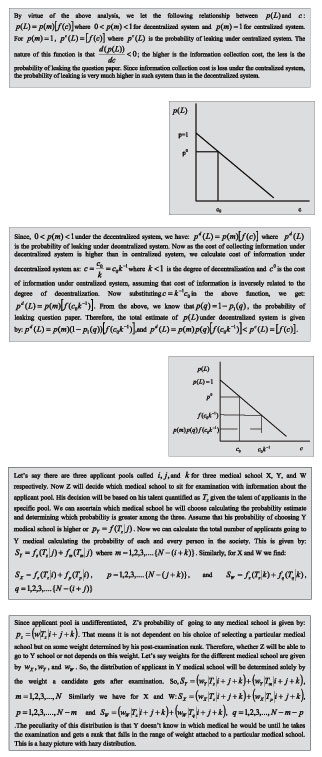
PROBABILITY OF LEAKING QUESTIONS: The above three points prepare the way to formulate an analysis by estimating the probability of leaking of medical admission question paper. For this purpose, we let the probability of question paper leaking p(L). From the first point we see that there is an information collection cost and we designate it as c. The second point gives us the probability of selecting medical school and we term it as [p(m)]m for medical school. P(m) is between zero and one under the decentralised system and equal to one under the centralised system. The third point renders the probability of leaking question paper and this is termed as p(q) which is equal to [ p(q) = 1-p1(q)] where p1(q) is the probability of leaking under the regime of homogenous questions paper and unqualified and undistinguished pool of candidates, and we can reasonably assume that p1(q) is very high and very much close to one. Now we establish the following estimate of p(L) using these information which is given in box below:
A graphical view of the relation between p(L) and c can be shown as follows:
In the above figure, probability of leaking medical admission question paper is measured on the vertical axis and cost of collecting information on the horizontal axis. The graph shows that as the information collection cost increase, p(L) decreases and vice-versa. Since p(m) is equal to one and the collection cost of information is higher under the centralized test system, the probability of leaking should be higher in this case as well. This is shown in the above figure with the information cost c0 and probability of leaking [p(L) = p0]. At c0 information cost, leaking probability is very high and close to one.
Now we calculate the probability of leaking under the decentralised admission test system.
In the above figure, the cost of information under decentralised system is measured on the horizontal axis and p(L) on the vertical axis. The graph shows that at c0 cost of information under the centralised system of medical admission test, the probability of leaking is p0 which is very close to one. Now, under the decentralised system, cost of information must be higher since cost of information is inversely related to the degree of decentralisation measured by k. The negative relation between cost of information and probability of leaking implies that probability of leaking in the decentralised system will be less since the cost of information is higher and this is shown as [f(c0k-1)] where [p0> f(c0k-1)]. Since 0
Moreover, the homogenous medical admission test is based on unqualified and undistinguished pool of candidates. For example, a prospective medical entrance examinee under the homogenous centralised admission test system would have to compete in an unrestricted and undistinguished pool of candidates; all are in the same group. This gives an examinee little choice to decide which school to choose and with whom to compete. To clarify the point more clearly, we can visualise the following scenario. Let's say the candidate Z quantifies his prospect for getting chance in medical school by quantifying his talent designated as Tz. Now Z has to decide with whom he will compete with his talent Tz for the medical admission test. Let's say each of the three medical schools administers their own admission test in their own way with completely different question sets at the same time. Now Z has a room to quantify and measure the applicants' pool for each of the medical schools. If Z thinks that he can't qualify for the top-ranked medical school X if he competes with the top-ranked applicants' pool but he can qualify for second top-ranked medical school Y if he competes with second top ranked applicants' pool, he will decide to opt out for competing for the top-ranked medical school X and will compete for the second top-ranked medical school Y. Moreover, in competing for the second top-ranked medical school, he will compete with a differentiated applicants' pool that will only compete for the second top-ranked medical school not for anyone else. By the virtue of rational expectations, Z can think that the other applicants competing for Y are more or less homogenous in terms of talent Tz he has. This method is optimising in two respects. First, this method is based on heterogeneous preferences and differentiated competing applicant pools. Second, this method gives a complete autonomy for Z as to what to choose; where to apply; with whom to compete; and with whom not to compete. In this way, the differentiated and distinguished and decentralised test system ensures an efficient allocation of applicants among medical school. This method also reduces the inequality in terms of quality applicants each medical school gets. We can state the above theoretical analysis more compactly as follows:
The above analysis renders the distribution of applicants among medical schools according to differentiated pool of candidates and preferences. Now we analyse the distribution under the current undifferentiated pool of candidates as:
CONCLUSION: The main implications of the analysis can be summarised as follows. First, the current medical admission test system is too flawed to give a high incentive for questions leaking. The very centralised examination system contains some inherent factors that induce leaking of questions. Second, the current medical admission system and the way students are distributed among different schools are not efficient. It doesn't give any room or freedom to choose a particular medical school until the examination takes place. Moreover, such hazy and unsystematic distribution of students according to weight attached to a medical school and the rank applicants get contributes to the ever marginalisation of the lower-ranked medical school. For example, under the current system applicants ranking in the lower tier are forced to go to a medical school that is also ranked low. This is not a problem as long as each and every applicant has chosen the respective medical school following some optimising rule such as differentiated applicants' pools and preferences. But this is not what happens with the current system. Furthermore, under the differentiated applicants' pool the lower ranked medical school will also be able to get better students that would otherwise have gone to higher ranked place. This is due to the self-selection performed by the applicant himself not by the forced distribution method. This will help over time to improve the quality of education and service of lower ranked medical school. Therefore, it is better to decentralise the medical admission test by giving every school the autonomy to conduct the test with its unique question set.
Md. Jamal Hossain is with the University of Denver and Md. Mustafizur Rahman with the Bangladesh Institute of Bank Management (BIBM).
jheco.du@gmail.com