
Medical spending beyond average households’ means
FHM HUMAYAN KABIR | Thursday, 6 July 2023
Medical expenditure per household (HH) in Bangladesh has risen beyond the means of many, almost having doubled in last 12 years by an official account.
Analysts say a high prevalence of chronic diseases and growing treatment costs are pushing up the medical spending, in lockstep with rises in general consumer prices.
The latest Household Income and Expenditure (HIES) Survey 2022 by the Bangladesh Bureau of Statistics (BBS) has shown that the average household expenses for medical purpose has jumped to Tk2,114.67 per month, accounting for 6.91 per cent of total Tk 30,603 monthly spending.
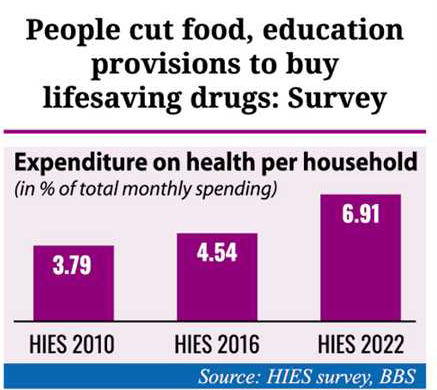
The spending rate was only 3.79 per cent in 2010 and 4.54 per cent in 2016, the HIES survey of the respective years showed.
According to the HIES 2022 report, each of the HH in the country spends Tk 30,603 per month from their Tk 32,422 monthly income for different purposes, including food and non-food consumption.
An FE analysis has found each of the HH in villages spending higher in getting health services than that in the urban areas.
A rural HH spends 7.27 per cent of their total Tk 26,207 monthly average consumption spending.
On the other hand, each HH in urban areas spends 6.40 per cent of their Tk 39,971 monthly consumption spending.
Ten years ago in 2012, the rate of health spending for each of the HH in rural areas was only 4.05 per cent and in the urban areas 3.35 per cent of their total monthly average consumption expenditures.
Meanwhile, the spending of the HH on food and education bills has dropped compared to the previous survey period.
The FE analysis has found the expense for food per HH having dropped to 45.76 per cent in 2022 from 54.81 per cent in 2010.
Similarly, the spending for education also fell to 2.78 per cent of their total monthly average expenditure in 2022 from 5.68 per cent in 2010.
Health expert and researcher Dr Liaquat Ali told the FE it is not surprising at all that the country’s health expenditure is rising. The government’s National Health Accounts report has also shown that out-of-pocket expenditure for getting health services stood at 68.5 per cent in 2022 in a rise from 63.3 per cent 10 years ago in 2012.
Dr Liaquat said: “Since there is less government investment in upgrading the health services, non-quality prescriptions for the patients and unholy alliance between some drug producers and doctors, the monthly HH spending for health is increasing.
“Actually non-communicable diseases are rising year on year in Bangladesh, which is expanding the overall health-service cost. Besides, the higher and uncontrolled price of drugs is another reason behind it,” the health researcher added.
Dr Abdur Razzaque Sarker, Research Fellow of Bangladesh Institute of Development Studies (BIDS), told the FE that the prevalence of non-communicable diseases in Bangladesh has been rising, which ultimately pushing up the HH expenditure for getting the essential services.
“From the positive perspective, rise in heath expenditure for a country is good news. But if it is expanded for the growing costs in getting treatment, purchasing drugs, and for disease diagnosis, then it is bad news for us. Unfortunately, the second one is mostly happening in Bangladesh,” he said.
Both the researchers have urged the government to invest more in improving the country’s health services and cutting the HH expenditure, as reports say people suffering from serious diseases in particular are in a quandary over unabated rise in prices of essential medicines and treatment bills.
kabirhumayan10@gmail.com