
Meeting the challenges of brain drain
Nilratan Halder | Monday, 8 December 2025
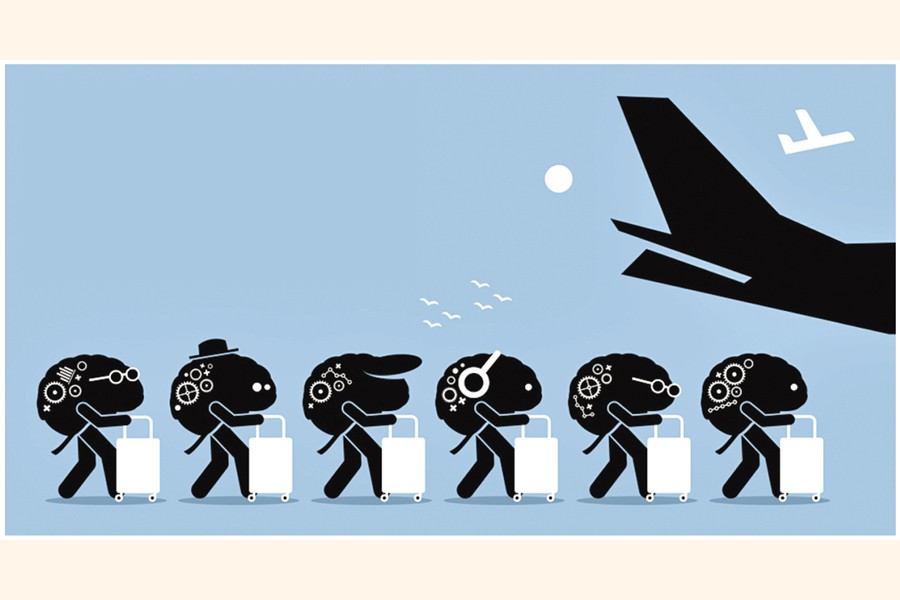
1.jpg) The problem of brain drain encountered by poor and underdeveloped countries is both a cause and consequence of a grand scheme. Its roots lie in the colonial exploitation of subjugated countries by the conquering powers such as the Indian subcontinent by the British. Following their conquest of countries in Asia, Africa and North and South Americas, the colonial powers either captured the lands for settling there or made arrangements for perpetuating the system of arrangement for exploitation. To that end, they introduced a system of education for producing a subservient class---mainly clerks---granting it limited financial solvency and privileges.
The problem of brain drain encountered by poor and underdeveloped countries is both a cause and consequence of a grand scheme. Its roots lie in the colonial exploitation of subjugated countries by the conquering powers such as the Indian subcontinent by the British. Following their conquest of countries in Asia, Africa and North and South Americas, the colonial powers either captured the lands for settling there or made arrangements for perpetuating the system of arrangement for exploitation. To that end, they introduced a system of education for producing a subservient class---mainly clerks---granting it limited financial solvency and privileges.
For about 200-250 years, the Spanish, British, French, Dutch, Portuguese and Italians captured vast tracts of the planet in order to plunder resources from there. Not only did the conquerors introduce a tailor-made system of education based on local languages but also imposed theirs on the subjugated nations keeping the option for the brighter and talented learners to pursue higher education at the colleges and universities abroad. The system is still prevalent and made further accessible to those who can meet the highly commercialised level of self-financing. Of course, the provision of scholarships for the uniquely endowed candidates is there.
In some countries, this is used as a bait to rope in extraordinary pursuers of higher studies. The host countries know it very well that once they are offered opportunities to conduct research and experiments in laboratories or other facilities vastly more advanced compared to the countries they hail from, except a rare few, the majority will not return home. No wonder, the saga of brain drain thus continues unabated and even gathers speed with political uncertainty and instability in the countries of birth of the pursuers of higher study. Even Donald Trump, known for his anti-immigration policy, is in favour of retaining the H1-B visa programme that allows migration of skilled professionals from abroad. He makes it amply clear that his country does not have people with 'certain talents' to fill some specific jobs domestically. When the interest of America is concerned, Trump has no hesitation to make this concession.
One of the reasons that prompts talented students to leave their country is undervaluation of their talents and the undue influence exerted by substandard political elements at all levels of socio-economic spectrums. When mediocre and muscle-flexing politicians join hands of the equally below standard bungling bureaucracy to plunder national resources, talented students opt for a life abroad. They know that they cannot accomplish their missions making use of their talents in substandard research facilities or receiving the required incentives either from the government or from private business or corporate entities.
What emerges from such an environment is that the country of origin of the diaspora is deprived of their service and additionally becomes a supplier of resourceful minds without any return in exchange for its sacrifice. Even a country as vast as India with a strong base of information and communication technology (ICT) proved its powerlessness to restrain a select pool of Ivy League techno-savvy people from heading tech and business giants of America like Google, Microsoft, IBM, Abode and Deloitte. Sundar Pichai, Satya Nadella, Arvind Krishna, Shantanu Narayen and Punit Renjen of Indian origin now serve as the chief executive officers (CEOs) of the world famous tech companies and business entities. Parag Agarwal and Indra Nooyi headed the former Twitter, now X under Elon Musk, and Pepsi Cola respectively.
Similarly, a large majority of scientists, distinguished professors and researchers of foreign origin, who have received Nobel Prize, are migrant scholars. The US boasts the overwhelmingly largest number of Nobel Prize recipients courtesy of brain drain from all across the planet. Bangladesh's only Nobel laureate Muhammad Yunus, now heading the interim government, may not fall in that category but US lobbyist groups had contribution to his nomination and recognition as an awardee of Nobel peace prize.
It is exactly at this point, China's emergence from an imitator to an innovator provides a lesson for the rest of the world. When the country's President Xi Jinping opted for catapulting China from a producer of cheap commodities to a cutting-edge innovator, Western pundits dismissed the initiative because, according to them, innovation and creativity cannot flourish under autocracy as China is labelled. Jennifer Lind in her book on China, Autocracy 2.0: How China's Rise Reinvented Tyranny has argued how the country under Xi Jinping found a new strategy for controlling its people and balancing it with the opening of market in line with the free-market economy.
The country's declaration of 'Made in China 2025" has thus kick-started and made the impossible possible, proving the Western economists and industrial experts wrong.
The technological base was weak and Chinese universities were mediocre and there was a serious lack of skilled employees. Right now China has overcome all such weaknesses and deficiencies. But this did not happen overnight. The country invested large amounts in education and development of human resources. China is now reaping the benefits of such investments and smart strategies. It is now leading, Lind argues, the world in some sophisticated technologies. The country's higher study has gone through qualitative changes so much so that it produces the largest number of PhDs in science and technology. Its open source AI (artificial intelligence) model, DeepSeek was created by the majority of home-grown technologists.
Chinese technological advancement is phenomenal. It produces 80 per cent of the world's solar panels. Its companies lead the world in manufacture of electric cars and became the number one car exporter in 2023 relegating Japan to the second place. It has also established its monopoly by capturing 70 per cent of the global drone market. The latest news is that China is building a nuclear-proof futuristic floating island that is projected to be complete by 2028. Chinese scientists claim it can withstand a nuclear blast, a fierce cyclone, rising tides and the most powerful typhoon.
All this is a display of Chinese scientific and technological might. Its strategy for innovation is a lesson for stopping, if not reversing, brain drain. The country produced cheap and small things for export. Revenues earned from such commercial transactions have accumulated over the years to finance its ambitious human resource and infrastructure development. Can Bangladesh emulate the policy for development of its own human resource, elevate its education and scientific and technological capability? It certainly can. But to do so, the country needs a government with futuristic vision and, above everything else, integrity of character and patriotism par excellence.
nilratanhalder2000@yahoo.com