
Meghmallar: War of independence in filmy representation
Md Razid | Saturday, 6 December 2014
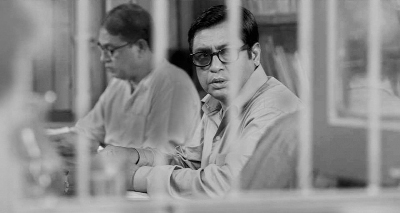
The premier show of Meghmallar by Zahidur Rahim Anjon was held on November 18, 2014 at Star Cineplex. This film will be released commercially this month (December 2014). The film focuses on a middle class family who unlike others started to live with fear and anxiety in the period of 1971 genocide. The narrative of this film is based on the three days of monsoon of 1971, just after the six months of hatred, violence and mass killing on Bengali people by Pakistan army and their collaborators. The lead character Nurul Huda plays a role of senior lecturer of Chemistry in a government college living in a quarter with his wife and a four years old daughter in a small town. His personality appears to be a quiet, punctual, coward and voiceless guy, where he always strives to avoid fuss for any sort of unexpected claims or allegations. His relationship circle is limited to one of his colleagues, named Abdus Sattar, alike him. During the war period, Abdus Sattar relocates his family to his village for the vulnerable surroundings of the town, but in such a scenario Nurul Huda did not take such initiatives in spite of his wife's eagerness to relocate. Meanwhile, his brother-in-law Mithu who used to stay with them suddenly joins freedom fighting group 'Mukti Bahini' ultimately leaving the house. This makes Nurul Huda more anxious as whether the army will point finger on him. After a bang incident by the Freedom Fighters at that time, Nurul Huda was arrested for accusation of having connection with the freedom fighters. The Pakistani Army began to torture him in their custody as a part of war brutality. Later on, he reckons himself as a valiant freedom fighter who now dares to sacrifice his life for the country.
Zahidur Rahim Anjon adapted the story from the short story titled 'Raincoat' of Akhtaruzzaman Elias. The story begins with a post-war scene and possesses an external flashback (moves prior to the narrative start-up), especially to narrate the past story. The movie concludes with the same scene it started. According to the narratologists, prolonged flashback might be a warning of deeper story problem but Mr Anjon did such a marvellous job to overcome such hypothesis. He rather selected this unorthodox technique for his visual story development that intensifies his story indeed. In films, flashback as a cinematic technique was introduced very long ago. It was first used in The Yiddisher Boy (1909), a short silent fiction by Siegmund Lubin. But great filmmaker D W Griffit used this cinematic technique effectively in his full length silent feature 'The Birth of a Nation' (1914). Since then this technique has become very common, which usually crafts a complex narrative structure (bridging & synchronizing between the past and the present frames). But the director of Meghmallar made it effortless. Using the technique, he also inserted two internal flashbacks (moves to an earlier point in the narrative or analeptic of character) within the external flashback of the narrative. It albeit makes the narrative non-linear but selection of the points for internal flashback enhances the quality of visual story telling processes.
In the reality we see that people of this region have experienced catastrophe, holocaust and a high scale of oppression by the colonial rulers in various eras. After the partition in 1947, people of this region believed that the situation will be in a better scale concerning the issues of development, changes, equality and dignity of a newly independent country. But Pakistan had always been depriving the Bengali's social and economic rights from the beginning. And through genocide in 1971, they had killed three million people within nine months.
The movie Meghmallar takes us to the past to see what situation the mass people had encountered and what happened to those who had not joined the liberation front directly at that time. Moreover it portrays how the people had passed their deadly days in upholding courage and hope in their hearts for an independent Bangladesh and how they had sacrificed their lives for the motherland. The entire terrifying environment of 1971 has been portrayed audio-visually in the movie, where there are no scenes of direct war or explosions but the whole film signifies the essence of the dreadful genocide of 1971.
From the beginning, Pakistan was perpetually covetous about the substantial resources and the immense beauty of Bangladesh. Land was more significant to them rather than the Bengali people. Comments of Butcher Tikka Khan signifies it, as he once stated, "We need land not people." Meghmallar successfully visualizes the eternal beauty, nature, monsoon, flora and fauna of Bangladesh with an artistic expression. In the film it shows that Nurul Huda, despite being a coward person, supported Bangladesh Liberation war from his inner soul. In the very first scene he mocks a comment of Henry Kissinger that was against the Bengali people. People like Nurul Huda are considered spineless men in the society, where the most common scenario illustrates that they are always oppressed and dominated by the maneuverers or intriguers. To live with dignity and integrity, one ought to deliver the hardest punch in taking a stand for the right thing. The stated substance has been clearly identified in the film, where poor Nurul Huda and a Geography teacher had been accused of a false allegation by the authority of college. This phenomenon is actually a universal act applied from the inception, as when the wild wind blows, small trees are affected most in the first place! The very initial scene of the movie was the wind blowing on Green Manure Corps! Director constructed the character (Nurul Huda) successfully with a selection of logical costumes and props, shaping the dialogue according to his class, and the fixing the movement, gestures and expressions of the character as per defined personality. Nurul Huda is played by Sahiduzzaman Selim, and most probably it is his best performance throughout his career. Cinematography, visual tones, frame, composition and utilizations of classical music is outstanding. Every image keeps details of every object and using very unique framing and composition, director tried to hold the audience's attention. Usually when audience finds uninterrupted and long-take scenes in a film, they drop interests. As in general, the audience anticipates for rapidity in a movie, which actually occurs from the movement of camera line and short-takes. Scenes of Meghmallar are treated on the long-take technique though in a unique way, where the camera stands still but the audience vision keeps moving on the screen even in a long-take scene. Every scene is arranged with details and creation of a 'mise-en-scene' (the stuff in the frame and the way it is shown and arranged) gives an essence of reality. Utilization of sounds, out of frame sounds and clear ambient sounds flourishes the emotion of the situations, places and the events.
Every work is not perfect. Hence Meghmallar is not beyond that limitation too. Some minor facts could be visible to the audiences, which could be hardly mentioned. On the whole, the film depicts a life, a time, a region and sacrifices of people for their motherland. The filmmaker should have a deeper understanding of life, intuitive observation and art of holistic approach to make films like Meghmallar. It is a unique audio-visual expression of a story without cliché.
The writer is a film activist and can be reached at e-mail: director_season@hotmail.com