
Memory chip price spike threatens digital infrastructure projects
ISMAIL HOSSAIN | Friday, 17 April 2026
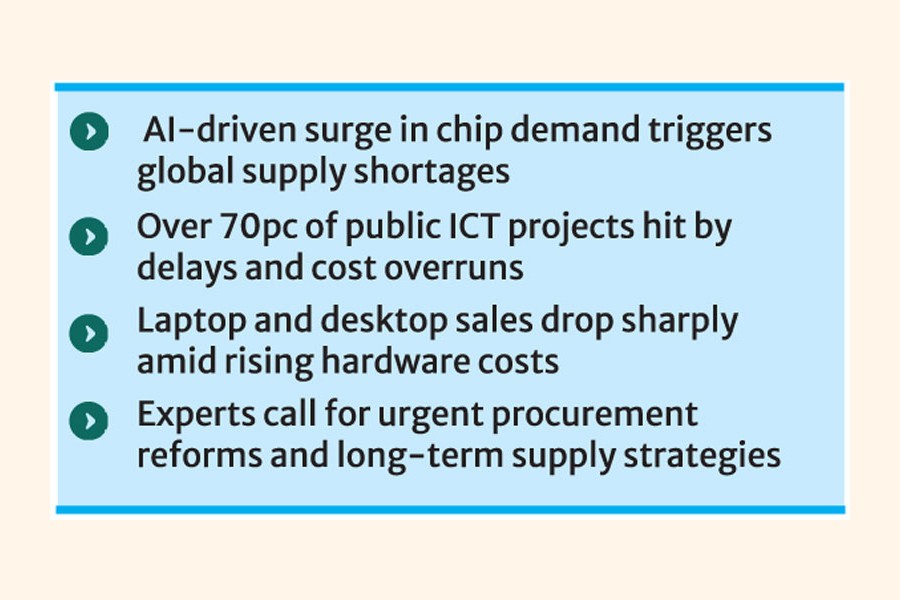
A sharp and sustained surge in global memory chip prices is pushing the country's ICT sector into a growing procurement crisis, with officials and industry insiders warning that delays, failed tenders and spiralling costs are severely affecting key digital infrastructure projects.
Driven by explosive demand for Artificial Intelligence (AI) infrastructure, prices of NAND flash and DRAM have risen dramatically over the past six months. According to global market trackers, enterprise SSD prices have jumped by more than 400 per cent, while DDR5 memory modules have surged by over 270 per cent.
Analysts describe the situation as a "storage media famine," as chipmakers redirect production capacity toward high-margin AI components, particularly High Bandwidth Memory (HBM), leaving conventional memory products in short supply.
They expect the imbalance to continue until at least 2028.
The impact is being felt acutely in Bangladesh due to the country's total reliance on imported hardware and its rigid public procurement systems.
"Bangladesh's ICT sector is facing sharp cost pressure as global DRAM and NAND prices rise, pushing device and server costs up by roughly 10-25 per cent," said Syed Almas Kabir, former president of the Bangladesh Association of Software and Information Services (BASIS).
"Supply is tightening because manufacturers are prioritising AI-grade memory, leaving local importers with longer lead times and inconsistent availability," he added.
Supply squeeze hits local market
Local vendors report growing difficulties in securing supply as global manufacturers prioritise large "hyperscaler" clients in major markets.
Sanjoy Sarker, General Manager (Enterprise Solutions) at Global Brand PLC, described the situation as a "perfect storm" of rising prices and shrinking availability.
"As Bangladesh relies entirely on imports, global shifts in manufacturing and currency value are felt immediately," he said. "Prices for some 16GB DDR5 modules in Dhaka have jumped from around Tk 7,800 to over Tk 28,500 within months -- an increase of more than 200 per cent."
He added that entry-level server costs have risen by nearly 58.6 per cent in six months, while SSD prices have increased by around 40 per cent.
The surge has triggered a steep decline in consumer demand, with laptop and desktop sales dropping by nearly 70 per cent in major technology hubs such as Multiplan Computer City.
At the same time, the depreciation of the taka -- hovering between Tk 122 and Tk 123 per US dollar -- alongside VAT and import duties, has further inflated costs for businesses and public agencies.
Procurement delays deepen the crisis
Experts say Bangladesh's slow and rigid procurement processes are turning a global supply shock into a domestic crisis.
Lengthy approval cycles -- often exceeding a year -- mean that by the time projects reach the tender stage, original budgets are already outdated.
"Bangladesh's slow procurement cycles and year-locked budgeting are intensifying the storage crisis," Syed Almas Kabir noted. "Projects are forced to rely on outdated specifications even as global memory costs surge."
The consequences are becoming visible across sectors: Hardware costs for server installations have increased by more than 50 per cent compared to original estimates, ongoing projects are experiencing cost overruns of 25-30 per cent on average, with some rising by as much as 70 per cent and a growing number of tenders are failing because official cost estimates fall below market prices.
In some cases, companies are incurring direct financial losses. Industry insiders cited instances where firms failed to secure contracts due to sudden price hikes, leading to forfeited bank guarantees.
More than 70 per cent of public ICT projects are now facing delays, particularly in areas such as e-governance, data centres, and digital financial services.
Digital transformation at risk
The broader implications for Bangladesh's digital ambitions are significant. Key initiatives under the "Smart Bangladesh" vision are increasingly at risk as procurement bottlenecks stall implementation.
A.K.M Fahim Mashroor, Chief Executive Officer of Bdjobs.com, warned that rising hardware costs could slow the adoption of new technologies across the economy.
"The increase in memory equipment prices will inevitably slow digital expansion," he said. "The overall ICT sector will be negatively impacted, especially with the added pressure of a stronger US dollar."
Industry observers say the crisis is creating a widening gap between project planning and market realities, forcing organisations to scale back ambitions or delay execution.
Call for urgent reforms
Experts have urged both the government and private sector to shift from reactive procurement to long-term resilience planning.
Recommended measures include multi-year supply agreements, flexible and performance-based technical specifications, and budgeting frameworks that allow mid-cycle price adjustments.
"The government must secure multi-year supply agreements and prioritise critical national projects for guaranteed memory allocation," Kabir said. "Without these reforms, essential digital projects will continue to lag behind rapidly shifting global technology markets."
Private sector players, meanwhile, are being encouraged to diversify suppliers and redesign systems to reduce storage dependency through cloud optimisation and smarter data management. With global supply constraints expected to persist for several years, analysts warn that the cost of inaction could be far greater than the cost of early intervention.
bdsmile@gmail.com