
MiB developed to provide real-time data on RMG factories
Says Afshana Choudhury
FE REPORT | Friday, 1 April 2022
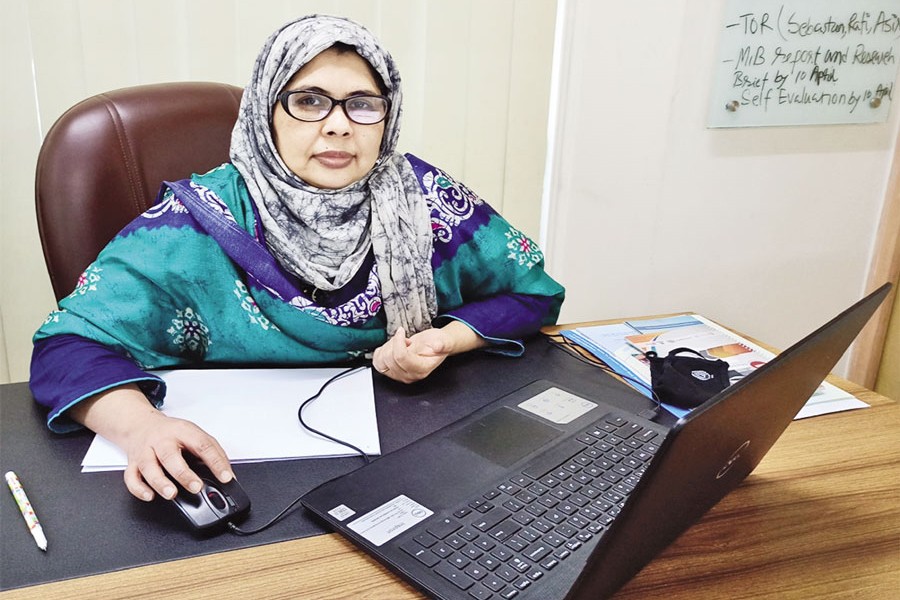
 Mapped in Bangladesh (MiB), a digital platform, has collated, so far, data from 3,723 export-oriented RMG factories spread all over Bangladesh using the census method, resulting in a digital map that is free, neutral, interactive and open access, says Afshana Choudhury, Lead Operations Officer of Mapped in Bangladesh (MiB), in an interview.
"MiB was founded in response to a scarcity of accurate data. We struggled to get real data when we first started this initiative, and we were also given a lot of secondary data from various sources. As a result, our major goal was to provide stakeholders with reliable real-time data so that they could make informed decisions," she said.
To make data more vibrant and useful in this age of information technology, the Centre for Entrepreneurship Development (CED) of Brac University has implemented "Mapped in Bangladesh" (MiB), a transparency mechanism of digitally mapping the export-oriented RMG industry, funded by Laudes Foundation and co-funded by the Kingdom of the Netherlands, she added.
Bangladesh Garment Manufacturers and Exporters Association (BGMEA) and Bangladesh Knitwear Manufacturers and Exporters Association (BKMEA) are strategic partners of this initiative, with the Department of Inspection for Factories and Establishments (DIFE) providing necessary strategic support. MiB is being coordinated by BRAC, she informed.
"The project was intended for the RMG sector, therefore we thought this was a digital map that could be utilised in other sectors as well," she added. "We had to start somewhere, so we started with RMG," she responded, when asked why the project is being designed for the RMG industry rather than another sector.
"So, if any fundraisers are interested in donating funds, we can replicate the digital map in other sectors as well," she noted.
Defining an example of the usability of the platform, she said, it's a combination of both database and map. Each factory has a unique number, allowing rights-based organizations working for the benefit of workers by using the map to figure out how many brands are working in Bangladesh and with which factories.
"We are still in the first phase of being transparent, but much to be done towards our journey to transparency. So, it's an initiative which indicates that we have taken some major steps," she added.
You will not find any map in all over the world to have this kind of information, this is the first time the Bangladesh RMG sector has developed this kind of map that provides essential information about export-oriented RMG factories, she said.
"Although the map is user-friendly, we need to make some improvements to our functionality. The map's language is currently in English; therefore, if we could acquire funds, we'll develop it in Bangla as well in the following phase to make it more user-friendly to all sorts of stakeholders, including workers," said Afshana Choudhury.
"We faced numerous challenges, including gaining access to the factories, bringing all parties on board, validating the data that had been collected (3,723 RMG factories), and finally, the arduous process of data collection," she recalled.
At this point, Mapped in Bangladesh (MiB) is now widely known to the industry stakeholders, and thus promoting the acceptance of a transparency mechanism for the betterment of the RMG sector, she said.
Afshana Choudhury is also Joint Director, Centre for Entrepreneurship Development (CED), at BRAC University. She can be reached at Email: a.choudhury@bracu.ac.bd