
Migrant crisis: Rallies in Europe as 9,000 arrive in Munich
Sunday, 13 September 2015
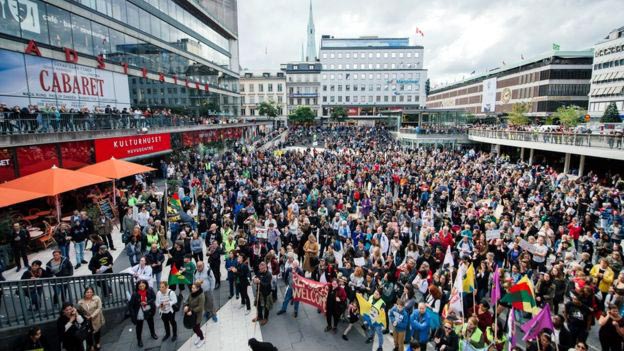
Tens of thousands of people have taken part in a "day of action" in several European cities - and in Australia - in support of refugees and migrants.
There have also been counter-demonstrations in some countries.
Europe is struggling to cope with an enormous influx of people, mostly from Syria, who are fleeing violence and poverty in their own countries.
More than 9,000 migrants arrived in Munich on Saturday. Germany expects 40,000 to arrive over the weekend.
Chancellor Angela Merkel defended the decision to let in large numbers of refugees, saying she was "convinced it was right".
However, she faces growing criticism from her political allies, including the premier of the state of Bavaria, who told Der Spiegel magazine (in German) the situation would soon be beyond control.
Around 4,000 troops are being deployed in Germany for logistical support.
In London, tens of thousands of people, some carrying placards that read "Open the Borders" and "Refugees In" marched towards the prime ministerial residence in Downing Street.
There were similar demonstrations in other UK cities.
The British government has said it will take up to 20,000 refugees over five years, but from camps in the Middle East rather than people arriving in Europe.
In the Swedish capital Stockholm, about 1,000 people appealed for more generous support for refugees.
"Sweden can do much more, not only because it has the capacity to do so, but also because it, along with the European Union, bears some responsibility for the conflict in Syria," said demonstrator Joakim, 38, who took part with his two children.
An estimated 30,000 people rallied gathered outside parliament in the Danish capital Copenhagen, chanting "Say it loud and say it clear, refugees are welcome here".
Mohammed Harra, who was born in Morocco, told Denmark's Politiken newspaper: "I am here to support refugees who have been driven out of their houses because of what has happened in Syria, with the bombings and the killings."
Rallies against welcoming more refugees and migrants took place in some eastern European countries.
About 5,000 people chanting anti-Islamic slogans marched in the Polish capital Warsaw, while a nearby counter-demonstration drew about 1,000 people.
In Prague, about 800 protesters carried banners reading "I do not want refugees and Islam in Czech Republic" and "Protect the borders".
Elsewhere in the city, a smaller counter-demonstration in support of refugees attracted about 200 people, witnesses said.
Another anti-migrant rally attended by about 1,500 people took place in the Slovak capital Bratislava.
Tens of thousands of mainly Syrian migrants have been making their way from Turkey, through the Balkans and Hungary to reach Austria, Germany and Sweden.
Migrants have continued to arrive in Macedonia from Greece. More buses were reported to be heading towards the Hungarian border.
Next to a set of old railway tracks, a long line of migrants and refugees queues for buses to take them to nearby registration camps, which I have not been able to visit.
A police officer calls families forward one by one. "Syria? Afghanistan? Pakistan?" the officer asks in English.
He notes their reply on a piece of paper and lets them board.
A translator stands by to help. At one point, she picks up a rake and clears rubbish from the road in front of the bus.
By contrast to the chaos and panic I witnessed at the same place on Friday night, the atmosphere is calm. The police are courteous and organised.
Volunteers walk along the line handing out sandwiches and bottles of water. The refugee families wait patiently in the sun, according to BBC.
-- Saikat--