
Migratory birds continue to skip Tanguar Haor
Fewer birds have led to a sharp drop in both foreign and domestic tourists
OUR CORRESPONDENT | Friday, 6 February 2026
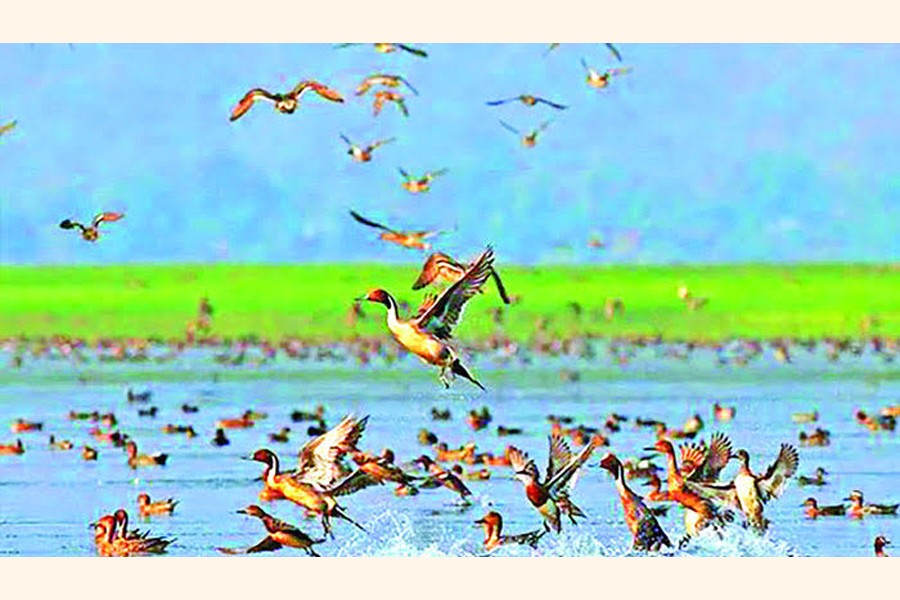
SYLHET, Feb 05: Although winter is about to end this year, migratory birds have almost been absent at the Tanguar Haor in Sunamganj district, as bird species have continued to skip the spot over the past few years, according to locals.
Known as the country’s second largest freshwater wetland, the haor is a World Ramsar Heritage Site—a sanctuary for various species of fish, migratory birds and aquatic plants. The haor spans across portions of Tahirpur and Madhyanagar upazilas of Sunamganj.
At the beginning of the winter season every year, migratory birds used to flock Tanguar Haor, which came back to life with the noise of birds. But for the past few years, birds have not been seen as expected. Journalist Alam Sabbir said that four-five years ago, due to a section of unscrupulous bird hunters and traders, the number of birds in the haor decreased drastically.
Locals said a few years ago, migratory birds were sold openly, and in some cases, secretly in various markets of Tahirpur Upazila and central areas of Sunamganj district.
Sources said that at the time of drastic fall in bird population, the deputy commissioner of Sunamganj gave special importance to the conservation of Tanguar Haor and the development of the tourism industry. Under his guidance, bird hunters were fined and imprisoned through mobile courts with the help of the upazila administration and police.
Local residents say that bird hunting has largely stopped for the past two years and is now “virtually non-existent.” But, the bird population has not recovered.
Once upon a time, despite the difficult communication system and housing crisis, biodiversity-loving tourists from home and abroad used to come to see birds in Tanguar Haor.
But in recent years, due to the decline in the number of birds, the numbers of foreign tourists and domestic tourists are very limited, locals say. Ahmed Sayeed, a local, said that for the last two years, the arrival of foreign tourists to Tanguar Haor has been completely stopped during the winter season. The number of domestic tourists is also very low.
Spread over an area of about 126 square kilometers, Tanguar Haor was visited by migratory birds from different parts of the world, including Siberia and other regions every year. This food-rich haor provided them with new vitality after their long flights.
According to Bangladesh Poribesh Andolon sources, the number of migratory birds at the renowned Tanguar haor has been on decline for years for various reasons, including a change in the weather and lack of monitoring. A Tk 450 million project taken by the environment department for the Tanguar Haor development has been ongoing for over a year, but the organisation failed to provide any information on the matter. About a decade ago, guards used to keep watch to prevent bird hunting, but such an initiative is no longer seen now.
Experts said that out of the world’s 10,000 species of birds, 1,855 are migratory. At one time, there were about 219 species of birds in Tanguar Haor. Of these, 98 species were migratory, 121 were endemic, and 22 were ducks. Notable species included the rare Palace Fishing Eagle, Maulvi Duck, Peari, Kaim, Ramkura, Matharanga, Balihans, Lenja, Chokhachokhi, and Beguni Kalem.
Saiful Alam, a resident of Tanguar Haorpar, said that these birds are almost non-existent today.
He further said, “The district administration recently banned the movement of all types of motorised boats in the core and buffer zones of Tanguar Haor since last year, which raised hopes for the situation to change.”
Sunamganj Deputy Commissioner Dr. Mohammad Ilias Mia said that the government has formulated special policies for the conservation of haors and wetlands. The district administration is in a strict position to implement these policies. Maximum surveillance will continue to protect biodiversity and develop the tourism industry, he added.
forsylhet@gmail.com