
Mining coal from Dighipara field
Mushfiqur Rahman | Thursday, 20 July 2023
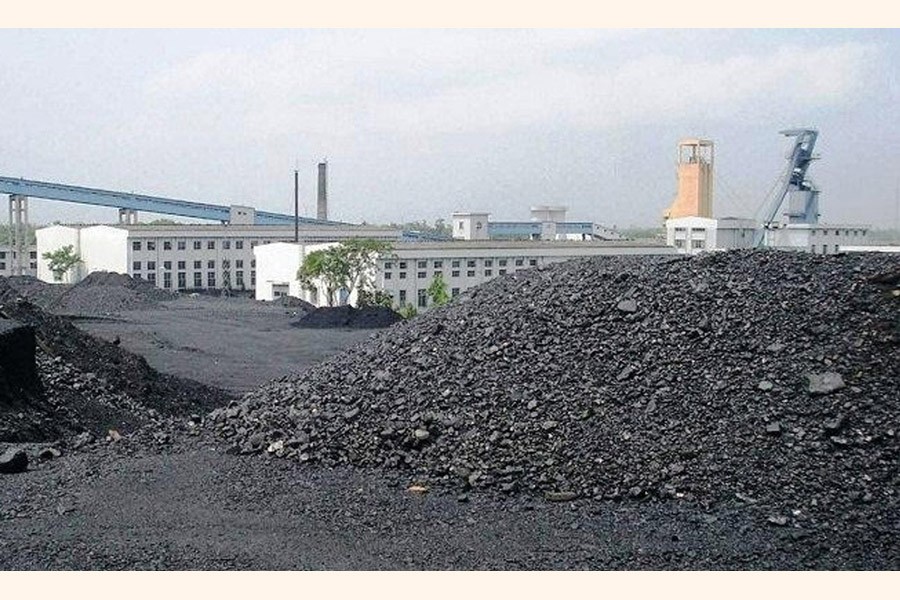
A leading local daily newspaper on July 15, 2023 reported that the government had been considering developing an underground coal mine at Dighipara, Dinajpur for mining domestic coal. The Dighipara coal field was discovered by the Geological Survey of Bangladesh (GSB) in 1995. As per primary estimate of GSB, there are 703 million tonnes of coal resource distributed in 7 coal seams at a depth of 346-420 meters below the surface. A further study of Petrobangla (carried out by a consortium of Fugro, Mibrag of Germany and RPM of Australia) suggested mining prospect of approximately 90-120 million tonnes of coal (15Per cent of reserve) from the deposit. The mining scheme was linked to a 30 meter thick coal seam at a depth of 360 meters at Dighipara field. The estimate suggested that a functional underground coal mine development at Dighipara may involve US$2.5 billion investment. Petrobangla has been re-assessing the feasibility with the help of a British consulting firm.
Coal mining has been a sensitive political topic in the country. There are different schools of thought favouring and disfavouring coal mining from domestic coal fields. They have been debating for last 20-plus years on the justifications of coal mining methods, applicable technology, and their advantages and disadvantages. Unfortunately, over-enthusiasm of a section of activists on issues related to domestic coal development made the topic politically charged.
Much of the bitterness regarding coal plant stems from the experience of Barapukuria coal plant. Barapukuria coal mine currently has been producing 3000-3,500 tonnes of coal a day. On the contrary, the Barapukuria power plant (525 MW) demands 5,000 tonnes coal per day for utilising its generation capacity. So far, the mine could secure only 3.41 per cent of the coal extraction from the deposit (390 million). The Barapukuria coal mine life is approaching to its end in 2027 and coal supply for the captive Barapukuria 525 MW power plant remains uncertain. This has put the decision makers in serious dilemma about the underground mining prospect and its commercial justifications in the conditions of Bangladesh coal fields.
Demand for coal in the country has been increasing mainly due to power generation needs but the foreign currency shortages impede import of coal for power generation. Coal prices have been fluctuating in the global market and a few months back it peaked to nearly US$400 per tonne. Australian thermal coal price has settled down now to approximately US$130-140 (down from US$374/tonne a year ago). Coal remains a major energy source globally and has been continuing to fuel power generation worldwide (38.2 per cent global power generation depended on coal in 1970. In 2019, approximately 36.7 per cent global power generation depended on coal. International Energy Agency report (July 2022) suggests that in 2023, coal consumption in China will be 4,252 million tonnes, In India 1,160 million tonnes, in the United states 459 million tonnes, in the European Union countries 459 million tonnes and in other countries of the world (together) 1,690 million tonnes. Published sources suggest that Bangladesh imports thermal coal for power generation mainly from Indonesia and import coal price (suitable for power generation at the installed power plants in Bangladesh) currently varies within the range mentioned above.
Currently there are 5 coal fired power plants (installed capacity nearly 2,692 MW) in operation in Bangladesh and they have been using imported coal. There are a few more coal fired power plants under construction and they will be in operation soon; hence coal demand will further increase in the country. Bangladesh Power Development Board (BPDB) has signed contracts for installation of 9 (installed capacity 8,609 MW) coal fired power plants in the country. In addition, Bangladesh has been importing 748 MW power since April 2023 from Adani's Jharkhand power plant (1,600 MW).
The Barapukuria 525 MW captive coal fired power plant in Dinajpur has been using coal mined from nearby Barapukuria underground mine. The coal fired power plants (except Barapukuria power plant) have been designed for imported coal and therefore they are located near the coast lines. Matarbari 1,200 MW coal fired power plant under construction at Matarbari, Cox's Bazar will also depend on imported coal. There are a few more coal fired power plants (to be operated with imported coal) in the pipelines to come into operation in the near future. Therefore, demand for uninterrupted coal supply will be increasing further and import dependence on coal supply will expose the country's energy sector to manifold difficulties and challenges. Domestic coal mining would be a timely initiative provided it maintains techno-economic, environmental and safety standards.
Mushfiqur Rahman is a mining engineer.
He writes on energy and environment issues.
mushfiq41@yahoo.com