
Mismatch between size and service delivery
Jasim Uddin Haroon | Friday, 21 November 2014
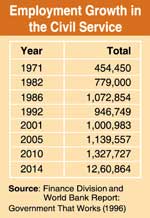
The number of employees under government revenue budget has increased by 83 per cent to 1.26 million over the last three decades since the early 1980s, leaving aside the first post-Independence period.
This growth, according to most of analysts and experts with whom this correspondent talked to, is rather disproportionate to the public services that the administration delivers.
And this overstaffing eats up a significant chunk of government revenues coming from taxpayers' money without yielding the expected quantitative and qualitative outcome, they said.
Government expenditure in the last fiscal also increased to Tk 248.67 billion--up nearly 69 times over the 1983 mark.
The expenditures hit this high even after exclusion of the money that autonomous and public sector bodies who foot their 'own' salaries and related bill on account of their personnel.
The size of government swells to 1.62 million (posted) when employments under the autonomous bodies are added up and the related expenditure bill also goes up accordingly.
There are some 1.8 million agree approved posts in aggregate for government and autonomous organisations.
Such a size of government, in terms of the numbers of officers and employees, according to some experts, should otherwise be considered rational one, if it is viewed in the context of Bangladesh's 160-million population.
But, when it comes to spending on 'non-development head' in a developing country like Bangladesh, the size is 'leviathan", they observed.
Government of such a kind gobbles up 17 per cent of the total annual revenue receipts.
This accounts for 15.7 per cent of the country's non-development budget amounting to Tk 1.69 trillion.
And it comes to 7.5 per cent of the current fiscal year's total budget worth Tk 2.5trillion.
According to official counts, the size of the government administration marked a rapid expansion by 26 per cent in the last 14 years up to fiscal 2013-14.
The government spent Tk 248.67 billion in the fiscal year (FY) 2013-14, for the salaries and allowances for its workforce from the national exchequer.
However, this comes to nearly 2.0 per cent of the estimated gross domestic product (GDP) in FY 2014.
This ratio, on the face of it, does not look to be high, in comparison to the size of the country's GDP in older terms of reckoning. But the fact is that the Bangladesh economy stood larger in size, following a revision of the base year for its national income accounting purpose to FY 2005-2006 from the earlier one FY 1995-96.
In FY 1982-83, the salaries and allowances for the then staff of 735,000 public servants, according to Brigadier Enam Committee, amounted to Tk 3.62 billion.
That happened to be the largest expenditure head of that period under a military government, claiming over 3.0 per cent of the country's GDP at the time.
In FY 1996, the salaries and allowances for 730,117 public servants cost Tk 42.13 billion, according to a report prepared by the Ministry of Establishments in 1996.
The pay bill as a share of GDP grew over 4.0 per cent in FY 1996.
In FY 2000-2001, the number of government officers and employees, from Class I to Class IV, stood over 1.0 million, according to database prepared by the Ministry of Finance.
And its corresponding expenditure for the heads of salaries and allowances had reached Tk 62.92 billion, or more than 4.0 per cent of GDP at that point of time.
The figures, compiled by the FE, related solely to approved posts in the bureaucracy.
Meanwhile, the number of annual retirements from civil services is more than 30,000.
Currently, the biggest-size of personnel in government service belongs to the ministry of home affairs followed by the ministry of primary and mass education.
In FY 2014, the number of approved posts for the ministry of home affairs was 281,122, against which and some postings were made for 258,451.
The ministry of primary and mass education has approved posts for 215,072. Some 189,544 have been posted.
In FY 1983, the ministry of education was the biggest ministry in terms of manpower followed by the ministry of home affairs. The ministry of primary and mass education was then part of the ministry of education.
The ministry of education had 185,587 posts in FY 1983 while the that of home affairs had 118,974.
Meanwhile, the departments and directorates also rose, in to 275 in number in FY 2014 from 181 in FY 1983.
Experts like economists and former bureaucrats are of the view that the fiscal space is shrinking as a result of a substantial growth of expenditure in the 'non-development' areas.
Fiscal space, they said, will shrink further after implementation of the next new national pay scale. It is set to be announced next month.
Dr. Akbar Ali Khan, a former adviser of caretaker government, suggested for trimming of the administration suiting the needs of the time. He made a point that some agencies have now lost their relevance.
"With the changing economic landscape and new priorities, many new agencies need to be created after closing down the redundant ones," he said while talking to the FE.
Dr. Khan, who was a member of a committee formed for preparing a report on the country's public administration for the 21st century, said government agencies should be established on the basis of 'need'.
"In my view, there are some departments that should be strengthened in the light of public demands."
However, Dr Khan, who had once served as Bangladesh's finance secretary and later become finance advisor for some time, wouldn't like to comment on whether the present size of government is right-sized or not.
"It's a matter of government….," Dr Khan said.
Dr. Saadat Hussain, a former cabinet secretary, told the FE that an 'army' of government employees expands when any force is created.
"When the Rapid Action Battalion (RAB) was created, there was a huge jump in the number of government employments," said Dr. Hussain, also a former chairman of Bangladesh Public Service Commission.
He stated that the country "is the public administration 'thinly administrated', whatever the size of government is. He, however, hinted at the mismatched distribution of government employees.
"There are some departments that have adequate manpower and there are some that lack in manpower," he said.
Dr Zahid Hussain, the lead economist at the Dhaka office of the World Bank (WB), does not favour the continued rise in the number of public servants.
He stressed the need for efficient and technology-based public-sector manpower to ensure good governance in the administration.
"What will we get by raising the number of traffic personnel without improving their efficiencies?" Dr Hussain asked.
The WB lead economist said expenditure on account of salaries and allowances of public employees at an increasing trend - that is funded out of revenue budget of the up keeping of government -- is a matter of concern.
"Our revenue base is weak. So, if we spend significant amount of budgetary resources for the public servants from tax receipts, it is not justifiable by any means," Dr. Hussain noted.
He said interest payments for public debt servicing and expenditure for the public servants constitute more than 36 per cent of government revenue.
"How will we carry out development activities if we spend so big for those two categories of non-development expenditure?" He wondered.
Dr. Ahsan H Mansur, executive director at the Policy Research Institute of Bangladesh (PRI), suggests trimming the lower segment of government servants, meaning those in Class III-and Class-IV categories.
"They do not work properly for the people," he observed.
The Class-III and-IV personnel constitute the major part of the overall government set-up.
According to official statistics, currently Class-III and-IV employees constitute over 73 per cent of total 1.26 million government personnel.
jasimharoon@yahoo.com