
Modi-fied India: Test of unifying the country
Muhammad Zamir | Monday, 2 June 2014
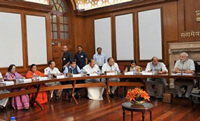
Narendra Modi has taken the oath as India's new Prime minister on 26 May 26. The relatively small Cabinet, includes, as expected, most his senior colleagues in the Bharatiya Janata Party (BJP) who had assisted him in the electoral process. They are Rajnath Singh (Home), Sushma Swaraj (External Affairs), Arun Jaitly (Finance and Defence), Najma Hepatullah (Minority Affairs) and Maneka Gandhi (Women and Children Affairs). An interesting aspect was the combined ministerial jurisdiction pertaining to Finance and the largest head on the budget - defence. Similarly, it was significant that the new External Affairs Minister would be assisted by former Army Chief Vikram Singh - a pointer towards future strategic involvement by India within South Asia and South-east Asia. Modi has claimed that he wanted a small government but better, transparent governance (by relying on digitalisation) so that there is greater accountability.
It was interesting to see his first initiative whereby his swearing-in ceremony was turned into an informal South Asian summit. The presence of Nawaz Sharif, Pakistan's Prime Minister and the absence of Mamata Banerjee and Jayalalita added to the drama. The function was well attended and included also Rahul Gandhi and his mother, leaders of the Congress party, a pointer for our political party leaders on how they could be graceful in defeat.
The Congress party has had a spectacular drubbing in the just-concluded parliamentary elections in India. Analysts have pointed out that Congress secured zero seats in seven States and failed to win more than 10 in any State. In Gujarat and Rajasthan, two States bordering Pakistan, Congress's loss was total. In Maharashtra, the Congress coalition won just three of the 48 seats and lost all six seats in the financial capital of Mumbai. It was almost a similar story in Paschimbanga where Mamata Banerjee's Trinamool Congress (opposed to the Congress) won 34 out of 42 seats (eight other seats being divided between the Congress, the Left and the BJP). In the central states of Madhya Pradesh and Chhattisgarh, Congress secured just three from a total of 40 seats. It won seven in Assam and two in the UP (which will most certainly lead to renewed BJP agitation to build the temple at Ayodhya). Congress also failed to open its account in Delhi.
The rout inflicted by the BJP on the incumbent Congress has already prompted analysts to pen obituaries for the grand old party which has ruled India for more than fifty years of its post-independence history. Such obituaries, however tempting, are probably premature. One must remember in this context that the decline and fall of the Congress party as a story has been written many times before, only to be repeatedly torn up and thrown in the wastebasket.
Congress was left for dead on at least two other occasions. The first was in 1977 when then-Congress Prime Minister Indira Gandhi was summarily tossed out of office after instituting a two-year period of emergency rule. Three years later, Congress roared back to life, winning 70 per cent of parliamentary seats in one of their best showings ever. The party was again pronounced dead in 1999 after a reluctant Sonia Gandhi, the wife of murdered Congress PM Rajiv Gandhi, took over the reins of the party. The party was trounced in national elections that year, suffering what was at the time its worst ever defeat (winning 114 seats in a house of 543). Yet by 2004 Sonia Gandhi reversed the party's decline, leading it to victory not once but twice. Although this time Congress has sunk to a historic new low of just winning only 44 in terms of parliamentary seats, the party has still earned a not insignificant share of the all-India vote (just under 20 per cent).
It would, however, be important to note here other aspects in India's parliamentary governance process. India has a bicameral national legislature. The upper house, known as the Rajya Sabha, is a body whose members are indirectly elected to six-year terms with staggered elections occurring every two years. In this context it would be fitting to mention that though the BJP has achieved a historic breakthrough in the Lok Sabha, it has only 46 members in the Rajya Sabha while the Congress has 68. This means that in a body of 240 members, the BJP (even counting alliance partners) lacks a simple majority while Congress wields sizeable veto power. With only 23 vacancies opening up between now and the end of 2015, the overall composition will change only marginally in the short run.
CONGRESS IS DOWN BUT NOT YET OUT: Another point to note is that governance in India is slowly shifting away from Delhi and toward its state capitals. Notwithstanding its parliamentary electoral debacle, Congress runs the government in 11 of India's 29 states and is part of the ruling coalition in two others. Granted, many of these states are small and politically inconsequential, but taken together they constitute a substantial bloc of federal power. Another feature that needs to be mentioned relates to looking beyond who occupies the Chief Minister's chair in the states. Twenty-seven per cent of India's state legislators belong to Congress compared with 21 per cent for the BJP. The Congress share will certainly decline because of setbacks in four state elections held concurrently with national polls, but the party will in all probability still remain the single largest party in terms of elected officials at the state level.
These factors have led Milan Vaishnav of the US Carnegie Foundation to mention that "there is nothing guaranteed about the Congress party's revival, but judging by history, even its opponents would be foolish to write it off. Congress may be down but it is not yet out". However, if this is to happen, then the Congress must devise a platform which goes beyond its current blend of 'secular nationalism meets social welfare'. It must now add on ideas about India's economic future. Milan Vaishnav has correctly stated that this assumes special significance given the fact that "every month for at least the next 15 years, a million new entrants will join India's labour force. And between 2010 and 2050, an estimated 500 million people will migrate from rural to urban settings. Indians are clamouring for an aspirational agenda in sync with these tectonic shifts, one that is concerned with jobs and growth in conjunction with, not subservient to, social safety nets".
Congress's revival will also greatly depend on whether they are able to persuade all the other parties to accept them as Leader of the Opposition. There is already a lot of muttering that other smaller parties could band together, form an alliance, and choose one of their leaders as the Leader of the Opposition. The BJP leadership might not favour such a scenario, but if they do, it will affect Congress's dominance in the future.
FOREIGN REACTION: Daily newspapers across South Asia, Middle East, China, Europe and North America have been generally impressed with the resounding election victory of Narendra Modi and his BJP party, admiring his campaign and India's ability to carry out a successful mass demonstration of democracy.
Some Pakistani and Western commentators have, however, expressed unease about Mr Modi's reputation as a Hindu nationalist (a politician with an explicitly communal background) and noted that a fresh start is needed to build a relationship with the new leader. Views have also been expressed by the leading liberal Pakistani daily 'Dawn' that hope needs to be pinned on the reality that a centre-right government in Pakistan with genuine legitimacy and political support in the heartland can do business with a right-wing government in India. In Sri Lanka, the papers have pointed out that the election reflected the Indian people's desire for a leadership that lives by the credo of CAN-DO.
In Bangladesh, the media watched the progress of the electoral process and subsequently expressed hope that they may look forward to a "speedy resolution" of some of the unresolved issues between the two countries, such as water sharing, completion of the ratification of the Land Boundary Agreement and addressing the issues related to para-tariff and non-tariff barriers in bilateral trade.
Commentators in China have pinned their hopes on what they see as Mr Modi's 'adaptability' and the quest to improve economic performance. This, they feel will help to improve their bilateral relations.
The UK and US press have generally noted that Modi might be the right tonic for India, and help that country to break out of the shackles of corruption, thereby emancipating millions of rural people from poverty. It has also been mentioned that the US administration will have some catching up to do if it wants a meaningful partnership with India. They will be watching Modi's performance carefully in the upcoming meetings of BRICS (Brazil, Russia, India, China and South Africa) and G-20.
The future will have a lot of challenges for the hard-nosed, occasionally abrasive leadership style of the new Modi-fied Indian Administration. It includes (a) turning the economy around by building manufacturing hubs and industrial projects that is key to creating faster economic growth for the whole country, (b) dealing fairly with Muslims and other minorities and by not pursuing an overtly majoritarian political and social ideology in a constitutionally secular India, (c) living up to the expectations of the young voting population who are looking for greater employment opportunities, and (d) having an effective foreign policy to resolve the existing differences with India's neighbours.
To all of the above will be added the ability of the BJP to unify the country and rule over an opposition that has lost its voice. That will be the key test of its governance.
Muhammad Zamir, a former Ambassador, is specialised in foreign affairs, right to information and good governance. mzamir@dhaka.net