
Modi: Once sold tea, now to govern India
Saturday, 17 May 2014
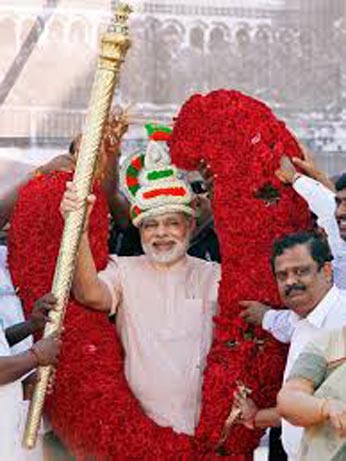
There was a time when he sold tea at a railway station in Gujarat as his family battled poverty. After toying for a while with the life of a renunciate, he finally took to politics. A determined man who had slogged for years amid great odds, Narendra Damodardas Modi, 63, is now all set to rule India as its 14th prime minister. It is a dream story that may well have been scripted in Bollywood. Today, Modi, who was an administrative novice when he took charge of Gujarat over 13 years ago, towers over men much older to him in politics, the result of a meteoric rise with few parallels. Aides say it is Modi’s ability to convert adversity into opportunity that has helped him to leapfrog from one milestone to another. Modi was born September 17, 1950 into a lower middle class family in the small Gujarat town of Vadnagar, the third of six children. The family lived in a poorly ventilated house, the floor plastered with cow dung, the kerosene lamp lit the whole day emitting smoke and grime. His father made tea at the Vadnagar railway station which Modi, called Kumar as a child, sold to train passengers for one anna (six paise) or two annas for ‘special tea’. Modi, six years old then, would daily wake up at 5am. Even while at school he would skip out when he heard the hooting of an incoming train, sell tea and then quickly return to the class. But poverty pursued the family. His mother, Hiraben, the one person Modi holds in highest esteem, worked at other homes, and cleaned utensils. She also fetched water from a well for a private office. When the young Modi desired to take an examination to join the Indian Army, his father had no money to send him to Jamnagar town. In despair, he turned to sadhus, Hindu renunciates, who frequented Vadnagar. Over time, Modi became a recluse. At age 17 he told his family that he wanted to leave home in search of truth. This he did in 1970. He wanted to become a monk. Modi had already rebelled against his family’s attempts to marry him off to a child bride. The marriage was never consummated, say his biographers. He returned to Vadnagar only in 1975, dressed as a Sikh, to avoid arrest. By then, his earlier love for the Akhil Bharatiya Vidyarthi Parishad (ABVP) had led him to its mother forum, the Rashtriya Swayamsewak Sangh or RSS, the Hindu ideological lodestar, which was to shape his life. In the mid 1990s, Modi went to the Gir forest and slept in an old temple. ‘I actually enjoy loneliness,’ he said. Once Modi formally joined the RSS, he moved into the Hedgewar Bhawan in Nagpur. He would make tea, breakfast and evening snacks for senior colleagues besides sweeping and cleaning the 10-room building. He formally joined the BJP in 1987 and became, within a year, general secretary of its Gujarat unit. Modi began to get noticed for his analytical mind and organisational skills. On the suggestion of colleagues, he pursued his education too, and became a post graduate in political science from Gujarat University. Modi was told by the Sangh to attend BJP meetings and rallies to learn the art of politics from up-close. Modi’s first big opportunity came when LK Advani undertook the Rath Yatra (chariot campaign to build the Ram temple) from Somnath to Ayodhya in 1990 and then helped Murli Manohar Joshi on his much less successful Kanyakumari-to-Srinagar Ekta Yatra. In 1995 he became the BJP’s national secretary and, three years later, a general secretary. He held the post until October 2001 when he was chosen to be the chief minister of Gujarat before leading the BJP to landslide victory in India’s Lok Sabha polls, according to IANS.