
Modi, Xi pledge stronger ties in first meeting
Wednesday, 16 July 2014
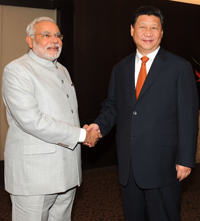
NEW DELHI, July 15 (agencies): Indian Prime Minister Narendra Modi and Chinese President Xi Jinping agreed on the need to resolve a decades-old border dispute during talks before the BRICS summit in Brazil, a statement said Tuesday.
The leaders also pledged to strengthen trade and diplomatic ties during the 80-minute meeting in Fortaleza, their first since nationalist hardliner Modi won landslide elections in May.
"Both sides emphasised on the need to find a solution to the Boundary Question," the Indian government said in a statement in New Delhi.
"The Prime Minister stressed the importance of strengthening mutual trust and confidence, and maintaining peace and tranquility on the border."
Modi said in a tweet he had "a very fruitful meeting" with Xi and they had discussed a wide range of issues.
Ties between the nuclear-armed giants have long been soured by border disputes and competition for influence in their neighbourhood.
Soon after coming to power, Modi invited Xi to visit India later this year, while China's foreign minister has travelled to Delhi for talks with the prime minister.
Leaders of the BRICS group of emerging powers are to meet Tuesday in Fortaleza to launch a new development bank and a reserve fund seen as counterweights to Western-led financial institutions.
During the bilateral talks, Modi accepted Xi's invitation to visit Beijing later this year, Indian foreign ministry spokesman Syed Akbaruddin said.
Xi also invited Modi to attend the Asia Pacific Economic Cooperation forum in Beijing in November, although India is not a member, Akbaruddin told reporters in Fortaleza, in a briefing shown on Indian TV.
Modi stressed the need to address a trade imbalance between the two countries, which is heavily skewed in China's favour.
Modi, whose new government has pledged to boost road, rail and port projects, called for enhanced Chinese investment in Indian infrastructure, the Delhi statement said.
Xi agreed the need for balanced trade and said "enhanced services exports from India to China could be one way to address the issue".
China is India's biggest trading partner.
But relations are still dogged by mutual suspicion-a legacy of a brief but bloody war in 1962 over the Indian state of Arunachal Pradesh in the eastern Himalayas that China claims as its own.
Meanwhile, US President Barack Obama told Chinese President Xi Jinping on Monday he wants US-Chinese relations defined by more cooperation and a constructive management of differences during a phone call in which Iran and North Korea were discussed.
Escalating tensions between China and some countries in the South China Sea and with Japan in the East China Sea, as well as US charges over hacking and Internet spying, have provoked anger on both sides of the Pacific in recent months.
A White House statement about the Obama-Xi conversation did not get into the details of US-Chinese tensions. It came after two days of talks in Beijing that were an opportunity for the world's two biggest economies to lower tensions after months of bickering over a host of issues.
Obama and Xi have tried to develop a working relationship over the past year, meeting for two days in June 2013 at a retreat in the California desert and, more recently, chatting in March at The Hague on the fringes of an international summit.
However, their talks have done little to resolve festering issues in the Asia-Pacific region. The statement suggested the two leaders would seek to work together when they can despite their disagreements.
"The president reaffirmed his commitment to developing a relationship defined by increased practical cooperation and constructive management of differences," the White House said.
China's official Xinhua news agency said Xi told Obama that the two countries should continue to meet each other half way and keep strengthening cooperation on key issues like climate change.
Obama told Xi he looked forward to seeing him at an Asia-Pacific summit in Beijing in November.