
Mosharraf\\\'s pleas for reviewing interim bail criteria dismissed
Monday, 31 August 2015
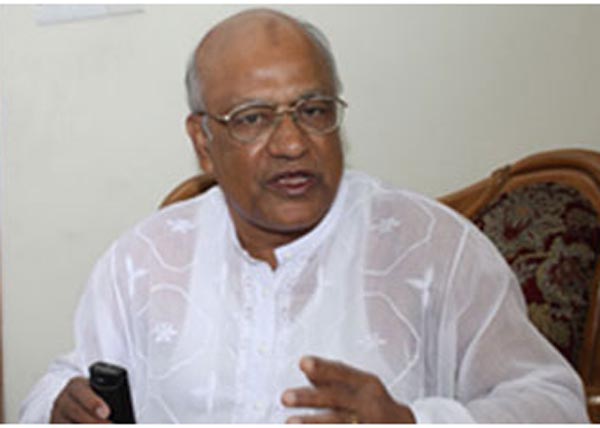
The Supreme Court has turned down the pleas of BNP standing committee member Dr Khandker Mosharraf Hossain seeking the review of its earlier verdict imposing guidelines for the High Court to grant anticipatory bail. A four-member Appellate Division bench, headed by Chief Justice SK Sinha, passed the order on Sunday. On July 9, the Supreme Court dismissed a petition of the Supreme Court Bar Association (SCBA) to review the verdict. Barrister Moudud Ahmed and Khandker Mahbub Hossain stood for Khandker Mosharraf Hossain while Attorney General Mahbubey Alam represented the state and Khurishid Alam Khan argued for the Anti Corruption Commission. After the court order, Khurshid said, “There’s no cause of action regarding the interim bail of Dr Khandker Mosharraf Hossain as he is now in jail.” On February 24 last year, the Appellate Division cancelled a High Court order granting a six-week anticipatory bail to the BNP standing committee member in a money-laundering case. On March 20 last year, the full text of the verdict was published that contained the 7-point guideline. Later, the SCBA and Khandker Mosharraf Hossain filed petitions with the Appellate Division to review the seven-point guideline.
The seven criteria are:
(a) To open the jurisdictional door they shall satisfy themselves that reasons for apprehension have specifically, explicitly, plausibly, credibly and with sufficient clarity been assigned, instead of relying on any generalised pretension. That must be treated as the precursor.
A metaphorical avowal that the Magistracy/lower judiciary is controlled by the executive should not be treated as specific because Magistrates/lower court/tribunal Judges do no longer dwell in the realm governed by the executive. If allegation of bias is aired against a particular or a group of Magistrates/Judges, cause of suspicion must be specifically spelt out. The Judges concerned, shall give reasons for their satisfaction on this unravelling point.
(b) Political threshold of the petitioner or claimed rivalry, by itself, without further ado, shall not be a ground for entertaining an application.
(c) Non-bailability of the offence cited in the FIR cannot be a reason for the High Court Division's intervention for even the Magistrates/lower court/tribunal Judges are competent enough to enlarge on bail a person accused of non-bailable offences in deserving cases.
(d) Effect of the accused's freedom on the investigation process must not be allowed to float on obfuscation.
(f) The High Court Division must scrutinise the text of the FIR with expected diligence and shall ordinarily be indisposed to grant anticipatory bail where the allegations are of henious nature, keeping in mind the ordains figured at paragraph 19 of the case reported in 51 DLR (AD), supra.
Claim that the allegations are cooked up shall also not be adjudged at that point if the FIR or the complaint petition, as the case is, prima facie, discloses an offences. Whether the allegations are framed or genuine can only be determined through investigation and sifting of evidence.
(g) Interest of the victim in particular and the society at large must be taken into account in weighing respective rights.
(h) If satisfied in all respects, the High Court Division shall dispose of the application instantaneously by enlarging the accused on a limited bail, not normally exceeding four weeks, without issuing any rule. Anticipatory bails shall not survive post charge sheet stage.
Earlier in a judgment in 2010, Chief Justice Khairul Haque gave a guideline for granting anticipatory bail, according to a news agency.
- biplab