
Most of Dhaka's rooftop solar systems dead
SAJIBUR RAHMAN | Tuesday, 28 April 2026
Hope of transition into clean renewable energy, now a global agendum, dims as most of the rooftop solar-power systems installed in Dhaka have gone dead, a spot survey shows.
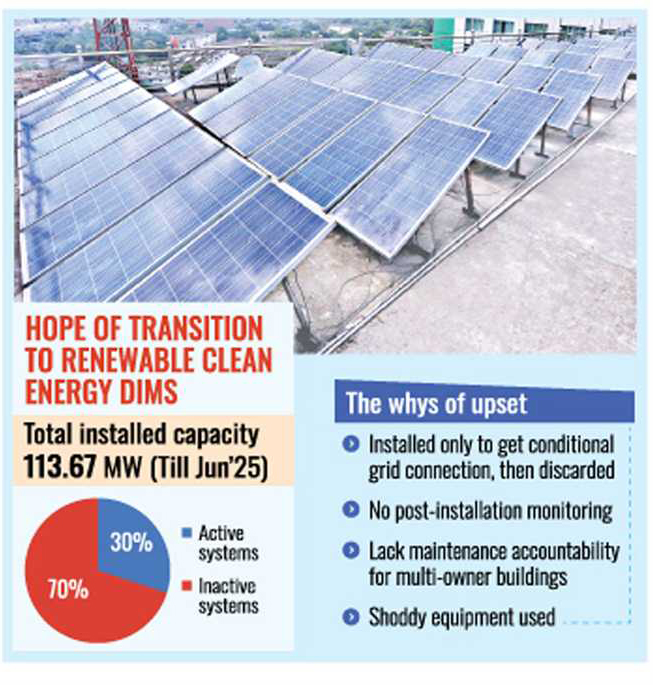
Over a decade of policy push had only 113.67-megawatt-capacity panels installed across the capital city, but nearly 70 per cent of the rooftop solar systems in DPDC area are found inactive due to weak maintenance, monitoring gaps, and multi-owner residential complexities.
In 2010, the government made it mandatory for customers to have solar-energy systems to get new electricity connections, in order to boost renewable-energy coverage.
Residential units must generate at least 3.0 per cent of their power from solar systems each while industrial and commercial users exceeding 50KW are required to generate 10 per cent, according to a government rule.
Dhaka Power Distribution Company Limited (DPDC) data show until March 2026, DPDC had installed a total of 52 megawatts of solar capacity since 2014, of which around 9.0mw is currently under net metering.
Overall, only about 30 per cent of the systems are active, while nearly 70 per cent are lying idle.
Until June 2025, Dhaka's distributors-- DPDC and Dhaka Electricity Supply PLC (DESCO)--had reported installed capacity of rooftop solar systems across the capital at roughly 113.67 megawatts.
On December 21, 2025, the Power Division issued a revised circular making rooftop solar installation under the net metering system mandatory for buildings with at least 1,000 square feet of usable roof space for a minimum of 20 years.
This correspondent finds many rooftop solar installations inactive during visits to several areas in the sprawling capital city.
By June 2025, a total of 73.67mw solar-power systems had been installed on the premises of 50,594 consumers within the jurisdiction of DESCO, including systems under the net metering mechanism.
Among these, 896 net meters alone account for a capacity of 12.16mw.
Consumers are directly utilising electricity generated from their solar systems while those under net metering export surplus electricity to the grid and is adjusted with their monthly bills.
Featuring a growing disconnect between policy intent and ground reality, Sabbir Ahmed, a rooftop-solar installer in Dhaka, says many building owners initially installed solar systems only to comply with the requirements for obtaining electricity connections.
"Once they got the connection, some of them removed the systems," he adds, highlighting a major reason behind the high number of inactive installations.
He points out that weak enforcement and a lack of post-installation monitoring had allowed such practices to persist, undermining the effectiveness of rooftop solar policies.
Ahmed also notes that in many cases, poor-quality equipment and the absence of regular maintenance further contributed to systems becoming non-functional over time.
A DPDC official says a key challenge lies in residential buildings where multiple owners made coordination, maintenance, and accountability difficult.
"Despite all this, interest in industrial solar is increasing, driven by rising energy costs and the demand for more reliable power solutions," he adds.
With a target of installing nearly 15 megawatts of solar power in each operation circle, totalling around 120MWp across eight operation circles, DESCO has undertaken a project titled "Design, Build, Finance, Operate and Maintain 120MWp (Approx) On-grid Solar Power System in DESCO Jurisdiction Area".
Another project has been taken up to install a 150kWp solar-power system on the rooftop of the head office of Bangladesh Investment Development Authority (BIDA) located at Agargaon under DESCO's jurisdiction.
On June 30, 2025, the High Court directed the authorities to ensure the installation and activation of adequate and functional solar panels on the rooftops of all residential and commercial buildings across Dhaka city.
Shafiqul Alam, lead analyst, energy, for Bangladesh at the Institute for Energy Economics and Financial Analysis, says rooftop solar could be central to Bangladesh's energy transition, which could ward off the country's highly imported fossil-fuel dependence and thus provide a natural hedge against energy-price shocks on the global energy market.
He mentions that one and a half decades ago, the government made mandatory solar-energy systems for all new electricity connections to boost renewable-power production, but low quality, lack of monitoring, and building-ownership dilemmas limited the effectiveness.
"Rooftop solar remained a low-hanging fruit that could reduce the energy costs of industries and offer a solution to energy-supply problems in load-shedding-prone rural areas, while industries are increasingly installing rooftop solar systems," he says, adding that the potential is still untapped.
Alam feels that the government should urgently reduce or waive the high import duties, ranging from 28.73 per cent to 61.8 per cent, applicable to the rooftop solar components.
To optimise rooftop solar usage in Dhaka, DESCO Managing Director Brigadier-General Shameem Ahmed (retd) announced a push to ensure all installed systems were fully operational.
"Instructions have been issued to audit the existing rooftop panels to identify which systems are active and which inactive."
A 150kWp solar power system was slated for installation at the BIDA head office in Agargaon, he said.
DESCO emphasises that transitioning to renewables is necessity, focusing on public awareness about benefits, Ahmed notes.
Morshed Alam Khan, executive director (engineering) at DPDC, says the utility company had floated tenders five times over the past three months to install rooftop solar systems at government schools and hospitals, but failed to attract any bidders.
"We are planning to invite tenders again next week."
Khan notes that space constraints remain a key barrier, even though many residential buildings with around 2,000 square feet of rooftop area showed interest in adopting solar solutions.
He also mentions that a significant number of rooftop solar systems already installed in residential buildings were currently out of operation.
sajibur@gmail.com