
Motorised three-wheeler business in disarray
Jubair Hasan | Thursday, 3 September 2015
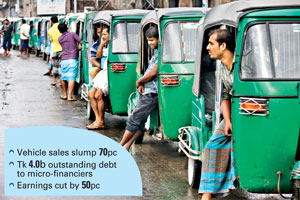
A nearly 70 per cent slump in sales has led to the stockpiling of some Tk 21 billion worth of three-wheelers with the traders in the last few weeks as all the stakeholders feel the bite of the highway ban on the vehicles, sources said.
And earnings from the small-transport sector for the low-income group of people suffered a 50 per cent erosion for the sudden restriction, slapped before making alternative arrangements, sector-insiders said.
However, the government took the measure in the wake a series of fatal accidents on the highways for which roadblocks created by variegated types of three-wheelers were largely blamed.
Because of the crunch on the sale chart, people engaged in the business chain are in 'serious panic' over the investment they made in the sector that records sales of such vehicles worth around Tk 1.7 billion annually, they said.
Not only the importers, distributors, dealers, owners and drivers but also some micro-finance institutions that made a huge volume of investment for providing financial assistance to the buyers are badly affected by the brake pressed on the smaller autos.
The market operators said the massive blow came at a time when the market players are thinking about further expansion of their market as the vehicles-mostly homespun with local nomenclatures--were being used as a tool of employment for many.
Educated, semi-educated and uneducated youths in the remote areas, where employment opportunities are thin and formal services are also scarce at national level, were the main beneficiaries of the growing transport sub-sector.
Worried over the current market trend, the industry operators have planned to sit with the ministry concerned with a plea to allow the popular transport on the country's highways through special arrangements.
Such bailout steps, they say, are an imperative to protect the growing industry where huge investments have already been made.
The government made country's 22 highways off-limits to the slow-moving vehicles with effect from August 1st, 2015 in a special move to cut down the rising incidence of road accidents.
Later, the government relaxed the embargo for two hours daily to facilitate refueling for vehicles from 6:00am.
Seven firms, namely Uttara Motors, Rangs Motors, Karnaphuli Industries, TVS Auto, Runner Group, Ifad Group and Jessore Trading, are currently involved with the business. They supply diesel-and CNG-run three-wheelers. Of some 0.35 million units in annual demand, 2,000 are diesel-driven.
Of the companies, Uttara Motors alone holds more than 80 per cent market share in the CNG-driven category while Rangs Group captures more than 50 per cent stakes in diesel-run kind.
Assistant General Manager (Sales & Marketing) of Uttara Motors Limited Mohd Akbar Hossain said they used to sell over 3,000 such vehicles per month.
"But, we managed to sell around 1,200 CNG-run auto-rickshaws in the month. So, you can realize how the latest embargo affects the business," he said.
He said the highway ban sparked serious panic among people in the business chain as highway police officials do not allow the vehicles even in the feeder or pocket roads, which are not highways.
Sayeed Sajjad, Business Head (Three Wheeler) TVS Auto BD, said tensions of the firms have intensified manifold due to the current stock of vehicles worth around Tk 21 billion. The market operators need to have stock for at least three months.
"We've some 1,000 units worth Tk 0.42 billion in our stock. We don't actually know about future of the investment," he said.
Citing their own study, he said the country has a total of 1,192 CNG-refueling stations for 348,000 CNG-driven three-wheelers, if some 2,000 diesel-run vehicles are excluded from the annual demand.
Under the calculations, the country has a single gas station for nearly 292 three-wheelers and the highest 34 CNG auto-rickshaws can take gas from a station in the allowable two hours.
"But, the remaining ones (88 per cent) will have no scope for refueling CNG. Is it a logical decision?" he posed a rhetorical question.
"It's a sabotage to destroy the growing sector, nothing else," said Iftakher Ahmed, Assistant General Manager and Brand Head (Three-Wheeler) of Rangs Motors, which supplies vehicles of Indian automobile company Mahindra.
He said the government allows three-wheelers on highways only for two hours (from 8:00am to 10:00am) for refueling from the highway-based CNG and diesel-refueling stations, but a vehicle needs to be refueled at least twice a day.
He pointed out that the three-wheelers are operated in two and, in some cases, in three shifts. "The regulation is now forcing the operators to run the popular transport only six hours for not having diesel or CNG," he added.
CNG-run vehicle with speed limit of 70 kilometres per hour is no longer a slow-moving vehicle in the country where maximum speed limit was fixed at 80 kilometres per hour, he noted.
Criticising the embargo, Manager (Marketing and Sales) of Karnaphuli Industries Ltd Md. Nuruddin Jahangir said the government did not talk to the market players before slapping such suspension.
He said the government should have given them enough time to squeeze their investments because they currently have credits worth Tk 500 million on the market as the company, like some others, allows installment facility with 12 per cent down payment, considering purchasing capacity of the buyers in remote places.
"The government should show them exit road with proper roadmap if it really wants to continue with the ban so that people involved in the sector can choose alternatives," he said.
Same is the situation for the micro-finance institutions like TMSS, Jagoroni Chakra, Uddipon, Bureau Bangladesh and SSS who have invested in the sector to ensure access of people in rural Bangladesh to finance under the Potential Youth Employment Project (PYEP) since 2010.
According to the NGOs (non-governmental organisations), they have outstanding loans worth nearly Tk 4.0 billion on the market.
When contacted, founding Executive Director of TMSS, an NGO, Dr Hosne Ara Begum said they have around 15,000 clients in the three-wheeler category who really struggle to pay monthly installments as the latest ban cuts their earnings significantly.
She said they have outstanding payments worth around Tk 2.5 billion, which is now in doubt because of the gloomy picture prevailing in the sector.
"We took the PYEP initiative following encouragement of the former livestock and fisheries minister to create employment space in remote villages," she said.
She also appealed to the government for allowing registered three- wheelers on the highways for 14 hours from 6:00am for a certain period under the circumstances.
The sector-insiders said the harsh decision, if not relaxed or withdrawn, would render a large number of people jobless as living of at least three families - one owner and two drivers in two shifts -- depends on each of such vehicles.
They also requested the government to provide dedicated lane for the vehicles or allow them on the highways for 10 to 12 hours a day for a certain period as most road accidents occur at night.
They also suggested strict vigilance to prevent unregistered vehicles from plying the highways and proper execution of regulations to shun reckless driving for making roads and highways free from accident.
According to them, the country has some 0.35 million three-wheelers of which 0.15 million are driven by owner-cum-drivers and over 0.4 million drivers are engaged with the vehicles.
jubairfe1980@gmail.com