
Muhith promises payroll tax reforms
FE Report | Sunday, 10 May 2015
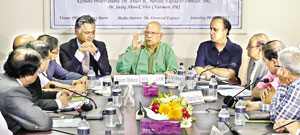
Finance Minister AMA Muhith Saturday promised to reform the system of collecting the payroll tax which now constitutes a meagre 2.0 per cent of the government's annual income tax revenue earning.
Mr. Muhith also hinted at rationalising the level of taxation on the telecom sector and lower segment of cigarettes.
Speaking as chief guest at a PRI seminar on the next national budget in the city, he also underscored the need for hiking the rate of tax on export proceeds of the apparel units.
"I wanted the tax on apparel export proceeds to go up 1.0 per cent and accordingly it had edged up at 0.8 per cent," said Muhith as chief guest at the seminar. Mr Muhith noted that on grounds of political disturbance in 2014 fiscal year it was cut down to 0.3 per cent.
"But, this time I want to go back," the finance minister said about higher taxing of apparel exports.
The leading private think tank organised the programme on fiscal policy for 2015-16 budget in the context of the seventh five-year plan at its office.
PRI chairman Dr Zaidi Sattar was moderator at the programme while president of the Metropolitan Chamber of Commerce and Industry (MCCI) Syed Nasim Manzur joined the function as special guest.
Presenting a set of suggestions on higher tax receipts and sustainable growth of industries, the PRI felt that the export proceeds should be fixed at least at the original level of 0.8 per cent.
Currently, the national exchequer gets around Tk 3.0 billion from the tax at source cut automatically on export proceeds.
The owners of readymade garment and knitwear industries pay it as their overall income tax--they need not pay income tax separately.
However, the PRI believes that tax receipts by the National Board of Revenue will rise to around Tk 9.0 billion once the government goes back to its previous rate at 0.8 per cent.
The PRI presented two papers on public resource mobilisation strategy and public expenditure strategy at the seminar. The keynotes were authored by its executive director Dr Ahsan H Mansur and vice-chairman Dr Sadiq Ahmed respectively.
The paper on public resource mobilisation strategy mooted a number of proposals as to how to enhance revenues and help ensure sustainable growth of the industries concerned.
The finance minister sounded positive on the PRI proposals for the enhancement of payroll tax and tariff rationalisation applied for telecommunications sector.
Speaking as chief guest the finance minister agreed on the proposal for restricted uses or ban on hazardous chemicals now being consumed by different industrial plants causing many health- related diseases.
The finance minister also showed keen interest about the rationalisation of tobacco taxes as the lower segment of the cigarettes enjoys low taxes.
Speaking on the telecommunications taxation, Mr Muhith said there are misunderstandings among the government agencies about the telecom taxation.
He hinted that the next budget might rationalise it for further growth of the industry.
Earlier, Mr Mansur in his paper showed Bangladesh having levied extremely high levels of taxation on he telecom sector.
Mr Mansur pointed out overall tax incidence at 56 per cent in the sector compared to 3.0 per cent in China.
Speaking on the payroll taxes (taxes that are collected by the employers from the salaries of the employees), Mr Muhith expressed his surprise over the mobilisation of 2.0 per cent of the payroll taxes in Bangladesh against 87.6 per cent in the United Kingdom and 62.7 per cent in Australia.
"It really remained neglected for long," the finance minister noted.
Finance minister AMA Muhith said attention would be given on payroll income tax reform in the face of dismal revenue earnings from this area.
"Idea of payroll tax is very impressive. I must honestly admit that this is an area that I did not realise before. It is totally neglected," he said.
He suggested that the NBR direct tax wing may set up a dedicated department to monitor withholding agents.
Out of 160 million people of the country, only 1.1 million pay income tax. "This is unbelievable! It's a damn shame. There should be minimum tax for everybody," said the finance minister.
PRI paper says payroll withholding is the most important source of income tax in all developed and emerging economies bar Bangladesh.
The finance mister said the use of hazardous chemicals either should be banned or restricted, considering its threat on the human body and the environment.
Mr Muhith said the tariffs should be rationalised on the tobacco products.
PRI showed that market share of low-segment cheap cigarettes has increased to 63 per cent in six years from 36 per cent in fiscal year 2008.
Effective tax rate on the low segment is almost a third of the rate on other segments (premium, high and medium), contributing to lower prices and the growing market shares of the low segments at the expense of huge revenue losses.
Following a proposal on the merger and acquisition of banks by panel discussant Anis A Khan, the finance minister said there is need for rules on the matter.
He said a guideline named liquidation process might be thought of.
The finance minister said the government is planning measures to ensure the use of the lands owned by different state-owned organisations.
"A survey has been done on the issue; we are planning proper use of those lands," Mr Muhith told the meet.
Speaking at the function, MCCI president Syed Nasim Manzur said the large taxpayers have been contributing much to the national exchequer and in return they are being harassed and penalised by the taxmen.
He said 13 per cent yield on the national savings certificate is affecting the other banking rates.
Mr Manzur also said import of hazardous chemicals should not be allowed in view of its bad impact on the human body and the environment.
He said the pharmaceutical industry should be allowed to invest abroad for registration of their products.
"Our existing law is very old and it needs to be updated with the need of the pharmaceutical industry to boost their exports," he told the meet on policy discourses.
He favours a separate slab for the small and medium enterprises in the new VAT law.
Former central bank governor Dr Mohammed Farashuddin was critical of the commercial banks for their higher charge on lending, despite rate cuts on deposits.
"You are lowering the interest rate on the deposits only," he said.
He was also critical of non-use of electric cash registers by the sweet makers.
Dr Farashuddin said there is need for nursing the export sectors and making ways for raising investment.
He said RMG should be diversified both in terms of its products and diversity.
Speaking as panel discussant, Centre for Policy Dialogue (CPD) executive director Dr Mustafizur Rahman said the government should take the matter of non-tax revenue (NTR) seriously.
He noted the NTR is falling.
He observed that the NBR estimates higher targets and for this reason they miss the mark in mobilising resources.
jasimhahroon@yahoo.com