
Muhith unveils nat’l budget targeting 7.3pc growth
Friday, 6 June 2014
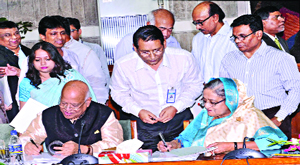
In the name of Allah, Most Gracious, Most Merciful
Progress Uninterrupted:
A Promising Future Beckons Bangladesh
Madam Speaker
1. I seek your kind permission to present the Supplementary Budget for the Fiscal Year 2013-14 and the Budget Estimates for the Fiscal Year 2014-15 before this august House.
Chapter I
Introduction and Background
2. This is the first time in the history of Bangladesh that an elected Government has stepped into its second term in office having successfully completed the first one. This bears testimony to the unflinching trust that the people have chosen to bestow on us. We believe that this continuity will enable the Government to take forward its development initiatives to a higher trajectory. The Honourable Prime Minister Sheikh Hasina took steps to hold the national election under an all-party government despite not being bound by any constitutional obligation. However, I have to say with deep regret that a large political party, by boycotting the election, vainly tried to disrupt our democratic process.
3. Tribute: At this historic moment, as I stand before you in this august House, I remember with profound respect the greatest Bengalee of all time, Bangabandhu Sheikh Mujibur Rahman, the Father of the Nation. I respectfully recall our four martyred national leaders, the illustrious aides of Bangabandhu. I pay homage to the martyred freedom fighters for laying down their lives at the altar of our freedom. I also recall with deep respect the supreme sacrifice of countless other martyrs who were killed at the brutal hands of autocratic regimes and undemocratic communal forces working against the trial of war criminals. We draw inspiration from their selfless sacrifices in the march towards realizing our dreams of building a prosperous Bangladesh. I thank all the civil and military officials who put their lives at peril by effectively performing their duties during the last national election.
4. Acknowledgements: I am grateful to the Honourable Prime Minister Sheikh Hasina for having confidence in me once again and entrust upon me with the responsibilities of Finance Minister even at the twilight of my career. I am committed to devote my utmost efforts to live up to the unwavering trust placed on me by the Honourable Prime Minister.
5. Like the previous years, I had several rounds of consultation with the honourable members of parliamentary standing committees, eminent citizens, renowned economists, professionals, businessmen, NGO leaders, journalists and secretaries to the government while setting this budget. I also travelled to Sylhet to be present in an open discussion session with the farmers in a bid to have their perspective on budget. I am grateful to all for providing me useful insights. I have tried to accommodate their suggestions as far as I could. I take this opportunity to thank all officers of the Finance Division, NBR and other ministries who have worked hard for accomplishing the arduous task of preparing this budget.
Future Roadmap: Building on the Successes of the Past
6. At the outset of our last term, we formulated the Perspective Plan (2010-2021) with the goal of elevating Bangladesh to a knowledge based and technology driven middle-income country by 2021. This is the first long term plan in the history of Bangladesh with elaborate programmes for development. Here, I want to assert unequivocally that all the development initiatives of our last term will continue in the present tenure as well.
7. In the last term, our aim was to put the economy on a firm footing. With that end in view, we laid emphasis on building of infrastructure, development of power and energy sectors, improvement of information technology and creation of an investment-friendly environment. Our concerted reform initiatives beginning from 2009 made the economy so resilient that even the violence unleashed by the opposition parties prior to the 10th parliamentary election could not destabilise it. We have successfully mitigated the pre-election damages and the economy, now, is back to its robust best.
8. Now, let me give you a brief description of what we have achieved in our last term. I would not claim that all that we committed have been met, rather I have categorized the plans, policies and programmes which have been implemented, those which are under implementation and those which are yet to be implemented and they have been presented in three appendices.
9. Facing Recession: One of the major achievements of our Government is tackling the impact of recent recession that swept through the whole world. Our action agenda to combat the possible impact of recession were widely acclaimed. Steady economic growth over the last five years (6.2 percent), tolerable inflation, macro-economic stability, robust export growth, favourable current account balance , record buildup of foreign exchange reserve, sustaining sovereign credit rating all are glaring examples of our success in managing the impacts of recession.
10. Establishing the Rule of Law: We have implemented the judgment of the highest Court for the brutal killing of the Father of the Nation and most of his family members. In implementing our pledge of trying the war criminals, we have made commendable progress by establishing International Crime Tribunals. So far, ten war criminals have been tried and the death sentence of one has been executed.
11. Elevating Living Standards: The real income and purchasing power of people have increased substantially following introduction of new pay scales and dearness allowance for the government employees, income generating activities, increase of minimum wages, expansion of social safety nets and many other interventions. At the same time, there has been significant improvement in social indicators like education, health and sanitation. Per capita income has increased to USD 1190 in 2014 from USD 843 in 2009. The rates of poverty and extreme poverty have gone down to 26.4 percent and 11.9 percent respectively in 2013 from 33.4 percent and 19.3 percent in 2009.
12. Power and Energy: Our persistent endeavours over the last few years to improve the power situation in the country have paid off greatly. Power generation capacity has now gone up to 10341 MW which was only 4931 MW in 2009. The people are now free from sufferings caused by terrible load shedding. However, the power production capacity could not be utilized fully due to deficiency of transmission and distribution lines and a drop in effective power generation capacity of a few very old power plants. We are taking special measures to get rid of this adverse situation soon. We have made remarkable strides in the energy sector too. Thanks to our earnest endeavours, we have been able to add 895 million cubic feet gas to the national grid.
13. Digital Bangladesh: Over the last five years, we have created an enabling environment and infrastructure for ICT. Following this, Bangladesh has already reached the threshold of becoming a technology driven modern state. Every day, on an average, 40 lakh people are getting e-services from 4 thousand 526 union information centres. Tele-density and internet-density have gone up to 77.8 percent, and 23.7 percent respectively. The coverage of e-commerce, e-payment and e-governance has expanded substantially. Moreover, Bangladeshi software and ICT services are being exported to 30 countries including USA, Canada, Japan, Australia and several European countries. In addition, a report on digital land zoning map of 152 upazilas of 21 districts has been prepared and the land zoning operation in other 40 districts is well in progress.
14. Agriculture and Food Security: We took a number of steps for the development of agriculture sector. Included among them are: keeping the fertilizer price within the affordability of farmers, ensuring adequate budget provision for agriculture subsidy, providing facilities for opening bank account with a deposit of Tk.10 only, introducing agriculture input assistance card and distributing fertilizer through union and block level sales representatives. All these integrated efforts have culminated into self-reliance in food. Storage capacity of food go-downs has been enhanced. Distribution of food is continuing at a minimum price or free of cost through TR, VGF, VGD, FFW etc. These programmes have saved people of northern region from recurrent monga. We have formulated the 'National Agriculture Policy 2013' with the targets of sustaining the achievements in agriculture, commercializing this sector and ensuring food and nutrition security.
15. Education: At the very outset of the last term, we formulated 'Education Policy 2010'.Our fundamental aim was to eradicate illiteracy, expand quality education and develop skilled human resources. A law titled 'Education Assistance Trust Act, 2012'was enacted to facilitate the poor but meritorious students. We also formulated a policy called 'Creative Talent Hunt Policy 2012' to hone and recognise the creative faculties of students. We are distributing text books free of cost among all students from primary through secondary levels and providing stipends from Class VI to graduate levels. Public examination has been introduced in Class V and VIII where students are evaluated under uniform grading system. At the primary level, as many as 26 thousand 193 schools have been nationalised while 1 lakh 4 thousand 776 teachers have been absorbed. Besides, 3 thousand 901 headmasters and 83 thousand 392 assistant teachers have been recruited. Under non-formal education system, as many as 1 lakh 66 thousand working children (of 10-14 age group) have been imparted basic education through 6 thousand 646 learning centres in 7 divisional towns. Following the recruitment of huge number of teachers, the teacher-student ratio has improved to 1:49. In order to recruit additional teachers at the pre-primary level, as many as 37 thousand 672 posts have been created. Apart from primary and secondary levels, adequate infrastructural work was undertaken to facilitate expansion of higher education. I appeal to the private sector to come forward and invest, not only in providing stipends, but also in building school infrastructure and improving the conditions of teachers.
16. Health: In fulfillment of our pledge to expand health facilities to the grass-root level, we have established new hospitals, increased the number of hospital beds and recruited nearly 40 thousand employees to infuse vitality in this sector. We have established 12 thousand 577 community clinics, 5 medical colleges, 12 nursing institutes, 5 institutes of health technology and 149 union health and family welfare centres. In addition, there has been considerable penetration of information technology in the health sector. People living at union and upazila level can now avail more advanced and specialized health care through telemedicine and internet service. Child mortality (under 5) rate has fallen to 41 (per one thousand live births) and maternal mortality rate to 1.94 (per thousand live births). You will be heartened to know that, Bangladesh now exports medicines to 91 countries of the world after meeting nearly 97 percent of domestic demand.
17. Communications: We are making all out efforts to develop transport sector and improve road safety. National Integrated Multimodal Transport policy 2013, 20 year Road Master Plan and National Road Safety Strategic Action Plan 2011-2013 have been formulated for proper management of communication and safe transportation. Last few years have been quite productive in terms of construction and renovation of roads and other communication infrastructure. A number of fly-overs have been built in and around Dhaka and Chittagong; a few notable ones are: the flyover at the Bishwa road -Airport intersection, Mirpur-Airport flyover, Banani flyover and MayorMohammad Hanif flyover. The Begunbari Hatirjhilproject, with all its splendour and aesthetics, not only reduced traffic congestion but also has added to the beauty of the capital city. Nabinagar-DEPZ-Chandra road has already been upgraded to four lanes, while upgradation of Dhaka-Chittagong highway into four lanes is going on in full swing. In addition, we have completed the construction of Teesta Bridge. As you all know, we have decided to construct the Padma Bridge with our own resources and have already completed some preliminary work. We have created a new Ministry for Railways considering the importance of railway communication. New train services have been added while existing services and networks are being expanded. A circular river route has been built around Dhaka city and some water buses have been introduced.
18. Social Protection: We have widened the coverage of social protection programmes and also increased the rates of different allowances to alleviate poverty, reduce social disparity and establish social justice. A country-wide survey is being conducted to identify people with disability of all forms. We have re-fixed the monthly labour wage from a paltry sum of Tk. 1600 to Tk. 5300 and also amended the Labour Policy. However, we must understand that in a poor country like ours, we need more time to ensure overall social security.
19. Women and Children Welfare: We are making continuous efforts to improve the living condition of women and children. Our commitment to their advancement is expressed in Women Development Policy, 2011 and National Children Policy 2011. In order to prevent violence against women and children a new law titled Domestic Violence Act (Prevention and protection) 2010 has been enacted. We understand the intricacies associated with gender and the need for creating gender sensitivity. Therefore, we are preparing Gender Budget for 40 ministries. Measures have been taken to prohibit child labour in industries. Autism Trust Fund has been established for the welfare of autistic children. Alongside, a number of programmes have been undertaken at the national and international levels. Our intention to empower women has been manifested in the increase of the number of reserved seats for women in the national parliament and raising the number of women reserved seats in the local government institutions to one-third of the total seats under direct election.
20. Expatriate Welfare and Employment: Over the last five years, nearly 1crore people have got overseas employment. As a result of our successful diplomatic efforts, it has been possible to export manpower to 159 countries including 62 new ones, more than 8 lakh Bangladeshis have been legalized in Saudi Arabia. Now we are exporting labour in many countries at a reasonable cost on G to G basis. Moreover, digitisation of immigration management facilitates completion of all immigration formalities online. Introduction of Expatriate Welfare Bank has made life much easier for the expatriate workers. They can avail themselves of expatriate loan at a minimum interest and can also safely remit their earnings. A new law titled 'Overseas Employment and Expatriate Welfare Act 2013' has been enacted repealing the 'Immigration Ordinance 1982' for more meaningful protection and welfare of expatriate workers.
21. Public Administration: Public administration is now more people-centric and modern. A number of measures have been taken to instill confidence and a sense of security in public servants. Raising retirement age to 59 years, extending maternity leave from four to six months, construction of a hospital, establishment of Pay and Services Commission-are all directed towards the welfare of government officials. We have fulfilled our constitutional obligation by separating the judiciary from the executive and introduced a separate pay scale for the judiciary. We have created independent Human Rights Commission and Information Commission. The Right to Information Act has been enacted. Furthermore, we have drawn up the National Integrity Strategy to establish integrity at all levels of the society. We are expecting that pay and services commission will be able to provide valuable recommendations on administrative reforms. Additional reforms will be initiated in this area after receiving the report of the commission.
22. International Recognition: Our achievements over the last five years have transcended the length and breadth of Bangladesh and got huge appreciation from abroad. Bangladesh and her Prime Minister earned the distinction of achieving the MDG Award, Indira Gandhi Peace Award, UNESCO Cultural Diversity Award, FAO Diploma Award and South-South Co-operation Award for advancement in relevant spheres.
23. Our Targets: Our policy is to enhance public expenditure in the next five years and to this end domestic resource mobilization has to be scaled up. Over the past 5 years, revenue collection has increased from 10.7 percent to 13.3 percent of GDP. At the same time, the size of public spending has increased from 15.7 percent to 18.3 percent of GDP. The target over the next 5-years would be to augment resource mobilization to 17 percent and increase the size of the budget to 22 percent of GDP. Side by side, it would be our core objective to transform Bangladesh into a middle-income country by 2021 through structural and other reforms, especially in the areas of strengthening local government, land management, institutional development and good governance. In the current tenure, human development will be high on our priority agenda. I shall provide a run-down of our policy strategies and action plans to attain these goals. I hope the proposed budget will represent a significant milestone in our journey towards establishing a prosperous Bangladesh.
Reorganization of Local Government and Decentralization
24. We want to ensure participation of people of all strata into the mainstream of nation building. Decentralization of local government has always been our priority and one of the election pledges. In compliance with the constitutional obligations, we have taken many initiatives to strengthen local government institutions. In our last term, we had widened the responsibilities and jurisdictions of Union Parishad, Upazila Parishad and Zila Parishad. After being elected to office this time, Upazila Parishad elections were held throughout the country amid fervor and festivity with the participation of all major political parties. I firmly believe that this trend of holding local government election will continue and that of Zila Parishads will take place very soon.
25. We will take a holistic approach encompassing all relevant issues to make the local government institutions more powerful and equally responsible. Establishing good governance with transparency and accountability at all levels is our motto. We want to shift the seats of power to the local levels, as far as possible, doing away with the heavily centralised administration. ZilaParishad, UpazilaParishad and Union Parishad will be vested with more power and authority.This will require us to revamp the present shape of local government which we will do gradually. We will try to make an effective hierarchical division among local government bodies and will leave issues like education, health, law enforcement, social safety in their hands to take care of. We will also expand the scope of e-governance for enhanced accountability and transparency.
Administrative reform and strengthening local government
26. With the decentralisation of power, we will have to take appropriate measures for administrative reforms. Having said that, we have to keep it in mind that it will require massive administrative reforms to introduce decentralisation in its truest meaning in our country, because of the fact that here centralised administration is so deeply rooted that it is quite hard to dismantle. It is not enough to just to arm the local government bodies with more power and responsibility; it will also require an efficient bureaucracy to make proper policies so that the people can enjoy the fruits of decentralisation. On the whole, the following issues will have to be carefully looked into to make the local government more effective:
l A careful scrutiny has to be made to decide what subjects of the central government can be transferred to the local authority and in what manner
l A clear division of work among Zila, Upazila and Union Parishads
l A specialised bureaucracy suited for the local government has to be created with provision for imparting appropriate training
l A fair system of revenue sharing between the central and local government institutions has to be established.
27. I have shared my ideas on these issues earlier in this august House. There should be wider deliberations on these issues both in the Parliament and beyond. The administrative system of a country gradually develops within the framework provided by its society, history and political system. Therefore, administrative reform process is not only slow, but also difficult. However, I am optimistic that we will be able to formulate and implement a strategy for decentralisation, administra
tive reforms and strengthening of local government system through national consensus.
Madam Speaker
28. Authoritative Land Records: There is no alternative to proper land management system for attracting investment in agriculture and industry sectors. I must admit that we are trailing behind in this sector. I have always maintained that we want to ensure food security together with rapid industrialisation. To fulfill this goal, our main task would be to implement scientific land management and digitise the land records of our country. In the case of land management, our core targets would be to carry the land-related services to the doorstep of the common people and make the whole process business-friendly. Accordingly, we want to introduce Authoritative Land Records (ALR). Steps have already been taken to provide Authoritative Land Records in 3 upazilas by establishing networks in the Assistant Commissioner (Land) offices, Settlement Offices and Sub-register's offices. Gradually, we will extend this programme countrywide. We are actively considering the use of PPP for rapid implementation of this initiative.
29. Land Survey and Record: You may know that we took the initiative in our last term to digitalise land settlement and record keeping. Land zoning process is underway in another 40 districts. Besides, the process of digital surveys and record updating has begun in 5 mouzas of Savar upazila in Dhaka district and 48 mouzas of Palash upazila in Narsingdi district. Implementation of Digital Land Management System (DLMS) in 45 upazilas of 7 districts and operationalisation of 20 land information service centres in 20 upazilas are underway. Computerisation of existing records of right in 55 districts will be completed by the next fiscal year.
30. Rural Infrastructure: We laid emphasis in our last term on building rural infrastructure to improve the livelihood of the rural people. We built approximately 25 thousand km road and 1 lakh 51 thousand meter bridges and culverts during this period. We ensured the maintenance of existing 48 thousand km metal road. Besides, 1 thousand 137 km canals were re-excavated to efficiently manage the surface water and to expand the irrigation system. Consequently, irrigation can now be extended to 91 thousand hectares area of agricultural land.
31. Pure Water and Sanitation: We have established 1 lakh 37 thousand arsenic-free water sources and also introduced water supply through pipe line in 86 villages. Our success in increasing the sanitation facilities in the country is commendable as well. Thanks to our constant efforts, more than 95 percent of the families in Bangladesh use sanitary latrine which is the highest in the SAARC region.
32. Growth Centre: We have completed the process of developing as many as 1414 growth centres and rural bazaars to revamp the rural economy. Ninety five percent growth centres are now connected with the district headquarters through upazila, rural and other roads. As many as 484 cooperative markets have been established so that necessary items reach the consumers at a fair price. 9 milk cooling centres have been established to increase the production of domestic milk through cooperatives.
Chapter III
Budget for FY 2013-14: Adjustments and Revisions
Madam Speaker
33. Political Instability and Revision of Budget for FY 2013-2014: Now I would like to reflect on the adjustments and revisions in the budget for FY 2013-14. In the run up to the 10th national election there had been a serious political unrest in the first six months of the current financial year. Various political parties and alliances observed a total of 45 days hartal and blockade during July 2013 to January 2014. These hartals and blockades were not limited to 12 or 24 hours, rather at times even continued for a week. Communication was disrupted, port activities came to a halt, retail and wholesale buying-selling came down to almost zero which had a debilitating effect on government revenue collection. Frenzied destruction of government properties was another salient feature of these hartals and blockades. The main targets of attack were Bangladesh Railway and government and non-government transports. Government offices and educational institutions were not spared either. Alongside the mass destruction of properties there had been a number of death incidents as well. According to the World Bank, this political vandalism caused loss of Tk. 11,000 crore in the national economy which is around 1 percent of GDP.
34. It is important at this stage to give some reflections on how negatively political instability affected revenue collection. The target of tax revenue collection was set at Tk. 95 thousand 785 crore in the budget of FY 2011-12 and was increased by Tk. 500 crore in the revised budget. It was Tk. 1 lakh 16 thousand 824 crore in the original budget of FY 201213, which remained unchanged in the revised budget. On the other hand, due to political unrest, the target of tax revenue had to be revised downward at Tk. 1 lakh 30 thousand and 178 crore in FY 2013-14 by reducing Tk. 11 thousand crore. Taking these factors into consideration, I am presenting the revised budget separately in Table 1 below. Now, I am presenting an analysis of the overall revenue, expenditure and deficit of the government along with the implementation of Annual Development Programmes (ADP):
l Revised Revenue Receipts: In the budget of FY 2013-14, the target for revenue income was set at Tk. 1 lakh 67 thousand 459 crore (14.1 percent of GDP). In the revised budget, the target for revenue receipts was reset downward at Tk. 1 lakh 56 thousand 671 crore by reducing Tk. 10 thousand 788 crore from the original target. I hope the revenue collection target of this fiscal year will be achieved. At the same time, it would also be possible to have an increase in revenue income (1 percent of GDP) as against the actual collection of the previous fiscal year.
l Revised Expenditure Estimates: The total government expenditure was estimated at Tk. 2 lakh 22 thousand and 491 crore in the current fiscal year's budget (18.7 percent of GDP). Now, it has been revised downward to Tk. 2 lakh 16 thousand 222 crore (18.3 percent of GDP) by reducing Tk. 6 thousand 269 crore. Due to reduction in project aid, the allocation of ADP now stands at Tk. 60 thousand crore. However, the overall revised ADP of FY 201314 will actually amount to Tk. 63 thousand 705 crore taking into account the self-financed projects of the autonomous bodies and corporations amounting to Tk. 3 thousand 705 crore. On the other hand additional allocations have been made for meeting expenditure against newly introduced dearness allowances, pensions and gratuities of government employees, supplies and services, construction and public works and honorarium of the freedom fighters. These additional allocations were made by reappropriating funds from the allocation of PPP, investments in share and equities, ongoing development programme under nondevelopment budget and unexpected heads of expenditure.
l Budget Deficit: In the original budget, deficit was estimated at 4.6 percent of GDP, which has been marginally increased to 5.0 percent of GDP in the revised budget. Of which, 1.6 percent of GDP will be financed from external sources and the rest 3.5 percent from domestic sources. Out of the domestic financing, 2.5 percent will come from the banking system.
l Implementation of Revised ADP: Since assumption of office, we have been diligent in speeding up the ADP implementation processes by enhancing our absorptive capacity of project aid. As part of this, the Planning Commission has been closely monitoring the progress of project implementation of 10 large ministries. I personally met the officials of all ministries and divisions on different occasions. Tripartite meetings were held between Economic Relations Division, project implementing ministries and development partners. Field monitoring of projects facing implementation problems is going on. Besides, the Economic Relations Division has identified 50 projects with slow implementation progress and has taken an initiative to physically inspect them. First Track Project Monitoring Committee headed by the Honorable Prime Minister is regularly monitoring the progress of important projects. We shall continue our endeavour to scale up the use of project aid. During the last tenure of our government we achieved remarkable success in implementing ADP. In FY 200809 actual expenditure of ADP was TK 19 thousand 438 crore (3.2 percent of GDP). And this time, it will be Tk. 63 thousand 705 crore (5.4 percent of GDP).
35. I would like to inform the citizens that despite the destructive activities of the opposition, the revised estimate will be only 2.8 percent less than the original estimate determined at the beginning of the current fiscal. It means that even in adverse situation, we could sustain the momentum of ADP implementation and maintain effective cooperation with our development partners.
36. Smooth implementation of revised budget will depend, to a great extent, on stable political situation that is prevailing after the election held on 5th January. I would like to call upon everyone through this august House: Let us resist collectively all nefarious activities that damage the economy of the country.
Chapter IV
Our Economy in the Global Context
Madam Speaker
37. Now, I want to say a few words regarding our economic development and probable growth in the context of the global economy.
38. Global Economic Trend: Following the adoption of accommodative monetary policy and fiscal consolidation, global economy, especially, advanced economies have been showing signs of progress since the fourth quarter of the last year. As a result, not only unemployment has gone down in these countries but consumer and investor confidence has been restored as well due to higher aggregate demand. Over all, economies of USA, Japan and Euro area have been experiencing a solid recovery. This is reflected in the latest IMF forecast of the world economic growth of 3.6 percent and 3.9 per cent respectively in 2014 and 2015. In 2014 and 2015, this growth would be 2.2 percent and 2.3 percent in the advanced economies and 6.7 percent and 6.8 percent in the developing Asian economies.
39. Domestic Economic Scenario: We have maintained satisfactory economic growth amidst global economic slowdown. Despite political tension in the second half of the FY 2012-13, we could achieve 6.01 percent growth (base year 2005-06). Attainment of 10 percent growth in the industry sector contributed significantly to this achievement. On the other hand, due to adverse weather condition and lower crop price, growth in broad agriculture sector was rather low. While there was significant growth in forestry, fisheries and livestock sectors, growth in the crop sector was relatively small. At the same time, due to interference in the transport sector because of strike, blockade and political violence, service sector growth stood below expectation. From the demand side perspective, despite increase in personal consumption expenditure due to inflow of remittances, investment did not show up any significant growth. In comparison, public investment registered substantial growth. On the other hand, while there was robust growth in export, it was not matched by import growth. A table containing macro-economic indicators on economic situation of Bangladesh is given below.
40. You are aware that at the outset of FY 2013-14, our GDP growth target was set at 7.2 per cent. However, due to political unrest that continued from the previous year different sectors of the economy were adversely affected. As a result, achieving 7.2 percent growth will not be possible in this year. According to the preliminary estimate of Bangladesh Bureau of Statistics (BBS) GDP growth in FY 2013-14 will be 6.12 percent. Resurgent political stability following the national election combined with government's complementary policy support have encouraged investment and export trade. As a result the industry and service will be able to make good the losses caused in the first half of the current fiscal year. Moreover, there has been a bumper production of Aus and Boro this year because of favourable weather condition and our continued policy and input support. I foresee a prospect of substantial growth in agriculture sector in this fiscal.
41. Growth Target and Assumptions: Now, I want to reflect on the growth target for FY 2014-15. We hope that in the next fiscal, investment, export and remittance flows will increase as it is expected that the global economy will experience accelerated growth. During this period, food and energy prices in the international market are likely to decline slightly. Besides, an investment-friendly monetary policy will be maintained ensuring uninterrupted credit flows to the productive sectors. Government initiatives for developing physical infrastructure in the power, energy and communication sectors will continue. Different initiatives will be undertaken for the development of skills and human resources. Fiscal, monetary and stock market reforms will go on. Foreign investment and assistance are expected to increase. Credit and input support will continue in the broad agriculture sector. Above all, I am expecting favorable weather and political stability. Based on these assumptions and expectations, we have set the GDP target at 7.3 percent for FY 2014-15.
42. Inflation: We have been quite successful in containing inflation. At the end of June in the last fiscal year, point to point inflation was 8 percent that came down to 7.4 percent at the end of April in the current fiscal year. During this time, non-food inflation declined to 5.2 percent. But food inflation sneaked up as there was disruption in supply due to continued strikes and blockades at the beginning of this fiscal year. However, I hope that the declining trend in food price in the neighboring as well as other countries will pull down the price of food grains in the coming days. Factoring in the declining trend in food and energy price in the international markets along with satisfactory domestic agricultural production and supportive monetary policy, I believe that the general inflation in Bangladesh will be hovering around 7.0 percent by June 2014 and will reduce further at the end of the next fiscal year.
43. Money and Credit: We are continuing our efforts to enhance efficiency in banking sector. As a result, the deposit and lending interest rate spread has come down to around 5 percent by February 2014. We are also seeking to ensure uninterrupted credit flows to the agriculture sector, and small and medium enterprises together with other important sectors. Over the first nine months of current fiscal, 78.4 percent of the total agricultural and rural credit target of Tk. 14 thousand 595 crore has been distributed. Credit flow to the small and medium enterprises up to December 2013 increased by 14.9 percent, year on year. Term loan in the industrial sector has increased by 3.7 percent in the second quarter of the current fiscal year. In the latest Monetary Policy Statement (MPS), broad money and reserve money growth target till June 2014 has been set at 17.0 percent and 16.2 percent respectively. At the end of February 2014, annual broad money and reserve money growth has increased by 15.8 percent and 13.3 percent respectively, which is within the MPS target. I think, it would be possible to achieve the money and credit supply targets with the improvement in external sector. We hope that broad money and domestic credit will increase in consistence with the growth and inflation targets.
44. Import and export: Export has increased by 13.2 percent till April 2014, year on year. On the other hand, imports of goods and services though declined in the last fiscal year, it has posted a growth of 17.5 percent till March 2014, year on year. We expect that import and export growth will accelerate thanks to a positive trend in the global economy. We are assuming that export earnings and import expenditure may increase by approximately 15 percent.
45. Remittance and manpower export: Remittance has declined by 4.8 percent till April 2014 of the current fiscal against last fiscal year's growth of 12.6 percent. In this context, I should add that it has declined not only in our country; rather there is a global downward trend of remittance flows. According to the World Bank, remittance growth in the South Asian countries was only 2.3 percent in 2013 while it was only 1.7 percent in India. Presently the significant spending by expatriate workers for legalization of their employment in Saudi Arabia brought this decline in remittance in Bangladesh. We are taking different measures to increase manpower export taking into cognizance the current trend in this sector. To create employment opportunities in potential markets and to expand employment opportunities in the traditional markets, we are opening new labour wings while taking diplomatic initiatives. We are also providing financial assistance for manpower export and encouraging manpower export on G to G basis. We are keeping an eye on manpower export through private channels so that it is not discouraged. Moreover, we already have taken up a number of initiatives to develop skilled human resources consistent with the demands of overseas labour market. As a result, I hope, remittance will be back to its normal growth trend in the next fiscal year. I fervently call upon our expatriate workers not to engage in any unlawful activities in foreign land. This not only lands you in trouble but also tarnishes the image of the country and impedes manpower export.
46. Foreign Exchange Reserve and Exchange Rate: Foreign exchange reserve stood at US$ 15.3 billion at the end of the last fiscal year. In the current fiscal year with the decline in trade deficit together with an inflow in the capital and financial account till February 2014, foreign exchange reserve has increased consistently and stood at US$ 20.2 billion on 27th May 2014 which is sufficient to foot the import bills of approximately 6 months. The value of Taka is stable against US Dollar as well. Remittance, aid flow and foreign investment will be at the satisfactory level as both domestic and external fronts are showing positive developments. As a result, I hope, though trade deficit may widen, foreign reserve will remain at a comfortable level while the exchange rate will remain stable.
Chapter V
FY 2014-15 Budget Structure
Madam Speaker
47. Medium Term Macroeconomic Framework: In the light of the global perspective and also what I reflected on our future agenda, we have prepared the budget for next fiscal year. The main objective of the proposed budget will be to maintain continuity of existing monetary and fiscal policy strategies being pursued and to ensure macroeconomic stability. As you all know, we have undertaken a range of legal, regulatory and structural reforms in the revenue sector. Moreover, additional manpower has been sanctioned to revamp the activities of this sector. Efforts to strengthen revenue collection in the next budget will continue through these ongoing reforms. Alongside, steps to widen fiscal space through public expenditure control will also continue. Its worth mentioning that all data used in setting the budget taking 1995-96 as base year although BBS has already rearranged their data using 2005-06 as the base year. In fact budget setting process starts around the middle of the fiscal year. There we could not present our data using new base year. Only in table 4 the provisional estimate has been presented using 20052006 as base year because BBS could not provide them using previous base year. In Table 3 an outline on budget structure has been presented.
48. In the overall budget proposals for the next fiscal year (Development and non-development combined) sector-wise allocation and priorities has been presented in Table-4 below.
49. Estimates of Revenue Collection: The revenue receipts for FY 2014-15 has been estimated at Tk. 1 lakh 82 thousand 954 crore which is 13.7 percent of GDP, of which NBR tax revenue is Tk. 1 lakh 49 thousand 720 crore (11.2 percent of GDP). Revenue from Non-NBR sources has been estimated at Tk. 5 thousand 572 crore (0.4 percent of GDP). In addition, Tk. 27 thousand 662 crore (2.1 percent of GDP) will be collected as Non Tax Revenue (NTR).
50. Estimates of Expenditure: The total expenditure for FY 2014-15 has been estimated at Tk. 2 lakh 50 thousand 506 crore (18.7 percent of GDP). The allocation for non-development and other expenditure has been estimated at Tk. 1 lakh 70 thousand 191 crore (12.7 percent of GDP). Expenditure for ADP has been estimated at Tk. 80 thousand 315 crore (6 percent of GDP).
51. Budget Deficit and Financing: The overall budget deficit will be Tk. 67 thousand 552 crore, which is 5 percent of GDP. Of this amount, Tk. 24 thousand 275 crore (1.8 percent of GDP) will be financed from external sources and Tk.43 thousand 277 crore (3.2 percent of GDP) from domestic sources. Of the domestic financing, Tk. 31 thousand 221 crore (2.3 percent of GDP) will come from the banking system and Tk. 12 thousand 56 crore (0.9 percent of GDP) from savings certificates and other non-banking sources.
52. Annual Development Programme: Following our usual practice, we have determined the size of ADP by taking into account the critical issues like regional parity, improved infrastructure and quality of expenditure. We laid emphasis on overall development of the country rather than tackling the on rush of demand of an election year. In the ADP for FY 2014-15, human resource sector (education, health, and other related sectors) will receive 24.3 percent, overall agricultural sector (agriculture, rural development and rural institutions, water resources and other related sectors) 25.8 percent, power and energy sector 14.3 percent, communication (road, railway, bridges, and other related sectors) 23.3 percent and other sectors 12.25 percent of total allocation.
53. Overall Expenditure Structure: Now, I would like to present a brief outline of the overall expenditure (development and nondevelopment) structure of the proposed budget. We have classified different ministries/divisions into three groups based on their functions. These are social infrastructure, physical infrastructure and general service sectors. In the proposed budget, 25.16 percent has been allocated to social infrastructure sector, of which 21.58 percent has been proposed for human resource (education, health, and other related sectors). 30.15 percent of total allocation has been proposed for physical infrastructure sector, of which 14.69 percent has been proposed for overall agriculture and rural development, 9.24 percent for overall communication sector and 4.61 percent for power and energy sector. 23.58 percent of total allocation has been proposed for general services sector, 3.4 percent of total allocation has been proposed for Public-Private Partnership (PPP), financial assistance for different industries, subsidy, and equity investment in nationalized banks and financial institutions; 12.39 percent has been proposed for interest payments. Remaining 5.34 percent will be spent for net lending and other expenditures. Hopefully, the budget framework proposed in view of the domestic and global perspectives will support growth as well as contain inflation. People will find their aspirations reflected in it.
Chapter VI
Important Policy-Strategy of the Government
Madam Speaker
54. We do not measure the development with the yardstick of economic growth alone. That is why, along with higher growth, we have been working relentlessly to ensure equitable distribution of resources, to reduce poverty and to remove social, economic, regional and gender disparities. We think that our growth strategy should be inclusive and our real success lies in ensuring that the fruits of development reach all.
Overall Growth Target and Strategy
55. You may know that, in the light of the 'Vision 2021' we want to transform Bangladesh into a middle income country by 2021. A little while ago I have said that the target of growth for the next fiscal year would be 7.3 percent, and in 2021 it would be 10 percent. Now I will present before you our policies and strategies to achieve this target:
l In continuation of our past strategy, we will attach priority to the power, gas and port development. We will increase power generation from the present 10,000 MW to 24,000 MW and ensure that the real supply does not fall below 80 percent of actual generation.
l We will increase the share of industrial sector in the overall national growth from 25 percent to 40 percent. We will attach high priority to small and medium enterprises and take necessary steps to enhance the skills of the workers to increase industrial productivity
l In order to attract private investment for infrastructure development, we will encourage implementation of project through Public Private Partnership (PPP).
l In the meantime as many as 34 projects under six sectors have been approved on principle and advisors/consultants have been engaged for 33 projects. In fact, this is the first step towards project implementation. A list of approved PPP projects has been given in table 6. I expect the legislation on PPP will be laid before the parliament shortly.
l We will create investment-friendly environment and continue essential institutional reforms in an attempt to bring down the cost of doing business. Effective measures will be taken to reduce interest rates with a view to increase private sector credit flows that will eventually enhance investment
l The scarcity of land is a major impediment to the development of industrial sector. Special allocation has, therefore, been proposed in the budget for the next fiscal year for land acquisition for large projects
l A number of measures including stimulus packages will be taken for readymade garments, pharmaceuticals, ship building, leather, and IT sectors to add further momentum to the export sector. Besides, steps will be taken for product and market diversification in the export sector
l We will continue to provide incentives for agricultural sector and take initiative to increase production of milk, meat and egg
l We will take measures to enhance skills of workers and continue the process of generating employment and increasing remittance by way of exporting skilled manpower.
l A fund of Tk. 50 crore will be created to implement our commitment for skill development.
l Over the last several years, we have been allocating funds for the development of rural infrastructure, rural housing, sanitation, land and water, fisheries and livestock, rural electrification and rural non-agricultural small and medium enterprises (SMEs) by bringing them under a comprehensive plan to make the rural economy vibrant. We will take necessary steps to make these sectors more dynamic in future.
l The problems of haor areas are a bit different. Protection of life in these areas is a major concern and added to this is the difficulties in establishing communication. I propose an allocation of Tk. 50 crore for the development of these areas in the budget for the next fiscal over and above the allocation for regular projects.
l Aside from the coastal belts, there are many char areas in different parts of the mainland. The main difficulty that the char dwellers face is one of marketing their produces due to lack of communication facilities, once they start farming activities. I also propose an allocation of Tk. 50 crore for char areas.
Reduction of Poverty and Inequality: Trends, Targets and Strategies
56. Poverty and Inequality: We have already achieved the targets meant for a hunger and poverty-free society under the Millennium Development Goals (MDGs). Our success in poverty reduction has been well-acclaimed by the international community. You all may know that when the grand alliance Government took office in 2009, around 5 crore people of the country were poor, of which 2 crore 88 lakh were in the clutch of extreme poverty. During our previous term, though population growth rate was 1.16 percent on an average, the number of poor and ultra-poor came down to around 3 crore 85 lakh and 1 crore 57 lakh respectively. Many of the ultra-poor crossed poverty line over the last 22 years. It is worth mentioning that 45 percent of those ultra-poor were pulled out of poverty within the last 5 years.
57. We had set the target to bring down poverty to 13.5 percent by 2021. The way we are progressing, InsAllah, poverty will be reduced to 10.2 percent by 2021. Not only that, extreme poverty will be totally eliminated from this country by 2018. Budget proposal contains various programmes worth Tk. 1,500 crore to eradicate extreme poverty. It could be observed that, as the rate of poverty has reduced, poverty gap has also significantly narrowed during our term. The share of income of poor people in the gross national income has increased while that of the rich people has decreased. As regional inequality has reduced, so has the gap between urban and rural areas.
58. Our success in reduction of poverty and inequality lies in the adoption of policies and strategies that support inclusive growth. In an open market system, economy is mostly driven by the private sector. We have, therefore, played a supportive role in the development of the private sector, on one hand and ensured balanced redistribution of wealth under social protection programmes on the other. We have taken various social safety net programmes by categorizing them into the following 4 broad groups:
l Enhancing capacity of the ultra-poor to face poverty by providing them with special allowances
l Creating employment and self -employment opportunities for the hardcore poor through micro-credit operations
l Ensuring food security for the hardcore poor by providing food assistance free of cost or at a nominal cost
l Creating capacity of the hardcore poor to deal with poverty by providing them with education, training and healthcare services.
59. Social protection: The Household Income and Expenditure Survey (HIES) 2010 reveals that 24.57 percent families of the country have been brought under the coverage of social safety net programme. In this coverage, the share of beneficiary families in the rural area is 30.12 percent. Over the last 5 years, we implemented a number of safety net programmes, namely, stipend program, special stipend programme for physically challenged students, allowances for insolvent disabled persons, old age allowances, allowances for expecting and lactating mothers, allowances for widows and divorced women, one house one farm project, Ashrayan project, food for works program, test relief, gratuitous relief, food assistance for destitute mothers, char livelihood project etc. Moreover, we provided special allowance, employment generating training and stipend to socially and economically excluded hizra, dalit, horizon and bede communities with a view to mainstreaming them. We also arranged food assistance programmes for the poverty-stricken tea-garden labourers.
60. Besides, we have taken initiatives to address the housing problems of the neglected segment of our society. As of now, construction work of houses for accommodating the cleaning staff of Dhaka City Corporation is underway. In order to take up similar programme in the divisional and district towns, a special allocation of Tk. 50 crore has been proposed in the budget for next fiscal.
61. Social Protection Strategy: I would like to reaffirm that these poverty reduction initiatives will continue in future. Moreover, we will lay special emphasis to make safety net programmes more target oriented with a view to accelerating the poverty eradication process. We have almost finalized the 'National Social Protection Strategy' (NSPS). At the same time, steps have been taken to prepare a list of hard-core poor and a 'National Population Register' for proper identification of beneficiaries of social safety net programmes.
62. Poverty Reduction Policy and Strategy: So far, I have tried to give you an idea about our strategies and programmes formulated for addressing poverty and inequality. At the moment the social safety net coverage is quite comprehensive. Basically, each of our policies is growth supportive as well as pro-poor. I believe that only the expansion of safety net coverage is not enough for effective eradication of poverty and inequality. Success in this area requires galvanising the inherent power of the poor. We have to create a congenial atmosphere, where the poor can develop themselves by dint of their own capabilities. Now, I would like to present some of our future plans for eradication of poverty and inequality:
l We will keep on maintaining a favourable macroeconomic environment to ensure pro-poor-growth. Steps will be taken for administrative decentralisation. We will continue to allocate resources on a priority basis for education, health and family welfare and science and technology.
l Activities relating to employment generation in manufacturing and service sectors as well as encouraging women participation in the labour force will continue. At the same time we will encourage industrialisation in different regions of the country
l More initiatives will be undertaken to eliminate regional disparity through expansion of trade and commerce. To this end, construction of quality roads and telecommunication infrastructure will continue. Besides, we plan to transform all the unions into planned rural settlement and the upazila headquarters and growing industrial centres into modern towns and satellite towns
l An increasing number of labour intensive and agro-based industries will be established in poverty stricken areas to generate employment and income. We have already ensured easy access of the poor to the institutional credit facilities, fertilizer, seed, irrigation, power and rural infrastructure. This will continue in future as well
l We will lay special emphasis on socio-economic development of the small ethnic communities living in Chittagong hill tracts and protecting their distinct culture
l We will institutionalize the facilities for disabled people. To this end, the National Foundation for the Disabled will be converted into a Directorate immediately. The rate and coverage of stipends for insolvent disabled and disabled students will be enhanced. A decision has been taken to increase the number of disabled beneficiaries to 4 lakh and that of disabled students to 50 thousand in FY 2014-15
l Besides, I propose to allocate Tk.20 crore to the trust established for the disabled with neuro-developmental disorder and Tk.5 crore to the trust for the welfare of the physically challenged
l Above all, we will take appropriate steps to enable the endangered poor in coping with the adverse effects of climate change.
Target of Employment Generation and Strategies
63. The main objective of our employment policy is the generation of productive employment and transforming unskilled population into semiskilled and skilled. Experts have identified three main obstacles to achieving the investment and GDP growth target. These are: (1) underdeveloped communication infrastructure (2) power and energy deficit and (3) lack of skilled manpower.
64. Skill Development: You might have noticed our remarkable success in achieving electricity generation target. The construction work of rail, sea and land port infrastructure and roads and bridges including the Padma Bridge are progressing fast. I can say with certainty that the main contract for the construction of the Padma Bridge will be signed in this month. We now need to concentrate on building skilled manpower and therefore, human resource development is our topmost
priority. It is my great pleasure to inform this august House that we have undertaken a 10-year comprehensive programme with the support of our development partners which will cover different national institutions including private institutions and industrial organisations.
65. Skill Development Training: In the first phase, training of international standard will be imparted to a total of 2 lakh and 60 thousand individuals over a period of three years using 32 institutes of three ministries, SME department of Bangladesh Bank, PKSF and 9 industrial organisations. At least 70 percent of these trained individuals will have the assurance of employment in different industries. Considering the demand of the day we have identified six priority sectors in the first phase, which include (1) garment industry (2) construction sector (3) information technology (4) light engineering (5) leather and footwear industries and (6) ship building.
66. We have set a goal for creating skilled and trained manpower of around 15 lakh by the next ten years. Successful implementation of this plan will enable us to export skilled manpower besides meeting our domestic demand. Remittances, in tandem, could be increased by more than three times during this period.
Strategy for Women Empowerment and Children Welfare
67. It is our firm belief that if we want to ensure faster pace of development, the cause of our women folk - the backward segment of the society has to be advanced by all means. To this end, we enacted a number of important pieces of legislations and formulated policies during our last tenure to eliminate all sorts of discrimination against women and ensure women rights in all spheres. Going forward with the legal and policy regime already established, we will enforce all relevant laws to protect and prevent violence against women, sexual harassment and sufferings and women and child trafficking. Besides, in order to involve the women in the nation building activities, we will ensure safety of women in educational institutions and at work places. In addition, we will ensure social, political and legal protection against all kinds of propaganda and social barriers imposed against women in the name of religion. In order to make our womenfolk self-reliant, we will expand microcredit programmes, and continue to provide special incentives to women entrepreneurs. A special allocation of TK.100 crore will be provided in the budget for the next year for development of women.
68. Women Empowerment: We are proud to have three renowned ladies as our honorable Speaker, Prime Minister -Leader of the House and Leader of the Opposition in our parliament. You already know that the number of reserved seats for women in the parliament have been raised to 50 during our last tenure. Moreover, one third of the seats of the local government institutions have been reserved for women representatives. You will be glad to know that according to the 'Global Gender Gap Report' Bangladesh has been placed 7th in the world in terms of political empowerment of women. Not only in the political arena, we have also appointed a number of women in the top positions of different institutions including public administration during our last tenure. This practice will continue in future as well.
69. Women Development Policy: Women Development Policy, 2011will remain our guiding document for women empowerment and their overall development. You will be happy to know that our government in the last tenure laid down the foundation of this undertaking. In August 2013, Ministry of Women and Children Affairs formulated a national work plan for implementing the Women Development Policy, 2011. This policy clearly stated the responsibilities of each ministry/division regarding women development. They have also been asked to incorporate these issues into their budget plan.
70. I think, now a days women development issue should not be considered in isolation of overall social and national development. Rather, the women rights issue is addressed in each development plan all around the world today. We will also take initiative to make all our development plans and policies gender responsive. It will enable the ministries to implement most of the women development related programmes within the medium term budget framework. Following the previous year, we have yet again prepared gender responsive budgets for 40 ministries.
71. Children Welfare: Our future lies in our children and we, therefore, are committed to guarantee their overall development. With a view to ensuring their physical and mental development and fulfilling the nutritional requirement, we will enhance the scope of their participation in education, sports, entertainment and creative cultural activities. We will also update the 'National Children Policy' in accordance with the UN convention on the rights of the children. Moreover, we have banned the use of child labour in all small and medium industries including the garments and all informal sectors. Appropriate measures will also be there to stop violence and discrimination against children. Hence, I would like to draw your attention to a particular issue. We noticed with great concern that in the run up to the last national parliamentary election, several religious groups and opposition political parties used innocent children in political violence and hostility. I would like to state firmly that we strongly oppose using children in violent activities and we will crush any such attempt in future.
72. There are demands being raised from various quarters for separate child budget. Some concrete recommendations are there as well to make it operational. We expect to implement it on pilot basis from FY 2015-16. I propose to allocate Tk. 50 crore for the projects for children welfare in the budget for FY 2014-15.
Resources in Major Sectors of the Economy
Human Resource Development
Education
Madam Speaker
73. Implementing Education Policy: It is our fundamental commitment to continue with the policies we pursued in the education sector and sustain the achievements we made during our last tenure. InsAllah, we will succeed in implementing most of our plans set out in the Education Policy, 2010 in this tenure. To this end, we will lay highest emphasis on improving the quality of education; adopting modern technology based teaching methods and continuing adequate infrastructure building. There will also be an initiative to .improve the teacher-student ratio to an acceptable level. Madrasa education will be modernised to make them amenable to the mainstream education. In these institutions, courses on IT will be introduced including Honours courses.
74. Expansion of Technical and Vocational Education: In a market economy environment, the main objective of education is to turn students into skilled manpower according to their merit and ability. In order to realize this objective, we will put special emphasis on vocational and technical education. Steps will be taken to enhance co-operation and coordination among all the government and private vocational and technical institutions. The on-going construction work of technical schools in each upazila will be completed soon. Besides, vocational training courses will be introduced at secondary and higher secondary levels.
75. Educational Environment: We are committed to maintain proper environment for education at any cost. We will undertake all out measures to eliminate violence, corrupt politics, and session jam in the academic sphere. Moreover, we will exert our highest efforts to make school and college management system more democratic, participatory, accountable, transparent and free from partisan interests.
76. Creative Talent Hunt: We have already started promoting originality in thinking by exposing our students to creative questions. Difficult though it was, thanks to the sincere efforts of teachers, students and guardians we could accomplish this task. We are aiming at setting creative questions for all the subjects. Besides, last year for the first time, we launched a programme titled 'Creative Talent Hunt' to recognize and reward the young talents. This practice will continue in future.
77. Higher Education: To fulfill our election pledge, we will continue to establish public and private universities in all the districts of the country. At the same time, the pursuit of science research will be encouraged in those institutes.
78. Eradication of Illiteracy: By now, we have ensured almost 100 percent enrolment at the primary level. Now our goal will be to eradicate illiteracy. With this end in view, we have undertaken some important steps, which include formulating Primary Education Policy, reorganising school management committees and upazila and city education committees as well as implementing Non-formal Education Policy. Within the broad coverage of Basic Literacy Programme throughout the country, we are planning to provide 45 lakh illiterate adolescent and people belonging to the age group of 15-45 years with basic literacy and livelihood training.
79. Primary Education up to Class VIII: As part of National Education Policy, we have taken up a number of programmes to upgrade the primary education level up to class VIII by 2018. In the meantime, we have started class VI and class VII in 754 primary schools. Gradually all other primary schools will be brought under this process.
80. Pre-primary and Inclusive Education: We have introduced pre-primary education programme at all primary schools. By this time, a curriculum has been developed and books have been printed. Side by side, we have formulated an inclusive education manual for the retarded children and people living in inaccessible areas. The relevant teachers have also been trained on the manual.
Health and Family Welfare
Madam Speaker
81. Community Clinic: Our success in the health sector has already been recognized both at home and abroad. We will be continuing with our efforts for further development of this sector. Earlier we took an initiative to build 13 thousand and 500 community clinics, one each for every 6 thousand people, with a view to extending the health care facilities to the grass root level. As of now, service delivery has begun at 12 thousand and 557 community clinics while 943 clinics are still under construction. We will deliver maternal health care services through these clinics. Our ultimate goal is to reduce maternal mortality rate down to 143 per lakh live births. Although our progress in reducing child mortality rate is satisfactory, we want to bring it down further.
82. Telemedicine and Health Insurance: We are aiming at raising average life expectancy to 72 years by 2021. At the same time, we will be trying to provide easy access to reproductive health service delivery system to reduce the birth rate. This time, as soon as we assumed office, we laid much emphasis on ensuring the presence of the doctors at the field level. Besides, we are working on expanding tele-medicine service. Moreover, we are going to take special attempt to introduce social health insurance programme, as early as possible, in order to bring down the medical expenses within the affordability of the poor. Preliminary attempts have already been made to initiate social health insurance for those working in the formal sector.
83. Improving the Quality of Medical Education: Aided by the supportive government policy and environment a number of government and private medical colleges, nursing institutes and medical technology institutes have been established. Along with the expansion of medical education, we will make sure that the standard of education is maintained. In order to fulfill that objective, attempts will be made to enhance the skill of healthcare institutions and healthcare regulatory agencies. We will also work on the development of Homeopathic, Unani and Ayurvedic medicines. Moreover we will take initiative to build appropriate regulatory framework and enhance institutional and technical facilities for controlling the quality of herbal medicine. You will be happy to know that National Drug Policy, 2005 is at the final stage of updating. We are also working to modernize the drug testing laboratory.
Power and Energy
84. Electricity: The ongoing progress in power generation will continue during our current tenure as well. InsAllah, with the implementation of medium and long term plans electricity will reach every household within the next five years. You might be aware that we had set a target of generating 20,000 MW of electricity by 2021. Considering the growing demand and increasing generation capacity, we have re-fixed this target at 24,000 MW. Several milestones have been identified to achieve the changed target. I am providing you the estimates of the year 2017 because the centres for which contract has been made will go for generation by that time.
l To take initiatives, apart from increasing domestic production, to generate and allocate power through bilateral, multilateral and regional agreements with neighboring India, Bhutan and Nepal
l To raise generation capacity to 18,162 MW of electricity by 2017
l To establish coal based power plants with a generation capacity of 1426 MW by 2017 which will shift the burden from gas which contributes to 78 percent of power generation in the country
l To establish two nuclear power plants at Ruppur with a total generation capacity of 2000 MW of electricity
l To produce 800 MW of electricity by 2015 using renewable energy. A special fund has been established to finance renewable energy based power plants. The size of the fund will stand at TK.400 crore with this year's allocation
l To install more than 60,000 pre-paid metres to ensure efficiency, transparency, and accountability in power management.
85. Energy: We will ensure reasonable extraction and utilization of natural gas. Steps are underway to enhance the capacity of BAPEX. Special emphasis will be laid on discovery of new gas and oil fields. In addition, scope of assistance and cooperation with international organisations to explore new gas and oil fields in the coastal and deep sea areas will be widened. Alongside, we will take necessary steps to dig 21 wells in order to enhance gas generation capacity by 2015-16.
86. We will take initiatives to reduce the misuse of gas by enhancing managerial efficiency in this sector. Import of LNG from abroad will continue. We are, however, considering the establishment of an LNG terminal and necessary infrastructure in Maheshkhali Island.
87. A separate booklet with updated status of power and energy sector has been placed before this august House.
Agriculture, Water Resource and Rural Development
88. Agriculture: Bangladesh achieved outstanding success in agriculture sector during our last term. We are committed to continue this trend in future. I firmly believe that Bangladesh will become a major exporter of agricultural products in the near future. I want to assure everyone associated with agriculture that all our policies and strategies to revitalise this sector will continue in future. Let me now present a brief account of the major steps that we are planning to undertake for the development of this sector
l Subsidies for fertilizer, seeds, irrigation and other agricultural inputs will continue. I propose an allocation of Tk. 9,000 crore for this sector in FY 2014-15.
l Share-croppers will continue to be provided with collateral-free agricultural loan. Moreover, agricultural loan and input assistance will continue. In addition, a database containing all information of farmers will be established
l Agricultural Rehabilitation Assistance and Incentive Programme will continue as before
l Supply of high yielding seeds to the farmers will be increased further.
l Special emphasis will be given on innovation and use of organic technology and genetic engineering
l Development of agro-based industry will be encouraged with right incentives
l Agricultural research will be given highest priority as before. Like jute, steps will be taken to decode genome sequence of other cash crops. Again, research for inventing drought, salinity and water logging resistant high yielding varieties will be intensified. Special attention should be given to minimize the adverse effect of climate change while conducting agricultural research and emphasis should be laid on faster innovation of technology.
89. Fisheries and Livestock: The fisheries and livestock sector plays an important role in removing malnutrition by way of meeting the protein demand of our people. Side by side this sector, apart from contributing substantially to the GDP, is making remarkable contribution towards poverty reduction through employment generation. This sector is making substantial contribution to export sector as well. We have taken various steps for the overall development of this sector which will continue in future as well. Let me enumerate the policies that we will adopt for the development of this sector:
l Programs for increasing commercial production of egg, fish, meat, milk etc. will continue
l Ongoing integrated actions to increase the production of national fish Hilsha will continue
l The National Shrimp Policy, 2014 will be formulated as soon as possible
l Steps will be taken to ensure sustainable management of aquatic resources in the newly earned 1 lakh 11 thousand 631 square kilometers of territorial sea at the Bay of Bengal. For this purpose we will take initiatives to identify fishing grounds, take stock of various species and set the maximum acceptable limit of fishing
l Genuine fishermen will be registered and provided with identity cards
l Cooperative pisciculture will be encouraged
l Manufacturing vaccine for domestic animals, providing veterinary treatment, developing species through artificial insemination will continue.
90. Food Security: We have been attaching priority to food security since assumption of office. Necessary allocations have been made to this sector to operationalise the National Food Policy and Bangladesh Country Investment Plan, CIP, 2009. There was adequate supply of food at fair price in the market throughout our last term because of our efficient management which we want to continue in future as well. In the present term, our aim will be to ensure food safety and its equitable distribution. A piece of legislation titled The Pure Food Act, 2013 was enacted last October. Framing of rules under this new law and the establishment of Pure Food Authority are underway. We expect your active support to our crusade against food adulteration.
91. While ensuring stable food price we ensured fair price of agricultural products. Procurement of food at fair price will continue in future as well. In the last term, we had a plan to enhance the storage capacity of food go-downs to 20 lakh MT by 2015 to tackle any emergency. The storage capacity of food go-downs has, by now, gone up to 19.38 lakh MT which will, InsAllah, stand at 25 lakh MT by 2020.
92. Water Resource Management: Appropriate water resource management is vitally important for the agro-based riverine Bangladesh. We are also highly vulnerable to the risks of climate change because of the fact that Bangladesh is situated at the downstream of the big rivers. This makes proper water management all the more important for the very existence of ours. A number of projects have been taken up to restore the navigability of big rivers with special emphasis on capital dredging, flood control, enhancing the water retention capacity of the rivers, extending irrigation facilities, prevention of saline water intrusion, desertification and land reclamation from sea. Now I lay before the House our future action plans on water resources management
l The on-going negotiations in regional and international forums to ensure a proper and equitable share of 54 common rivers flowing between Bangladesh and India will continue. In the meantime, a framework for water sharing of Teesta and Feni Rivers has been prepared. The joint water resources management activities along with generation of hydro-electricity by making reservoir at the Ganges and Brahmaputra basins are well on course. We have a plan to preserve and maintain nearly 52 km of river banks by FY 2015-16 to protect our valuable lands, border outposts and important infrastructures from river erosion
l We will make 1.63 lakh hectares of land free from flood and expand irrigation facilities to 54 thousand hectares of land in the next five fiscal years
l We will excavate 192 km and re-excavate 2,111 km of irrigation canals. In addition, 204 irrigation structures will be built along with the repair of an additional 279 structures. Furthermore, 6709 km of discharge canals will be excavated and, where necessary, re-excavated.
l We will construct 1,209 km of embankment, repair and maintain over 15,358km, construct and repair over 4,540 flood control structures and preserve, repair and maintain, as per necessity, 1,443 km of embankment
l We will carry out capital dredging in the major rivers like the Ganga-Padma, the Brahmaputra-Jamuna and the Meghna. Side by side, regular dredging will continue in the Buriganga, the Turag, the Pungliand the Dhaleshshari rivers
l Steps will be taken to reclaim land from sea by constructing Swandip-Urirchar -Noakhali cross dam, infrastructure and circular dams around char Alexander, char Mainka -char Islam-char Montaj cross-dam to prevent intrusion of saline water. We will also build cross dam in the coastal areas to reclaim 20,000 hectares of land
l We have installed modern equipment at 38 points which can forecast weather three days in advance. In future we will be able to provide weather forecast 7 days in advance
l Efforts to build the Ganges barrage will continue
l All necessary measures to develop the haors of Sylhet, Moulvibazar, Sunamganj, Habiganj, Brahmanbaria, Kishorganj and Netrokona under the stewardship of the Haor Development Board will be taken. We will also take up dredging in baors to increase fish production, irrigation facilities and thereby generate employment.
93. We have undertaken a long term Sector Development Plan 20112025 for sustainable development of water and sanitation sector. Once the projects are completed, pure drinking water coverage in rural areas will go up to 93 percent from its present 88 percent. In addition, we will lay more emphasis on increasing dependency on surface water than on underground water.
94. Rural development: We believe in equitable development in all parts of the country. We want to narrow the existing gap between rural and urban areas in terms of development which will stem the tide of urban migration. Each union parishad will be transformed into a vibrant habitat with all modern civic amenities. We will connect 2 thousand 51 growth centres with district headquarters. Modern education, electricity, health care, pure drinking water, sanitation, agro-based industry will be made available in rural areas that will facilitate establishment of small township and suburbs.
95. We want to remain true to the pledges that we have made to the nation in our election manifesto. We are moving forward with a master plan spanning up to 2021 to develop a rural road network. We will build five thousand kilometres of new road, repair and maintain ten thousand km of pucca road, build, repair and maintain thirty thousand metres of bridges and culverts. All these initiatives, we believe, will widen road network coverage from 32.15 percent to 33.80 percent.
Climate Change and Environment
96. Action Plan for Climate Change: Bangladesh is one of the most vulnerable countries exposed to global climate change. We are leading the least developed countries in international negotiations on mitigation of adverse impacts of climate change. We will sincerely take forward all our initiatives to combat the impending dangers of climate change and preserve environment.
97. We will take initiatives to evaluate and update Bangladesh Climate Change Strategy and Action Plan, 2009 on the basis of our need. To implement this Action Plan, we allocated Tk. 2,555 crore in the last five fiscal years. However, this allocation will be reduced in future and instead steps will be taken to increase Bangladesh Climate Change Resilience Fund (BCCRF) established with the assistance of our development partners. Our development partners have already provided a total amount of US Dollar186.9 Million in BCCRF fund. Besides, we have started working on the implementation of Road Map for National Adaptation Plan as well as Road Map for Nationally Appropriate Mitigation Action, NAMA. We have formulated a Climate Fiscal Framework to ensure transparency and accountability in climate change related public spending.
98. Industrial effluent and waste from urban sewage is severely contaminating our river water and taking heavy toll on the aquatic environment and its surroundings. The level of pollution in rivers surrounding Dhaka is severe. That's why we declared the Buriganga, Shitalakshya, Balu and Turag as ecologically critical water bodies to protect them from pollution. We have prepared a draft instruction manual with the guidelines to protect environment and control pollution of the rivers. Eco-tax will be imposed on the polluters to get rid of this situation. Arrangements have already been made to transfer the tanneries from Hajaribagh to Savar by March 2015.
99. We will continue our all-out support to the programme for converting wastes to compost fertilizer with the wastes collected from all city corporations and municipalities in an eco-friendly waste management system. The action of conversion of existing brick kilns to hi-tech environment-friendly brick-kilns will be carried on within a specified period of time. To reduce the severity of air pollution, 11 Quality Air Monitoring Stations (QAMS) will continue to monitor the quality of air in the atmosphere.
100. Afforestation and preservation of bio-diversity: As we did in the previous term, we are attaching considerable importance to the expansion of afforestation and preservation of bio-diversity. Emphasis will be laid on sustained afforestation in the coastal and char areas. Internal communication and storage of agricultural produces pose serious problems
the people of char areas together with the scarcities of other civic amenities. To overcome the situation I have proposed to allocate TK.50 crore as block allocation a little while ago. We have taken initiatives to harmonise our National Biodiversity Strategy and Action Plan, 2020 with the Strategic Plan for Biodiversity 2011-2020 drawn up under the United Nations Biodiversity Charter.
101. Combating Disaster: During our last tenure, besides laying emphasis on inclusive growth we undertook programmes for rescuing the victims of different natural disasters and providing them with assistance for rehabilitation. Under this programme construction of cyclone shelters, cyclone resistant buildings and flood shelters is well in progress. We are sending warning messages to the inhabitants of flood-prone Shirajganj and cyclone-prone Cox's Bazar with the help of Grameen Phone and Teletalk. People can now access latest weather forecasts and bulletins from any mobile operator via Interactive Voice Response (IVR).
102. We have started buying necessary equipment to run rescue programme during earthquake and other natural disasters. Besides, efforts are going on for determining the disaster and calamity risks. We are also working to formulate practical guide and local action plan to reduce these risks. In the meantime, we have published a countrywide earthquake risk map. Contingency plan for Dhaka, Chittagong and Sylhet City Corporations has been drawn up to mitigate the possible damages in the event of an earthquake.
Physical Infrastructure
103. Development and Expansion of Communication Infrastructure: Thanks to collective efforts, our economy has made commendable progress in the last five years. In tandem, the necessity of roads, railway and water ways communication has gone up high. Existing road infrastructure is insufficient to keep pace with the growing economic activities. We will, therefore, continue to repair, maintain, improve and expand existing roads on a priority basis. Our priorities for this tenure are:
l Contract signing for the construction of Padma Multipurpose Bridge will be done this month and construction will be completed by 2018
l Construction of a tunnel underneath the Karnaphuli river in Chittagong
l Conversion of nationally important highways into four lanes gradually
l Continuation of investment to reform and modernise railways
l Construction of circular rail road track around Dhaka city.
l Construction of the 3rd Sea port at Payra in Patuakhali.
l Construction of a sea port and an LNG terminal at Moheshkhali
l Making Biman a profitable organisation by improving its management and enhancing the capacity of passenger transport.
104. The Padma Bridge: The construction of Padma Multipurpose Bridge is our topmost priority. It will create a direct road link between 19 districts of south-west region and Dhaka along with northern region of Bangladesh. Once completed, this will induce a growth to the tune of 1.2 percent of GDP per year. Let me inform the House that the construction of Padma Bridge is underway despite myriads of difficulties. In the meantime, the land acquisition and rehabilitation activities of the project is about to finish. The construction of approach roads from both directions is progressing well. I hope the construction of main bridge will kick-start this month and the engagement of contractors for river training will take place in July-August.
105. Prevention of Traffic Congestion: At the very outset of my speech, I mentioned about the construction of flyovers along with other initiatives to mitigate traffic congestion in Dhaka city. Now, I would like to share with you some other issues in this regard. We have taken proper initiatives to implement the MRT Line-6 project from Uttara to Motijheel under the supervision of Dhaka Transport Coordination Authority (DTCA) as per plan. Meanwhile, the Metro Rail Act, 2014 has been sent to the cabinet for its approval. A contract has been signed with the investment partner to construct the 46.73 km. long Dhaka elevated express way from Hazrat Shah Jalal International Airport to Kutubkhali of Dhaka-Chittagong highway. Besides, pre-feasibility study for 42 km long Dhaka-Ashulia elevated express way from Hazrat Shah Jalal (Ra) International Airport to Chandra under PPP has been completed. We have a plan to construct an international convention centre on the other side of the Buriganga and a fly-over starting from Shantinagar, crossing over the Buriganga to ensure faster communication with the convention centre.
106. Railway: We always laid special emphasis on railway communication as it is cheaper, safer and fuel efficient and this will continue in future. In recent times, groups working against the trial of war criminals went on a rampage to destroy this public property acquired with the tax payers money. We took proper steps to make good the damage done so far. However, I would like to say firmly that it is our bounden duty to protect and maintain this public property and we will not hesitate to take any stern legal action to protect our public properties in future.
107. Construction and reconstruction of 441 km rail line is under way. In order to make railway communication between the two cities more punctual, we have taken initiatives to upgrade Dhaka-Chittagong corridor into double lines. Side by side, the construction of 2nd Bhairab and2nd Titas Rail Bridge is in progress. The Dhaka-Sylhet railway communication is extremely delicate and we have taken up a plan to revamp it. The feasibility of establishing a container terminal either at Shayestagonj or Srimangal will be assessed by conducting a survey. In this respect, the prospect of growing trading activities with Tripura and Karimgonj will be taken into consideration. We will construct in phases the Dhaka-Mongla and Chittagong-Cox's Bazar rail lines.
108. Alongside the activities relating to making the railway commercially viable, we have a plan to take the general mass on board and to construct medical college, five star hotel, shopping mall etc. to ensure the proper utilization of railway land. We have taken up the task of constructing an ISD in the vicinity of Dhirashram.
109. Water Transportation: During our last tenure, we have taken proper steps to rescue dried up rivers and river routes together with maintaining navigability. A River Protection Commission has been formed under the River Protection Commission Act, 2013 to prevent illegal encroachment, river pollution, illegal construction and other unlawful activities. These initiatives to develop water transport paid off as trade and commerce went unhindered during recent political unrest and blockade.
110. Port Infrastructure: In order to expand trade and commerce, development of Chittagong and Mongla Sea ports as well as land ports will continue. In the past, I talked about an initiative to construct a deep-sea port in Sonadia of Cox's Bazar under PPP. Due to lack of response from the private sector, steps have been taken to implement the project under Government to Government (G2G) arrangement. Besides, the Payra Port Authority Act, 2013 was enacted to establish a port at Payrain Patuakhali District.
111. Civil Aviation: In order to improve passenger service, two Boeing 777-300 aircrafts have been procured. Procurement of two Boeing 737800 aircrafts is underway. Hopefully, another four Boeing 787-800 aircrafts will be added to the Biman fleet by 2019. However, in the management of Biman commercial interest should get precedence over other considerations. Appropriate steps have to be taken to reduce its losses. Alongside, the work for expansion and upgradation of other airports including Hazrat Shahajalal International Airport will continue. In the meantime construction of the second runway in Hazrat Shahjalal Airport has been taken up. The airport at Cox's Bazar will be upgraded to an international one soon.
Housing and Planned Urbanisation
112. Planned Urbanisation: Planned urbanisation has become a big challenge for us because of the acceleration of population growth. Realizing the importance of planned urbanisation our government formulated Dhaka, Khulna and Chittagong Metropolis Detailed Area Plan (DAP) and Sylhet, Chittagong and Barisal Divisional Area Structural Plan in the last tenure. In our current tenure, we will modify Dhaka Detailed Area Plan (DAP) to make it more realistic and modern. To this end, we have started drafting DAP (2016-2035). The principal means of solving the problem of urbanisation is to build rural habitats encompassing a number of developed or densely populated villages and to create townships by linking them with the national highways. At the same time, ongoing project of building growth centres should be strengthened.
113. Ensuring Safe Drinking Water: Our government took the initiatives to increase the use of surface source of water instead of using underground water in urban areas. Recently, the second phase of Saydabad Water Treatment Plant project has been completed. With this, over 22.5 crore litres of water have been added to Dhaka WASA. At present, production capacity of pure water of Dhaka WASA has been increased to 242 crore litres. Now, Dhaka WASA has taken initiatives to implement the third phase of Padma (Jashaldia) Water Treatment Plant and Saydabad Water Treatment Plant. After completion of the third phase of water treatment plant project, we will ensure the use of 70 percent of water from surface sources and 30 percent from underground sources. Special attention is being given to the use of surface water sources while implementing the water supply projects in Sylhet, Barisal and Rajshahi.
114. Extension of Housing Facilities: We are committed to ensure 'Housing for All'. Accordingly, we have started developing around 44,316 plots and also constructing 32,258 flats in Dhaka City as well as in different divisional and district towns. I hope, in the near future, the government will adopt and implement a Comprehensive National Urban Policy. Side by side, for the implementation of planned urbanisation and for ensuring the civic amenities, the government will take appropriate steps to reduce traffic jam, enhance urban beautification and put in place improved sewerage system.
Digital Bangladesh
115. Digital Infrastructure and Information Technology Services: At the beginning of my speech, I mentioned about our commitment for building digital Bangladesh. In the present tenure of our government, we will accelerate the development work for building the infrastructure of Hi-tech Park, Software Technology Park, ICT Incubator and Computer Village. At present, the programme for transforming 8000 rural post offices and 500 union post offices to E-centres is underway. Bangladesh is going to be connected soon with the second Submarine Cable Consortium as its member. Besides the massive expansion of the use of information technology in our education system, Bangladesh is holding the highest position in South Asia in terms of using information technology in the banking, medical, business and commerce and mass media sectors. A booklet containing the progress made so far in this sector and future programmes have been placed before this august House separately.
116. Science and Technology: Our government provides grants to encourage researchers to carry out research in science and technology. We will continue to provide scholarships and grants in this sector in the coming fiscal year. We have started establishing a National Marine Research Institute with a Marine Aquarium of international standard at Ramu in Cox's Bazar for carrying out marine research. However, for expansion of science education and its quality, it is most important to reinvigorate science education at the secondary level.
Industrialization and Commerce
Madam Speaker
117. We all know that there is no alternative to industrialization if we mean to earn the status of a middle income country by 2021. Here, I would like to enumerate the strategies that the Government will consider as priority for employment generation and investment in the next five years as it did in its last term:
l Expanding physical infrastructure facilities
l Simplifying the rules and regulations
l Making One-Stop Service operational
l Creating investment-friendly political and social environment
l Diversifying export products
l Providing reasonable financial incentives to the investors
l Providing tax benefits and financial assistances to the entrepreneurs of industries like food and agro-processing, ship building, light engineering, pharmaceuticals, plastic, toy industry, household appliances, IT, leather and chemicals. At the same time, special tax benefits will be provided to the entrepreneurs for establishing industries outside the jurisdictions of city corporations.
l Providing a grant of Tk. 10 crore for establishing an Institute of Plastic Engineering and Technology considering the potential of plastic based industry.
118. Minimum Wages: Since the day of its inception, Bangladesh Awami League has been working for the greater welfare of the underprivileged farmers and workers in the society. Considering the contribution of garment workers to the national economy as well as the escalating costs of living, our government has re-fixed the minimum wages by raising it to Tk. 5,300. To award minimum wages in line with the costs of living, inflation and GDP growth as well as to ensure safety and security in garment industry, a tripartite work plan has been initiated with the participation of the representatives from the government, owners and workers association. In this regard, the Accord signed between the BUET and EU at the initiative of ILO and the Alliance established at the initiative of the importers from the western hemisphere are helping us in identifying the factories with deficient facilities. We have strengthened the Department of Inspection for Factories and Establishments and we should take this initiative forward.
119. Small and Medium Enterprises: We will continue our support in terms of providing credit and refinancing facilities at a low rate of interest to help develop labour intensive small, medium and cottage industries. We will extend the credit facilities to women entrepreneurs as well. Side by side, we will encourage the expansion of internal and international markets of this industry.
120. Trade expansion: We have always laid emphasis on the improvement of the trade relation with the neighboring countries. Meanwhile, India has given us duty free and quota free access to its market for all commodities except for 25 items related to tobacco and liquor. We have sent an offer list of 476 commodities under an agreement to the TPS-OIC of the OIC member countries. Once the Agreement is implemented, Bangladesh will be able to increase its export to those member countries. We have also finalised the 4th round of tariff negotiation under Asia Pacific Trade Agreement (APTA).
121. Tourism Industry: For the development of the tourism industry, we are taking necessary steps to improve and renovate tourism facilities of different areas of the country. Steps have been taken to develop exclusive tourist zones under the PPP initiative. A separate booklet containing detailed information on present initiatives and future plans for the development of tourism industry has been presented before this august House.
122. Overseas Employment: Employment generation is one of the key elements of the total endeavours that are in place for eradicating poverty. With our whole-hearted efforts, around 24 lakh 50 thousand workers got overseas employment from January 2009 to December 2013. In order to develop skilled manpower to be sent abroad, 27 training centres and 5 institutes of marine technology are being established. The model of sending manpower abroad at low cost using Government to Government (G2G) method has already created a huge enthusiasm in other countries.
123. The system of migration management has been digitised to ensure security of life and livelihood of the migrant workers. For this, online registration has been made compulsory. In addition, the facilities for providing smart cards with finger prints, online visa revision and online lodgment of complaints by the deceived workers have been created. The draft Overseas Employment Policy, 2014 by amending the existing one is at the final stage.
124. We have taken several initiatives to expand the overseas labour market. During the last BNP led coalition Government, workers used to be sent to only 97 countries. Thanks to our successful labor diplomacy, we are now sending our workers to 159 countries in the world. Now-a-days around 87 lakh Bangladeshi workers are working abroad. So far we have opened 12 labour wings in our missions abroad and another 11 will be opened soon to expand our labour market.
Culture
125. We are committed to establish a non-communal and liberal democratic Bangladesh. In furtherance of this commitment, we have been patronising all efforts pertaining to the preservation of our traditional Bengali culture and heritage. And we will continue to do so in future as well. We will keep supporting all institutional endeavours meant to nourish Bangla language and literature, art and craft, music, open air opera, drama, movie, folk art and creative pursuits. Adequate allocations have already been given for archeological excavation, renovation and preservation of archeological sites in different parts of the country to showcase the glorious history and heritage of Bangladesh to the rest of the world. At present preservation and renovation work is going on in Buddha Bihar at Paharpur, Shatgumbuz Mosque at Bagerhat, the Kantajeu Temple at Dinajpur and Mahasthangar at Bogra. We have a plan to establish cultural centres in some selected foreign cities to introduce our cultural heritage, art and craft and literature. In order to infuse dynamism into the development activities in our cultural front, I propose a block allocation of TK.100 crore in the budget for the next fiscal year.
Religion
126. As enunciated in the Election Manifesto, we are committed to ensure religious freedom of all citizens and to remain deeply respectful to the teachings and ideals of each religion. With the support from all quarters we will march ahead maintaining communal harmony by eradicating militancy at any cost. Strict enforcement of law will be ensured alongside generating mass awareness to combat this evil. We will direct our endeavours towards building a forward looking humane society imbued with the true spirit of religion. At the same time, all programmes for construction and renovation of all religious establishments will continue. Moreover, we will continue to patronise all establishments bearing the heritage of different religions. At the behest of the Honorable Prime Minister, we have introduced 'Al-Quran Digital Website'. Hajj management system is being modernized by penetrating information technology. Our Hajj management has been applauded by the Government of Saudi Arabia. InsAllah, this year a total of 1 lakh 1 thousand and 758 pilgrims will travel to Saudi Arabia for performing Hajj.
Sports
127. We have received wide acclamation for our success in sports management and hosting international tournaments. Having successfully organised the World Cup Cricket 2011, we have hosted Asia Cup Cricket 2014 and ICC World Cup T-20, 2014 immediately after assuming office this year. We will continue to organise such major tournaments in future with a view to building a healthy nation imbued with the spirit of sports. We will give special attention to upgrading the skills of our sportsmen so that they can make their mark in international arena. Skilled trainers will be appointed for all kinds of sport. Distribution of sports materials to different districts together with establishment of stadiums will continue for promotion of sports. We will put in our all-out endeavours to maintain a congenial atmosphere in sports management. Stern actions will be taken against corruption and mismanagement in sports organisations. The task of identifying play grounds at the upazilla level will be taken up. However, construction of stadium involving high cost will be discouraged. I propose an allocation of TK. 50 crore for this purpose.
Spirit of Liberation War
Madam Speaker
128. Preserving Memories of Liberation War: We have been implementing various programmes to preserve the glorious history of our great Liberation War and to ensure welfare of the freedom fighters. We have built a glass tower at the historical premise of Suhrawardy Udyan from where Father of the Nation Bangabandhu Sheikh Mujibur Rahman declared independence of Babangladesh on the 7thof March 1971. In this tenure we plan to implement the following agenda:
l To continue ongoing programmes to identify every battle field, slaughter ground and mass grave that bear memories of the war of liberation and to build mausoleums on those sites
l To establish museums and libraries at the memorials of liberation war
129. We have raised the freedom fighters' honourarium to ensure their welfare. At the behest of the Hon'ble Prime Minister, monthly honouraria of freedom fighters have been raised to Tk. 5,000 which will take effect from July, 2014. We have extended government facilities for the children and grandchildren of the freedom fighters. Alongside, we are taking initiatives to ensure housing facilities for the landless and insolvent freedom fighters throughout the country.
Chapter VIII
Reforms and Good Governance
Madam Speaker
130. Public Expenditure Management: Thanks to our prudent fiscal management, both revenue mobilization and government expenditure have more than doubled in the last tenure of our government. We are continuing the reform initiatives to gradually increase revenue mobilization and to ensure optimal use of public money. In this part of my speech, I would like to reflect briefly on the progress of these reform initiatives and the future plans to carry those forward.
131. We have brought all the ministries/divisions under Medium Term Budget Framework (MTBF) by which a link can be established between government's policies and priorities to resource allocation and resource allocation to performance. We have taken steps to formulate government expenditure and procurement plan for successful budget implementation. I believe this will ensure quality of public expenditure and minimize rush of expenditure towards the end of a fiscal year. We have completed the revision of existing Budget Classification Framework to make it consistent with the existing international standards and practices. This will go into operation in the next fiscal after completion of necessary training for relevant officials building required infrastructure.
132. We have started incorporating the self-financed projects being implemented by the autonomous bodies in our ADP from the current fiscal year. This step was taken to disclose the allocation of public funds from all sources to establish enhanced transparency and accountability in the budget setting process. It came to our notice that some of the autonomous bodies do not submit financial statements showing their income and expenditure to the government which is contrary to the financial discipline. To stop this practice, we plan to bring about reforms in the current practice of maintaining their books of accounts.
133. Revenue Sector: There is an ongoing reform agenda to streamline the revenue collection process and procedures. Automation and infrastructure development along with taxpayer-friendly programmes and motivational campaigns have resulted in a higher growth of revenue collection especially of income tax collection. I will discuss the matter at length while presenting the revenue proposals.
134. Financial Sector: We have strengthened the monitoring and supervisory role of Bangladesh Bank to maintain discipline in the banking and financial sector. To make the banking system more dynamic, Bank Companies (Amendment) Act, 2013 has been enacted by amending the earlier act. Relevant rules have been framed under the Grameen Bank Act, 2013 with a view to making the selection procedure of directors more transparent and representative.
135. In FY 2013-14 we approved the establishment of 9 banks in private sector including 3 under the ownership of non-resident Bangladeshis all of which are now in operation. In the meantime these banks have opened 71 branches across the country. These banks have been asked to channel 5 percent of their total credit to the agriculture sector in order to bolster investment in this sector.
136. We have started mobile banking to facilitate financial inclusion of the poor. Financial Action Task Force (FATF) has lauded our initiatives in anti-money laundering and anti-terrorism drives. Our initiatives have helped us graduate from the Grey List of risky countries to the list of risk free countries.
137. Insurance Sector: We want to end the prevailing mess of the insurance sector and to make it business-friendly. To attain this goal we are working on the formulation of a time-befitting insurance policy. Insurance Development and Regulatory Authority has been established to facilitate legal and structural reforms.
138. Capital Market: In FY 2010-11, our capital market suffered a major setback and the small investors became the worst victims of the situation by losing their investment. The Government appointed an inquiry commission and also took up a comprehensive reform programme. The Securities and Exchange Commission was reorganized which ensured good governance in the capital market by reforming the legal and regulatory framework within 2 years. Above all, it is at their initiative with support from Dhaka and Chittagong Stock Exchanges that demutualisation of ownership and management from trading rights have almost been completed in these two stock exchanges under the Exchanges Demutualisation Act-2013. As a result of the initiatives taken from time to time the price index and market capitalization of DSE has been quite stable since the beginning of 2013.
139. Business Environment: In order to remove legal hassles and its possible consequences in business we have introduced Alternative Dispute Resolution (ADR) and incorporated necessary rules and regulations in Income Tax, VAT and Customs Acts. In addition, relevant sections of the Code of Civil Procedure are being amended. We have introduced automation in the judicial system and also in the delivery of services for processing exports and imports to infuse momentum in trade and business. We have also decided to establish economic zones in 5 different places of the country under the Economic Zone Act, 2010.
140. Formation of Pay and Services Commission: A Pay and Services Commission, 2013 has been constituted to recommend an appropriate salary structure for government employees commensurate with the price level and their living standard. The commission is expected to submit its report by December this year. We hope to implement the new pay scales gradually from FY 2014-15 as per the declaration made by the Hon'ble Prime Minister. Besides, introduction of a separate pay structure for the employees of Bangladesh Bank and state owned banks is at the final stage. Income tax would be imposed on all pay and allowances once the new pay scale is implemented.
141. Parliamentary Activities: We believe in the sovereignty of our parliament. All necessary measures have been taken to make the parliament more effective. Modern data centre and digitally controlled precedence of questions have been introduced. Foreigners with an entrance fee and students of schools, colleges and universities without fees can now watch the proceedings of the parliament, use library, move around and enjoy the beauty of the premises and the vicinity. We have introduced Children Gallery for children below 12 years. We hope these initiatives will provide the general mass a better understanding of the parliament and its functions.
142. A committee has been formed to strengthen parliamentary oversight over budget setting process and to ensure transparency and accountability in public spending. Three different websites have been launched to inform the general public of the committee's functions. We are working on developing Management Information System (MIS) to infuse dynamism in the activities of the parliamentary committees. Moreover, we are working out an IT strategy paper to provide an added touch of modernity to the activities of the parliament.
143. Rule of Law: We are committed to uphold the dignity and independence of the judiciary. Various steps have been taken for quick disposal of cases that include enhancing efficiency of the judges through training, forming new courts and tribunals, developing new infrastructure and renovating the old ones. Salaries and other benefits of the judges have been raised to elevate their living standards.
144. We have enacted Cyber Crime Act, 2013 to prevent cybercrime and constituted a Cybercrime Tribunal in Dhaka. A special tribunal for Bangladesh Securities and Exchange Commission, Dhaka has also been established in the current fiscal year. Alternative Dispute Resolution has been made compulsory to avoid legal hassles. A set of rules to implement this has been finalised which is now awaiting circulation by the Rules Committee of Supreme Court. On the other hand, Code of Criminal Procedure (Amendment) bill will be placed before the cabinet soon.
145. Combating Corruption: Combating corruption has always been our priority. We, however, believe that laws alone cannot eliminate corruption from the society. It will require strong political will, social commitment and institutional drive. Required amendments have been made in the Anti-Corruption Commission Act, 2004 and the Commission is equipped with adequate manpower and logistics to be able to work more efficiently and independently. To raise mass awareness about the evils of corruption, Corruption Prevention Committees have been formed in towns, districts and upazilas comprising respected citizens. We are focusing on students and trying to imbue them with the spirit of honesty and morality and therefore have formed 20,886 Honesty Clubs drawing students from all levels of institutions. Campaigns are being organised throughout the country displaying posters and billboards to raise mass awareness about the stigma of corruption. Above all, we are gradually increasing the use of ICT in government offices to provide more transparency in government activities.
146. Public Order: We want to eliminate militancy, terrorism and communalism from our country and establish peace, discipline and stability at every sphere of the society. To this end, we have strengthened every branch of our law enforcing agencies which are now working more efficiently with the aid of modern training and equipment. These initiatives for development will continue in future as well. Not only their financial benefits package has been raised; training needs, healthcare and other relevant facilities are also well taken care of.
147. We want to make police and other law enforcing agencies more people centric and free them from political influence. As declared in the Election Manifesto, we will take steps towards the decentralisation of police. Steps have been taken to improve the capacity of Fire Service and Civil Defense through training and by putting in place modern equipment so that they can handle any eventuality on their own. The BDR has been completely overhauled and emerged with a new name Border Guard Bangladesh in a bid to efface the trauma of the BDR carnage and instill a sense of confidence in them. They are also being provided with further training to improve their skills. Besides, we are investing heavily to increase efficiency of the Department of Narcotics Control, Ansar, VDP, Prison guard and Coastguard.
148. Right to Information: We believe that freedom of press and free flow of information are the basic elements of any democracy. We want to make the Information Commission more efficient and effective and raise public awareness about their right to know. We have included Right to Information Act in the secondary school curriculum. This Act has been published in braille too for the visually impaired people.
149. All will agree that in our tenure the highest number of radio, television and newspaper entrepreneurs have been granted licences and been working without any pressure and intimidation. Furthermore, due to the penetration of ICT facilities, use of online news portal and social media has increased considerably. This trend will gain further momentum in future, Insh Allah. While media is allowed to work freely, we will also guard against its improper use designed to jeoperdise communal harmony and freedom of others.
150. Foreign Policy: We revisited our foreign policy in the last term to instill the spirit of our liberation war. Bangladesh is dead against any interference in the affairs of other countries. We believe that relations among the states should be based on equity and justice. We followed this principle objectively in last tenure and will follow it in future.
151. Regional, Sub-regional and Bilateral Cooperation: We have earned remarkable success in forging regional, sub-regional and bilateral cooperation. In our last tenure, there had been visible achievements in terms of bilateral cooperation with India in the areas of security, electricity import and duty free access of Bangladeshi commodities in Indian market. In this tenure, we will work more expeditiously to reach agreement on water sharing of common rivers, demarcation of land boundary and solve the problems of enclaves with India. We will continue diplomatic efforts to send back the Rohingyas to their homeland and stop their further influx.
152. Maritime Boundary: In the ongoing negotiation with India, our claim regarding our right in the Bay of Bengal will be firmly argued. We will also uphold our interest in the Indian Ocean through active participation in Indian Ocean Rim Association (IORA). Moreover, we will remain actively engaged in the initiative for creating Economic Corridor between Bangladesh, China, India and Myanmar.
153. Empowering People and Development Model: Our role in the negotiation on climate change and international migration issues and our participation in the discourse on Post 2015 Development Agenda have been acclaimed internationally. 'Empowering People and Development Model' proposed by the Honourable Prime Minister Sheikh Hasina also received global recognition. Our agenda will be to highlight the relevance of this model in poverty alleviation, reduction of regional disparity and world peace and development in preparing Post 2015 Development Agenda and to implement them. Besides, we will continue to consolidate our relation with Muslim Ummah, D-8 and OIC.
154. National Defence: We are committed to build a strong and efficient defense force capable of meeting the challenges of the 21st century. We have already added modern war equipment to the armoury of our army, navy and air force and extended their training facilities. This process of modernising armed forces will continue. I am delighted to inform this august House that for the first time we have added a home-grown battle ship to our naval fleet. Our armed forces, apart from serving the country, are serving as members of the UN peace keeping force with distinction. In terms of numbers, Bangladesh holds the first position in sending soldiers to the UN peace keeping missions.
CHAPTER IX
Resource Mobilization Activities
Madam Speaker
155. I have mentioned at the beginning that one of our principal objectives is to strengthen and expand the government activities. Now let us focus on the means of financing the activities I have elaborated so far.
156. We want to raise the revenue as a percentage of GDP from existing 13.5 percent to 17 percent in the next five years. This, however, requires adoption of appropriate strategy as well as increased manpower for collection of more revenue. Meanwhile around 9 thousand new positions have been created to strengthen NBR. Recruitment in these positions is expensive and lengthy. The recruitment process, however, is in progress. During our last tenure, we have enacted an important revenue related law (Value Added Tax Act), which will come into force in FY 2015-16. The draft Income Tax law is in the website of NBR for quite some time. The reform agenda to revise Income Tax law and the Customs Act will be accomplished during the tenure of this Parliament. Meanwhile, a set of draft Value Added Tax Rules 2014 has been prepared. We are attaching highest priority to the use of modern technology for collection of different taxes. Our objective is to bring all revenue activities under automation.
157. Although NBR collects the lion share of the domestic revenue with as many as 24 thousand employees, it does not have any administrative building of its own. I am pleased to inform you that after long 34 years, the possession of the land allocated for Rajashaw Bahaban in Agergaon, Dhaka has recently been taken over from illegal occupation. The construction work of the 12-storied Rajashaw Bhaban on 2 acres of land at a cost of Tk. 146 crore will begin soon.
158. The revenue target for NBR in FY 2014-15 has been set at Tk. 1 lakh 49 thousand 720 crore. The share of four major taxes in the total amount of target are shown in Table 7 below. These revenue will be mobilized from following source of taxes and duties.
159. Of the total target, 38.40 percent will come from income tax, 37.74 percent from Value Added Tax (VAT) and the rest 23.86 percent from custom duty. There are around 8 lakh VAT registered business entities in the country. The number of registered TIN holders is close to 18 lakh with roughly 12 lakh regular taxpayers. Many believe that the actual number of potential taxpayers would be much higher than that. In order to mobilise domestic resources for development, we have a plan to organize training and awareness programmes for both the taxpayers and tax collectors. We are working to transform the revenue department into a business and tax-friendly organization by laying emphasis on risk management and monitoring rather than relying on traditional audit system. Steps have been taken to take up a comprehensive programme towards creating a tax friendly environment by implementing the VAT Online Project funded by the World Bank. Over and above, emphasis has been laid on automation to scale up cooperation among the three wings of NBR viz., customs, income tax and VAT. It is expected that these efforts will help NBR achieving its revenue target in the coming years.
160. In order to develop a taxpayers' friendly revenue administration, besides motivating the taxpayers to pay more taxes, it is imperative to have the mentality of delivering better services to the taxpayers. As a consequence to rationalization of duty structure under ongoing trade liberalisation regime, revenues from import are decreasing gradually. This would mean attaching added importance to domestic VAT and income tax. In this situation, taking the advantage of advanced technology, we are working to transform NBR into a modern service-oriented organisation. Now, I would like to briefly discuss some of the steps taken so far to this end.
(a) Simplification of Income tax return form: A new two-page simple income tax return form has been introduced to simplify tax payment system. It can be downloaded easily from the website of National Board of Revenue (www.nbr.bd.gov);
(b) e-Payment System: Using the Q-Cash network under the platform of e-payment of NBR, income tax, customs duty and VAT can be paid. To make this system speedier and more user-friendly, the system of paying taxes directly from taxpayers' bank account has been added;
(c) e-TIN Registration System: NBR has launched a platform with facilities of registration online for the taxpayers with the objective of generating TIN automatically from 1st July 2013. This platform has been created by NBR with the financial and technical supports of IFC. Meanwhile, more than 12 lakh taxpayers have obtained their TIN from this system;
(d) e-TDS System: With the financial assistance of IFC, an initiative has been taken to introduce Electronic Tax Deduction at Source (e-TDS) system with the objective of establishing discipline in management of Tax Deducted at Source and augmenting revenue collection;
(e) Tax Administration Retrieval System: Tax information retrieval System is being created at the Central Survey Zone under the project 'Tax Administration Capacity and Tax Payers Service' (TACTS). Once implemented, it would be feasible to collect information from Bangladesh Road Transportation Authority (BRTA), land registration offices and other related offices. This will eventually expand tax network and prevent tax evasion attempts substantially;
(f) e-Filing: In order to automate the work of the income tax wing, a project titled 'Strengthening Governance Management Project' (SGMP) has been taken up with the assistance of Asian Development Bank (ADB). Under this project, procurement and installation of software, hardware, networking, server etc. will be completed by the end of 2015;
(g) Tax Payers Service Centre: In order to intensify self-compliance of the tax payer through better services, 'Taxpayers Information & Service Centres' have been opened in Dhaka, Chittagong, Sylhet, Khulna, Comilla and Rajshaji. Three more taxpayer service centres will be opened in Rangpur, Bogra and Barisal very soon. More Taxpayers Information & Service Centres will be opened in other important places of the country in phases;
(h) Transfer Pricing and Anti money Laundering: Transfer Pricing Cell will start working from 1st July 2014 at the National Board of Revenue. This cell will be effective in preventing money laundering and tax evasion;
(i) Implementation of VAT Online Project: The Value Added Tax and Supplementary Duty Act, 2012 will be implemented from 1st July 2015. In order to reach the target, a time-bound implementation plan has been prepared with the assistance of IMF. Moreover, to support this initiative, a project costing TK 551 crore has also been taken up. This includes 60 million dollar financial assistance from the World Bank. Procurement work under the project is in progress;
(j) Paperless Customs Procedure: ASYCUDA World system of customs clearance is in operation at all major Custom Houses of the country. The coverage of this system will be extended soon to other Land Customs stations. It is expected that by the end of this year, paper less custom management will be introduced in all customs station/housed across the country;
(k) Following policy and procedure of WCO: In the international arena, Bangladesh Custom is playing increased active role in the WTO than any time before. In the meantime Bangladesh has ratified International Convention on Simplification and Harmonisation of Customs Procedure of WCO or Revised Kyoto Convention (RKC). Accordingly Bangladesh customs will follow WCO standards and procedures. To this end, a four year strategy paper has been prepared.
(l) Alternative Dispute Resolution (ADR): NBR's ADR cell has started working since 1st July 2012. Till date, ADR cell has received 295 applications involving Tk. 878 crore. Out of these, 251 cases involving Tk. 601 crore have already been resolved;
(m) Recognition of Highest Income Taxpayers: CIP status along with tax cards is given each year to 10 persons and 10 companies paying highest income tax nationally in order to encourage and give recognition to their contribution. In addition, 3 top taxpayers and 3 persons paying taxes for longest time are recognized at the district level with a certificate and a crest';
(n) Recognition of Highest VAT Payers: Similar recognition is also given to highest value added tax (VAT) payers in the fields of manufacturing, trade and services to 3 taxpayers in each category at national level and one in each category in district level. The recognition goes in the form of certificates and crests.
(o) Income Tax Fair and Tax Days: Income Tax Day is celebrated on 15th September every year and this event is followed by 'Income Tax Fair' organised during 16-22 September throughout the country. Besides, VAT day is celebrated on 10 July and International Customs day on 26 January every year.
161. For many years, the bulk of the domestic revenue in Bangladesh used to be collected at the import stage. This dependency, however, is on the decline. Now we are envisaging a free world market resulting in extensive decline of import based revenue. The tax proposals that we are going to place would cover 23.86 percent import duties and the share of VAT from imported goods would be only 13 percent. Direct tax will therefore, be the principal source of revenue in our proposals. Now I would like to present the proposals on direct taxes, customs duties and supplementary taxes and value added taxes by turn.
Direct Tax
Income Tax
162. At the very outset, I would like to place the proposals on income tax slabs for individual taxpayers and rates applicable for all taxpayers for the FY 2014-2015. Table 8 below contains individual income tax and corporate tax proposals for the forthcoming fiscal year:
163. I would like to draw your kind attention to the following issues and proposals:
l Considering the principle of equity and progressivity with a view to ensuring equitable distribution of resources and to reducing economic disparity, I would propose to increase tax rate from 25 percent to 30 percent for the high income earning taxpayers having annual income of more than Tk. 44.20 lakh.
l To empower women and to integrate them more in the economic activities and to reduce tax burden of senior citizens, I propose to increase tax exempted income threshold for women and senior citizens aging over 65 years from Tk. 2 lakh 50 thousand to Tk. 2 lakh 75 thousand. In view of the responsibility of both the society and the state for physically challenged people, I propose to increase tax exempted income threshold for them from Tk. 3 lakh to Tk. 3 lakh 50 thousand. I also propose to increase tax exempted income threshold for gazetted war-wounded freedom fighters to Tk. 4 lakh.
l To ensure employment opportunities for our workforce as well as to attract foreign direct investment (FDI), I propose to reduce corporate tax rate for non-listed companies from 37.5 percent to 35 percent. I also propose to reduce turnover tax of both companies and partnership firms from 0.50 percent to 0.30 percent.
164. In order to turn Bangladesh to a middle-income country, several steps will have to be taken in various fields. As part of the process of fulfilling this objective, I would like to present the following proposals in three groups, such as, tax holiday, tax rebate and change of tax rates.
Tax Holiday
l To encourage female education as well as vocational education, I propose to exempt all donations through banking channels to girls' schools or colleges and vocational and technical institutions from payment of tax.
l In order to put the country on stronger economic footing, there is no alternative to the use of acquired knowledge productively through research activities. I, therefore, propose to treat all donations through banking channel to national level research institutions established under any law engaged in research work in the field of agriculture, industry, science and technology as totally exempted from tax payment.
l In addition, we have taken effective measures to further the existing incentives with a view to creating investment-friendly atmosphere for industrialisation and economic progress. I, therefore, propose to extend the existing tax holiday facilities from June, 2015 to June, 2019. I also propose to reinstate the facilities of accelerated depreciation alternative to tax holiday for the new industrial entrepreneurs.
l I propose to offer tax exemption facilities for 5 years in graduated rate for Demutualised Stock Exchange with a view to maintaining stability in capital market together with its continual expansion and strengthening. I also propose to extend the limit of tax exempted dividend income from Tk. 10 thousand to Tk. 15 thousand.
l It is essential to lay emphasis on protecting ecology and environment for sustainable development. I therefore propose tax holiday-facilities for pollution-free Hybrid Hoffman Kiln (HHK) brickfields.
l We could achieve extensive development in agriculture during last five years. The farmers are our significant partners to this achievement. In recognition of their contribution, I propose to enhance the tax exemption limit for agriculture sector from Tk. 50 thousand to Tk. 2 lakh.
165. Various steps have been taken to give impetus to new industrial venture in accordance with the electoral commitment of the present government of enhancing investment and increasing employment opportunities. It is, however, important to ensure sustainable industrialisation without disturbing the civic amenities. Industrialisation in the areas other than City Corporations including Dhaka, Chittagong, Narayanganj, Gazipur would effectively create massive employment berths in the least developed areas. With this end in view, I propose the following tax holiday and tax rebate facilities for the industrial undertakings
set up in places other than City Corporation.
166. In some cases, tax exemptions are made either to encourage domestic manufacturing or to benefit the general public. These are as follows:
l To encourage the export sector, I propose to reduce the rate of deduction of tax at source on Cash Incentive from 5 percent to 3 percent. Meanwhile, tax deduction rate at source on garments export has been reduced from 0.80 percent to 0.30 percent and the rate, for all other exports, has been reduced from 0.80 percent to 0.60 percent to provide more competitive edge to the export sector. These preferential rates will remain effective up to 30 June, 2015.
l Considering the pensioners' retired life and the contribution of wage earners, I propose tax exemption on interest income from investment on pensioner savings certificate and wage earners' bond up to Tk. 5 lakh.
l To encourage activities under corporate social responsibility (CSR), I propose to extend tax facility on contribution to any fund created and approved by the government to help victims of natural disaster and accidents as CSR. I also propose to raise the expenditure limit from Tk. 8 crore to Tk. 12 crore keeping unchanged the existing condition of allowable limit at 20 percent of total income of any company.
167. In addition, I propose some procedural reforms in this budget. These are:
l It is essential to bring transparency in the process of house-rent collection in order to widen tax net and deter tax evasion. Amendments to the Income Tax Law will be made to define house rent as both rent and service charges and to ensure payment of monthly house rent amounting more than Tk. 25 thousand through banks.
l Undervaluation at the time of registration of land transfer is causing significant revenue pilferage every year. It is therefore essential to impose per katha-based advance tax system irrespective of registration value. For that purpose, I propose to impose katha based advance tax replacing existing 3 percent tax at source on registration value of sale of land in the posh residential and commercially important areas of Dhaka and Chittagong. I also propose to impose Specific Tax in the same manner based on per-square-feet in case of transfer of important residential/commercial and other structures in Dhaka, Chittagong, and Narayangonj city corporations.
l Considering the issue of capital gain, I propose to increase the rate of tax at source from 3 percent to 4 percent on the deed value of land in areas other than the important commercial and posh areas within the jurisdiction of RAJUK and CDA. Besides, I propose to impose tax at source at 3 percent on registration value in other City Corporations and municipalities at district headquarters and 2 percent in other municipalities and 1 percent in all other areas outside municipalities.
l Considering the views of different trade bodies including FBCCI, I propose to reduce deduction-rate at source from existing 5 percent to 3 percent on local LC valuing more than Tk. 5 lakh. In addition, I propose not to deduct at source on local LC of daily necessary consumer items including rice, onion, dal, turmeric, chili, wheat, maize, flour, salt, edible oil, sugar, etc. Besides, I propose to reduce tax rate from 5 percent to 3 percent on deemed commissions.
l As per existing provision, all allowances excluding basic salary of government employees are taxfree. On the other hand, the allowances including basic salary of the employees of semi-government and autonomous bodies are liable to tax. Under such circumstances, it is reasonable to bring parity of tax liability of all the employees of government, semi-government and autonomous bodies. National Pay Commission is now working on new pay structure. We are expecting pay commission's report by December, 2014. The issue of existing discrepancies of tax liability on salary income is expected to be addressed while implementing the National Pay Commission report.
l Income of autonomous bodies, as per existing provision excluding revenue generated through rendering public services is liable to tax at 37.5 percent. The main objective of the autonomous bodies is not to make mere profit but to provide essential services to the citizens. Considering this issue, I propose to reduce the rate of tax from 37.5 percent to 25 percent on income of all autonomous bodies including Dhaka WASA, Chittagong WASA, Khulna WASA, Rajshahi WASA, RAJUK, BTRC and CAAB.
l It is extremely important to build mutual trust and confidence between taxpayers and tax administration to augment revenue collection. To encourage the taxpayers for voluntary compliance, I, therefore, propose (1) to make necessary provision in the existing rules not to select for audit the returns submitted under universal self assessment scheme showing 20 percent higher income than the latest assessed income subject to fulfillment of certain conditions and(2) There are some complains of harassment about repeated audit of return of the same taxpayer. I therefore propose to select the return of the same taxpayer for audit not more than once in three years unless there is any complaint of irregularities. Same procedure will be applied to selection for audit in VAT returns.
l Microcredit organisations are not required to pay any taxes on their accrued interest income. This system shall continue. However, many micro credit organisations are running other businesses and the interest received from these businesses are not exempted from payment of taxes. The relevant provision of the law lacks some clarity on this. I propose to amend paragraph 1 of Schedule VI of the Income Tax Act, 1984.
Customs Duties and Supplementary Duties
168. Duties and taxes at the import stage and the presence of an efficient customs administration play an important role in the overall economic development of the country including smooth supply of essential commodities, augment investment and promote trade and industry. In consideration of this and in the light of the ongoing global experiences, the government has been liberalising and rationalising import tariff structure. As a result, our economy has been maintaining a sustained growth over the years. In continuation of the policies being pursued, I shall now place before this august House the proposals on the policies and strategies of the government to be followed during FY 2014-15.
Supplementary duties at import level
169. The Value Added Tax and Supplementary Duty Act, 2012 is scheduled to be implemented from 1st July, 2015. Bearing in mind the imperative of rationalising the present incompatible import tariffs in the light of the provisions made in the new VAT law and also the capacity of tolerance by the domestic industries, existing supplementary duty (SD) rates shall have to be reduced. With that end in view, existing SD rates are proposed to be reduced in phases (Annex-1). Under the proposed scheme, the present 10 (ten) SD slabs are to be changed to 12 (twelve) slabs. From the following Table 10, it is seen that SDs on 770 items are proposed to be changed in FY 2014-15. In these proposals, the existing SDs have mainly been proposed to the nearest next lower slabs. The impact of such proposals in terms of revenue loss would be around Tk. 500 crores.
Proposals on Import Duty
170. Now I would like to present the proposals on import tariffs before this august House as shown in Annex-2, Annex-3, Annex-4, Annex-5 and Annex-6. These include proposals for withdrawal or imposition of regulatory duties and in some cases, proposals for tax exemption, reduction, augmentation, or rationalization of import tariffs. Now, I bring to the notice of this august House a few remarkable proposals as stated below:
a) In order to ensure development of backward and forward linkage industries of the pharmaceutical sector, and in consideration of a request from the Bangladesh Association of Pharmaceutical Industries and the recommendation of the Directorate of Drug Administration, SD rates on 40 (forty) basic raw materials' (Annex-3) are proposed for reduction to 5 percent concessionary rate from existing 10 percent and 25 percent. The sector, however, shall continue to enjoy other existing concessionary rates.
b) The customs duties on 14 (fourteen) items used as raw materials in the manufacture of anti-cancer drugs and medicines are proposed to be fully exempted. Side by side, the import duties applicable to infusion pump used for the treatment of Thalasamia are proposed to be fully exempted.
c) The existing 10 to 25 percent duties applicable for 41 (forty one) items shown in Annex-4 used as essential raw materials in the manufacture of Ayarvedic medicines are proposed to be reduced to 5 percent.
d) For further development of the poultry and cattle sub-sector, the duties and taxes on some new raw materials as mentioned in Annex-5 and recommended by the Ministry of Livestock and Fishery are being proposed to be fully exempted.
(e) In consideration of the legitimate interests of the local industries and to make them competitive with imports, existing customs duties of 10 and 25 percent on the raw materials (Annexure-6) used in domestic paper, glass and ceramics, rubber, furniture, paint, electrical, plastic industries that are gradually evolving under duty and tax exemption, concession and protection, are being proposed to be refixed at 5 and 10 percent respectively.
(f) Faster development of the public transport particularly the rail sector is one of the important goals of the present government. With this end in view and as complementary to the other developmental steps being taken by the government, the existing 10 percent duty applicable to the machines and equipment used in this sector are proposed to be reduced to 5 percent.
(g) 15" to 16'' rim sized tyre is presently manufactured in the country. Hence, to protect the interest of the local industry, in addition to the other existing duty and taxes, 5 percent regulatory duty is proposed to be imposed on it. In the same consideration, the present 10 percent duty on bicycle tube is proposed to be increased to 25 percent.
(h) The present Tariff values applicable for petroleum products need to be reviewed as these are in vogue for more than 10 (ten) years. Accordingly, the tariff value at USD 32 per barrel on crude petroleum oil is proposed to be increased to USD 40 per barrel. Likewise, tariff values on other refined petroleum products are being proposed to be increased from present 31 cent per liter to 40 cent per liter. It is to be mentioned here that the international market prices of petroleum products are much higher than these proposed values.
(i) In order to provide incentives to the growing ship building industry, most inputs needed for the manufacture of ships are enjoying concessionary duty rates. Considering the potentialities of the sector, this concessionary facility is proposed to be extended. As part of that, the existing duties on navigation light, broadcasting equipment and fire extinguishers are proposed to be fixed at 5 percent only.
(j) Dump Truck is used in the construction industry. It is presently chargeable to 10 percent Customs duty. Considering its importance in the development work particularly in the construction sector, it is proposed to allow it the concessionary benefit presently being enjoyed by the capital goods.
(k) In order to help create favorable production environment compatible with international standards, it is proposed to allow the export-oriented readymade garments sector (RMG) to import without duties on certain conditions the raw materials necessary for the manufacture of prefabricated buildings. In addition to that, the existing duties on fire resistant door, emergency light, sprinkler system, etc. are being proposed to be fully exempted in order to ensure internal security and compliance of standards by the RMG sector.
(l) For the continuation of the development of the textile sector and in addition to the facilities given in the previous period, the present 10 percent duty chargeable to a few raw materials used in this sector is proposed to be reduced to 5 percent. Flex fiber, a raw material of textile sector, used to make the fabrics bright is proposed to be subjected to 5 percent duty from the present 10 percent. Likewise, the existing 5 percent duty on artificial staple fiber is proposed to be reduced to 3 percent from the existing 5 percent.
(m) At present there are six duty and tax slabs on Motor Vehicle. These slabs and duty rates need further rationalization as follows:
(i) It is proposed to unify the existing two slabs of 1,501 to 1,750 C.C. and 1,751 to 2,000 C.C. motor cars into one slab of 1,501 to 2,000 C.C. and fix 100 percent SD thereon while maintaining the other duties and taxes unchanged. Likewise, the existing 250 percent SD applicable on motor cars falling between 2,001 to 2,750 C.C. is proposed to be reduced to 200 percent. The year-wise depreciation system shall continue.
(ii) The facility given to 1500 to 2500 C.C. new hybrid vehicles should be limited. In the budget for FY 2014-15, I propose imposition of 60 percent SD on new hybrid cars from 1,500 to 2,500 C.C. This will encourage importation of more quality and environment-friendly vehicles yielding more revenue.
(iii) CKD importation has been given special benefit to encourage progressive manufacturing. But in reality, very little has been done by the users of this facility for progressive manufacturing.. In view of this, the present 45 percent SD rates applicable to CKD motor jeeps having cylinder capacity above 2,000 C.C. is proposed to be increased to 60 percent.
(iv) Low rates of SD have encouraged significant increase in import of microbus and double cabin pickups which require some control. In consideration of this, I propose to raise SD rates from 30 percent to 45 percent on microbuses of 1501 C.C. to 1,800 C.C. engine capacity, while 60 percent SD rates on 1,801 to 2,000 C.C. microbuses to remain unchanged. 30 percent SD is proposed on motor vehicles falling under HS code 8702.10.40 with seating capacity not exceeding 15 persons. Moreover, present 30 and 45 percent SD rates on double cabin pickup upto 1,500 C.C. and from 1501 to 2750 C.C. are proposed to be raised to 45 and 60 percent respectively.
(v) Gold smuggling has gone up too much recently. Meanwhile, two big attempts of 106 and 105 kilograms of gold smuggling were thwarted in last March and April at Hazrat Shahjalal International Airport. Under the present Passenger (non-tourists) Baggage Rule, a passenger can bring up to 200 grams (about 17 tola) of gold ornament as duty-free. The passenger can bring another 200 grams of gold bar/bullion on payment of Tk. 150 specific duty for each tola (11.664 gram). I propose to allow passengers to bring 100 grams of gold ornaments free of taxes under the Passenger Baggage Rules and additional 200 grams on payment of Tk. 3,000 specific duty for each tola of gold bar/bullion.
(vi) The iron and steel industry has registered phenomenal growth and more than Tk. 5,000 crores have already been invested in this sector. For the protection of this sector, I put forward two proposals: (a) enhancement of specific duties that remained unchanged for many years; and (b) exemption on billet manufacturing raw materials such as sponge iron and reduced iron.
(vii) Multiplexer, grand master clock etc. are used in high speed internet connection. At present, these are chargeable to 25 percent custom duty and 5 percent regulatory duty. With a view to ensuring faster and speedy internet connection, I propose to reduce the said custom duty on these items to 5 percent.
(viii) Some Companies are assembling quality mobile phones in the country. They have to pay 15 percent VAT at the assembling stage. On the other hand, there is only 10 percent VAT on imports of mobile phones. This has created uneven competition between local assembling industries and imports. In view of this, I propose to impose 15 percent VAT on mobile phones at the import stage.
(ix) High quality LPG cylinders are produced in the country. But local industries are not getting adequate protection as import attracts 5 percent customs duties only. To encourage this industry and to make it competitive, I propose to raise the import duties on LPG cylinders to 25 percent form 5 percent.
(x) With a view to safeguarding the interest of local industries and reduce tariff anomalies, I propose fixation of customs duty at 25 percent on energy saving bulbs and electric fan motors.
(xi) Quality diaper is now locally produced. In order to protect the diaper industry from uneven competition of imports, it is proposed to reduce the existing 25 percent duty on raw materials of diaper to 10 percent.
(xii) Tax reduction and rationalization proposals made above may cause loss of revenue to the tune of approximately Tk. 800 crore. On the other hand, the duty and tax enhancement proposals, rationalization of tariff values and automation and better management measures would lead to a rise in revenue collection to the tune of approximately Tk. 1,000 crore.
171. In order to prevent misdeclaration, under and over invoicing and money laundering, it is proposed to introduce modern customs management techniques and tools such as Risk Management, Customs to Customs Co-operation, Customs Valuation Management, Goods Examination Management, Customs Business Partnership, Customs Bond management and Coordinated Border Management from the very beginning of 20014-15. These measures are expected to reduce evasions, mis-declarations, undervaluation, smuggling and leakage from bonds.
Value Added Tax (VAT)
Madam Speaker
172. VAT has emerged as the most important source of revenue collected by the National Board of Revenue (NBR). Revenue collection posed more than expected growth during the last two and a half decades and this trend got momentum during the last term of the present government. This domestic source of revenue has got high growth potential in the context of our growing economy. Considering the growth potential of local VAT, the prospect of economic growth, demand pattern, interests of business communities and consumer interests, I would like to place before this august House the following proposals relating to Value Added Tax.
173 In the last year's budget speech, I made a declaration that the new Value Added Tax and Supplementary Duty Act, 2012 will be fully implemented from 1 July, 2015. In furtherance of that objective, a set of draft VAT and Supplementary Duty Rules, 2013 has already been framed. In order to implement the law successfully, a project has been takenup by NBR. Online registration will be launched on 1st of January 2015 and online filing of return will begin by end June 2015. In order to create an enabling environment for both the taxpayers and the tax officials, a comprehensive taxpayer's education programme will be launched very soon. As part of that programme, a massive publicity campaign has already been launched to make the people aware of the salient features of the new Act. Under the implementation plan of the Act, a nationwide modern technology based computerized tax network system would be established, which will pave the way for ensuring transparency deterring corruption. Apart from this, with the installation of the automated tax regime, a taxpayers-friendly environment will be created which will reduce the cost of compliance and encourage them to pay tax voluntarily, resulting in significant improvement in tax collection.
174. As there is no limitation to the discretionary power of VAT officials to impose fine in lieu of confiscation of goods under Section 41 of the VAT Act, 1991, taxpayers are often subjected to harassment by such discretionary power of the VAT officials. In order to create a taxpayers-friendly environment and to make this provision consistent with other relevant provisions of the Act, it is necessary to reduce the discretionary power of the VAT officials. For this reason, I propose to fix the maximum penalty in lieu of confiscation of goods not exceeding fifty percent of the evaded amount of tax.
175. There is no alternative to the development of domestic industries for the economic growth of our country. But it cannot be ignored that this development is also having some adverse effects on the environment by way of polluting the soil, air and water resources. In order to encourage the owners of the industries, which causes excessive pollution to the environment, to set up effluent treatment plants (ETP) and to make an endeavour to make them aware of the harmful effect of the environment, I propose to impose 1 (one) percent 'Environment Protection Surcharge' or 'Green Tax' on ad-valorem basis on all kinds of products manufactured in Bangladesh by the industries which pollute the environment.
176. Tobacco and tobacco products are injurious to health. The world is witnessing movements against use of tobacco. Despite that the use of tobacco products are growing. Nearly 60 thousand people die and 4 lakh people become crippled every year in Bangladesh due to smoking. Treatment of tobacco related disease is also very expensive. For this reason, I propose to impose 1 (one) percent 'Health Development Surcharge' on all imported and domestically produced tobacco products. The fund so received could be used for the treatment and rehabilitation of tobacco disease-stricken people. Bangladesh is a signatory to the Framework Convention on Tobacco Control (FCTC) framed by WHO. As such, we are committed to reduce the use of tobacco. Presently, cigarette prices are based on 4 slabs. We determine tax incidence on the basis of these price slabs. I propose that the tax incidence of the premium and high slabs will be the same or 76 percent, and for the medium slab is 75 percent and finally, for the lowest slab is 58 percent. The 1 (one) percent Health Development Surcharge will be imposed on these items. The proposed value slabs and tax incidence on cigarettes are presented in Table 11 below:
177. Considering the interest of local bidi industry, no reform or change in tax structure of handmade bidi has been made for the last 5 years. I participated in the anti tobacco campaign just five days back. Despite that many of our colleagues in the Parliament are appealing for the protection of bidi. The present prices of 25 sticks non-filter and 20 sticks filter bidis are Tk. 5.354 and Tk. 6.052 respectively. Because of being less expensive and easily available, a large number of people smoke this product and get sick. According to some account, bidi manufacturing is in decline. I consider discouraging smoking as my primary responsibility and as such am proposing fixation of price of 25 sticks non-filter bidis at Tk. 6.14 and 20 sticks filter bidis at Tk. 6.94. I also propose to raise the existing supplementary duty rate on jarda and gul products from 30 percent to 60 percent.
178. There is a mandatory provision in the relevant law and rule to deduct VAT at source while 100 percent export oriented industries procure services from the service renderers. In order to free the exporters from the hassle of getting duty drawback, I propose for the inclusion of few services namely; procurement provider, security service, transport contractor, and imported service into the relevant exemption notification on VAT
179. Presently, there are 23 sectors under VAT regime which are taxed on the basis of truncated base value system. We shall have to leave them apart while implementing the new VAT law. As a beginning, I propose to cancel the truncated base value system on air conditioned launch, bus and railway services, and instead charge VAT at the standard (15%) rates. Besides, there are some other services namely; motor garage, workshop, dockyard, photograph maker, English medium school, immigration advisor and transport contractor (except petroleum product carrying contractor) services, I propose to raise its net VAT to 7.5 percent from the existing 4.5 percent. Likewise, land development and building construction sectors and jewellery services are paying 1.5 percent and 2 percent net VAT respectively. I propose to raise its net VAT to 3 percent. Apart from these, I propose to raise net VAT to 7.5 percent from existing 6 percent on general restaurant service (not air conditioned).
180. Several reform proposals on supplementary duty rates are made in this year's budget with the objective of easing the implementation of the new VAT law. In this respect, some proposals are made to rationalize the existing tariff values. To come out of the culture of exemption, some proposals abolishing these exemptions on VAT are made. Some important proposals are as follows:
(a) VAT on crude and refined palm, soyabean and sunflower oil at the import stage was reduced from 15 percent to 10 percent on certain conditions and for up to 30 June, 2014. With a view to keeping the price of edible oil stable and within the buying capacity of the people, I propose to allow this concession to continue up to 30 June, 2015.
(b) VAT on other edible oils such as canola, rapeseed, colza seed etc. at the import stage is 15 percent. I propose to reduce one third of the applicable tax on it and fix it at 10 percent at the import stage. Also I propose to impose VAT at the rate of Tk. 1 (one) per litre on the local production of these products.
(c) I propose to withdraw VAT exemption facility given to ocean going vessel having capacity exceeding 5,000 DWT. Instead, I propose to fix tariff value on small cargoes and passenger vessels at the rate of Tk. 2,500 hundred per metric ton.
(d) With a view to keeping the price of contraceptives within the purchasing capacity of the common people, I propose to withdraw retail level VAT from them.
(e) Presently, there is 15 percent supplementary duty on locally produced filament bulb. This is the reason for which this item remains beyond the buying capacity of the common people. Taking this aspect into consideration, I propose to withdraw the existing 15 percent supplementary duty from filament bulb with the objective of encouraging the common people to use this bulb and get the benefit of electrification.
(f) There exists no control on the activities of local satellite TV channels and foreign channels enjoy full freedom of broadcast. On the other hand, Bangladeshi satellite channels could not broadcast their programmes to neighbouring countries. Ministry of Information has taken an initiative to rationalise the satellite TV channel distribution networks. This may take few more months. For this we decided not to change the SD rates at this moment and as such present 25 percent SD rate shall remain. However, the matter will be reviewed after six months.
(g) Presently, there is a fixed tax of Tk. 300 on the supply of every single piece of SIM card by the mobile operators and this will continue. There has no such tax on the supply of replacement SIMs. It causes inconvenience in revenue accounting. In order to ensure transparency, I propose to impose a fixed tax of Tk. 100 on the supply of every single piece of replacement SIM.
(h) There are about 6 thousand brick fields in the country. The remoteness of their location causes problems for proper collection and monitoring of revenue. In order to make it obligatory on the part of the brick field owners to submit an unconditional Bank Guarantee equivalent to the tax payable at the time of making an annual declaration in respect of number of section or chimney to the VAT authority, I propose to bring about necessary amendment to the relevant rules which deal with the collection of tax from brick fields.
(i) Treatment of kidney disease is very expensive in our country. With a view to reduce the expenditure of the kidney patient; I propose to exempt kidney dialysis solution from the payment of VAT at the local production stage.
(j) Physically ill and mentally dejected people get cured by taking meditation service. For this reason, I propose to exempt meditation service from the payment of VAT.
Chapter X
Conclusion
181. We formed Government in 2009 with a clearly spelt out road-map for prosperity called Vision 2021. This is the first time in our history that a government has embarked on its journey with a specific development agenda. We laid bare the promises that Bangladesh would be transformed into a middle-income country by 2021 where economy would be driven by superior technology, more skilled manpower and higher growth. Social justice and participatory democracy would be our guiding lights. We pledged that through wider and innovative use of ICT, we will elevate the country to a new height of excellence which will give it a new branding Digital Bangladesh. Unfortunately, however, ours was not a silken path. Our journey was interrupted by many global phenomenon and domestic disturbances. We stood tall against all odds and never flinched from our avowed targets. I firmly believe that our march forward, taking the whole nation with us, shall never succumb to the machinations of any evil force.
182. I have, so far, provided you with a résumé of the plans and policies to achieve our goals. I have also put forward the financing proposals that we plan to take up in FY 2014-15. Many amongst us take our projects and plans with a pinch of salt, tend to label them as too ambitious to implement. But we have proved, time and again, that we can implement our plans, however ambitious they may sound. Last five years witnessed a significant leap in our implementation capacity. We are consistently implementing nearly 96 percent of the revised budget. In the present term, our main aim will be to continue the on-going programmes and start new ones to implement the Vision. I hope this budget will provide necessary guidelines for accomplishing the planned activities.
183. Many of you know that I have gone past eighty. It has indeed been an eventful life full of musings and alacrity. Life has taught me much through the vicissitudes of success and failure. In this whole journey I have never fallen short of optimism-the silver lining over the thick cloud gives me hope and keeps me going. I do believe in the boundless potentials of this country, like our youth do. These potentials can be translated into prosperity only when we can offer a democracy not tinged with the evils of communalism. This is the spirit that has guided our people through the trials and tribulations of history. This time, I am sure, it will be no different. I stay firm on this belief and hope that all our political parties will stand united for development of the country and shun the deadly path of violence. I accept, protests and criticisms are the essence of democracy, but it deeply disappoints us when this is marred by vendetta and violence. A vigilant and inspired nation, as we are, can hardly afford to stand the menace of deaths and wanton violence.
184. At the end, let me remember once again our eternal source of inspiration Bangabandhu Sheikh Mujibur Rahman. In the 'Unfinished Autobiography' he says, "As a Bengalee , everything that is associated with this people, touches me. The source of this unbridled bond is love, all-pervading love, which gives meaning to my existence". We proudly foster his legacy of unconditional love for this people and soil in our marrows. Imbued with this legacy we want to say, with all firmness, that we shall remain by the side of our people in weal and woe. We shall crush all evil forces and march along the bumpy roads of prosperity with the people in our side. We shall leave for our progeny a country where there shall be no cry of poverty and hunger, no dark shadow of disparity and disunity, no trampling of people's right under misrule.
JOY BANGLA
JOY BANGABANDHU
MAY BANGLADESH LIVE FOREVER