
Muhith unveils yet another \'ambitious\' budget
Shamsul Huq Zahid | Friday, 2 June 2017
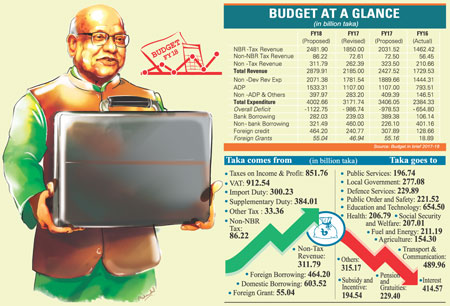
Finance Minister AMA Muhith placed Thursday a Tk. 4.0 trillion-plus 'ambitious' budget for the financial year (FY) 2017-18 in the Jatiya Sangsad (national parliament) banking heavily on value added tax (VAT) and income tax for bankrolling it.
But given the shortfall in mobilisation of both the taxes in the outgoing FY a fair amount of uncertainty remains as far as achieving the targets in the upcoming fiscal is concerned. Experts have also highlighted a few more irritants, including poor export growth and falling inward remittance.
However, the finance minister sounded confident about the ability of a 'revamped' tax administration. In his budget speech, the finance minister pointed out a host of measures that were initiated during last eight years to enhance the capacity of the National Board of Revenue (NBR).
Muhith, who only read out the salient features of the budget, said he was encouraged by the rate of increase in tax return submission and registration of new taxpayers in recent years.
The budget for next fiscal puts revenue projection at about 2.88 trillion, including tax revenue receipt amounting to Tk. 2.57 trillion. Of the projected tax revenue, Tk. 868.67 billion would come from income and corporate tax, Tk.913.44 billion from VAT, Tk. 382.12 billion from supplementary duty (SD) and Tk. 301.53 billion from import and export duty. The VAT target for FY'18 is 33 per cent higher than the revised estimates for the outgoing fiscal. In the case of income tax, the target is 36 per cent higher.
The revised estimates for the outgoing fiscal in the case of income tax and VAT are well short of their original targets.
The finance minister has also pinned much hope on the effectiveness of the new VAT and SD law, to be enforced on July 01 next, in greater revenue mobilisation despite a few adjustments proposed to appease the businesses. The notable adjustments relate to the replacement of the First Schedule of the said act to provide for VAT exemption of at the import and supply stage and the Second Schedule to reduce the number of SD rates.
The finance minister has proposed both incentives and disincentives for different sectors. Export-oriented industries such as leather, medicine and ceramics got some duty incentives and apparel sector corporate tax benefit while tobacco, as a matter of avowed policy of the government got duty and tax hikes.
Another important feature of tax proposals made in the budget for next fiscal is the conditional exemption of tax on core infrastructures built under public-private partnership (PPP) initiative. The proposal is aimed at wooing increased investment in this particular area.
The budget for next fiscal has not made any mention-worthy changes in areas of tax on personal and corporate tax barring the raise of the tax exemption threshold for individuals.
If it is an 'election year' budget, as mentioned earlier by the finance minister himself, the proposal to increase the amount of excise duty on the balance of accounts held with banks would not go well with the electorates. If adopted, the measure would create resentment among bank accountholders when actual return on deposits turns out to be in the negative.
The government proposes to spend over Tk. 4.0 trillion in the upcoming FY Including a development expenditure of nearly Tk. 1.6 trillion (the annual development programme is worth Tk.1.53 trillion).
More than 56 per cent of the revenue expenditure is meant for salary, allowances and pension payment of public servants, interest payments and subsidies and incentives.
The finance minister estimates the overall budget deficit in the next fiscal at 5.0 per cent and plans to meet the same with net foreign borrowing worth Tk. 464.20 billion and domestic borrowing worth Tk. 603.52 billion. The borrowing from the banking system might be around Tk. 282.03 billion. The government may mop up funds worth Tk.301.5 billion through the sale of national savings tools. In the outgoing fiscal the revised estimate puts the borrowing through these tools at Tk.450 billon as against the original target of Tk.196.10 billion.
Of the development budget for the upcoming fiscal, allocations of resources for key sectors of the economy was almost the same of the outgoing fiscal. Agriculture got less while education got more than 4.0 higher resources than that of the current FY. Health sector also got slightly more in the upcoming budget.
In his budget speech, the finance minister did not elaborate many important issues, including banking sector, price situation and capital market. Some remarks seemed cursory. Many had expected a brief progress report on a few fast-track projects in the budget speech. But they were disappointed.
zahidmar10@gmail.com