
Muslims in fear as Indian democracy turns 75
Modi says India aims to become developed nation in 25 years
Tuesday, 16 August 2022
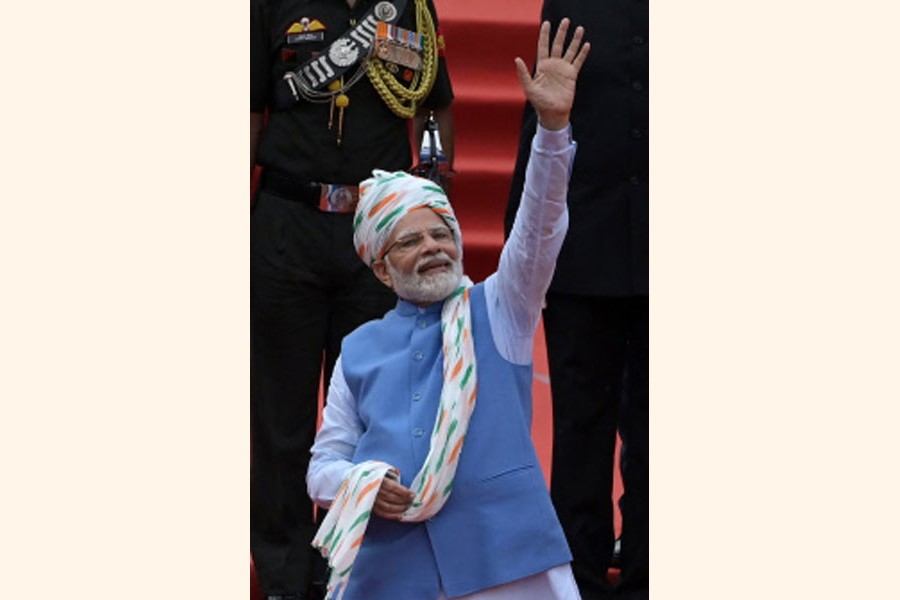
NEW DELHI, Aug 15 (Reuters/Al Jazeera): As India celebrates 75 years of independence, the country's Muslims and other minorities say they find themselves in a state of siege.
Ruled by the Bharatiya Janata Party (BJP) since 2014, the South Asian nation has lunged rightwards under Prime Minister Narendra Modi, with an overt and organised state patronage to a Hindu majoritarian agenda worrying its Muslims.
Critics say Hindu majoritarianism has become a de facto state policy under Modi, with Hindu supremacist groups ratcheting up their demand to turn the country into a "Hindu Rashtra" or an exclusive Hindu state.
Across the country, Muslims are facing blatant and subtle discrimination from state and private institutions as well as Hindu right-wing groups backed by Modi's Bharatiya Janata Party (BJP).
Whether it is what Muslims wear, eat, their places of worship and their constitutional rights to practise and preach their religion - all have been systematically attacked, banned, demolished or diminished since Modi came to power in 2014.
For the first time in India's history, its governing party does not have a single Muslim parliamentarian.
"If Hindu Rashtra means assigning second class status to Muslims, then India has practically already become one. Now it's a question about making it official. Even if they don't do it, the change has taken place", author and journalist Dhirendra K Jha told the news agency.
In 2018, the federal government passed a law banning "triple talaq", a controversial though rare practice of divorce among Muslims. Many BJP-ruled states also passed so-called "love jihad" laws, which criminalised religious conversion by marriages.
The Modi government in 2019 passed the Citizenship Amendment Act, which grants nationality to non-Muslim minorities from neighbouring countries. The passage of the law led to unprecedented protests and even religious violence in the national capital, killing at least 53 people.
In the southern state of Karnataka, the BJP government banned the hijab in educational institutions. In 2021, in the northeastern state of Assam, the BJP government passed a law to abolish "madrasas" or Muslim seminaries.
Last week, in Modi's constituency Varanasi, right-wing Hindu organisations released a 32-page draft constitution of a "Hindu Rashtra" which aims to deny Muslims and Christians the right to vote.
The "Hindu Rashtra" that is being talked about can only be based on injustice and atrocities and would be opposed to non-Hindus, especially Muslims, activist Khalik Khan told Al Jazeera. Khan is based in Faizabad, a twin city of Ayodhya - the ground zero of the Hindu supremacist movement.
"The aim is to disempower and demoralise our community and reduce them to a pariah status in society," Khan said.
The BJP rose to prominence in the 1990s on the back of a religious movement that polarised the country's Hindus and Muslims, with the latter labelled as "invaders" and "outsiders".
In 1992, the then-BJP government in the northern Indian state of Uttar Pradesh allowed a Hindu mob to demolish the Babri Mosque, a 16th-century structure in Ayodhya, because they believed it was built on the exact spot where Hindu God Ram was born.
In November 2019, India's Supreme Court ordered the construction of a Ram temple on the site, despite ruling that there was no evidence to prove any such temple existed there before the mosque. Muslims were given a plot 25km (16 miles) away to build a mosque.
Meanwhile, India will aim to become a developed nation within 25 years, Prime Minister Narendra Modi said in a national day address on Monday, with policies to support domestic production in power, defence and digital technology.
Speaking from the 17th century Red Fort in Delhi as India celebrates its 75th year of independence from British colonial rule, Modi exhorted youth to "aim big" and give their best years for the cause of the country.
"We must turn India into a developed country in the next 25 years, in our lifetime," said the 71-year-old Modi, wearing a turban in the colours of the Indian flag, in his 75-minute-speech in Hindi.
"It's a big resolution, and we should work towards it with all our might."
The World Bank currently categorises India as a lower-middle income economy - meant for countries with a gross national income per capita of between $1,086 and $4,255. High income countries, like the United States, have a per capita income of $13,205 or more.
India is the world's sixth-largest economy and is expected to grow at over 7 per cent in the current fiscal year ending in March 2023 - the fastest among major economies.
Many experts say India's economy could expand to become the world's third-largest by 2050 after the United States and China, although per capita income, currently around $2,100 may remain low compared to many countries.