
Funding the arts
My road to Canadian PhD
Tazeen Nuwari Anwar | Sunday, 10 May 2026
For decades, the conversation around academic funding was tilted heavily in one direction. Fields like robotics, medicine, artificial intelligence commanded headlines, attracted investors, and generated the kind of excitement that flows naturally into research grants and institutional support. The arts and social sciences, by contrast, have long occupied a quieter corner of that conversation valued in principle but too often overlooked in practice.
Funding does exist for scholars in these fields. Not in abundance, and not without considerable effort, but it exists. What it requires, more than anything else, is a different kind of preparation: slower, more personal, and rooted in the kind of lived experience that no research methodology course can provide. My story that follows is one such story, of navigating systems, building a case, and finding that the door, when approached with the right intent, does eventually open.
I did not arrive at this point quickly or easily. My path towards a PhD goes back much further than most people assume. I spent my childhood in Saudi Arabia, where my curiosity often grew in the quiet corners of classrooms rather than at the front of them. Later, I completed a Bachelor of Laws through the University of London, followed by the Bar Professional Training Course and, eventually, a Master of Laws at the University of the West of England. Those years were formative in ways I did not fully appreciate at the time. They taught me discipline and precision, of course, but more importantly, they taught me to see legal and social systems as living mechanisms, ones that shaped people's lives in ways that textbooks rarely captured.
Returning to Bangladesh as a lecturer at one of the University of London's registered centres added an entirely new dimension to that understanding. Standing before students who were full of potential but struggling to navigate the very structures I had once struggled through myself made me realise something: there is genuine power in translating complex systems into human language. That was when teaching stopped being a matter of delivering dry instruction and became, instead, a process of opening doors for people who were intimidated by them.
I carried that sense of responsibility with me when I joined Bangladesh's largest start-up, a company whose operations were expanding into Singapore, India, Dubai, and Saudi Arabia. The work exposed me to cross-border commerce and, far more significantly, to the workers who made that movement possible. I began to see how migration decisions were shaped long before anyone left home, and how quietly, almost invisibly, policy determined the fate of families who depended on those journeys. These were no longer abstract theories. They were people I knew personally. That was the moment I understood that Policy Studies was not simply a degree I wanted to pursue; it was work rooted in my own lived experience.
Even with that clarity, the question of funding loomed. Could someone from the arts or social sciences genuinely compete for major scholarships? The honest answer is yes, but almost nothing about the process is straightforward.
Preparing an application demands far more time than most people imagine. Academic equivalency assessments alone can take several months. Recommendation letters require early, thoughtful, and persistent communication with former professors who have their own demanding schedules, English language proficiency tests cannot be rushed, and opportunities such as the ERASMUS programme, the Swedish Institute Scholarship for Global Professionals, and the Bridging Divides PhD Stipend, through which I am funded by the Government of Canada via the Canada First Research Excellence Fund, expect not only strong academic performance but also careful planning and a well-constructed personal narrative.
In the arts and social sciences, funding bodies are searching for purpose, and that purpose must be grounded in genuine lived experience. They want to understand why your research matters to you specifically, and how it connects to a wider public need. They are looking for direction and depth rather than a list of qualifications. My own application needed to feel like a coherent story, one that traced a clear line from my childhood in Saudi Arabia to my work in labour migration to the national and global questions I felt compelled to address. The more honest that narrative became, the more it seemed to resonate.
There were difficult moments throughout this process. Drafting my Letters of Intent and Statements of Purpose often felt like holding a mirror to myself, searching for the thread that connected the last decade of my life. I revisited experiences I thought I had long since set aside, and I questioned more than once whether I was truly ready for a doctoral journey at all.
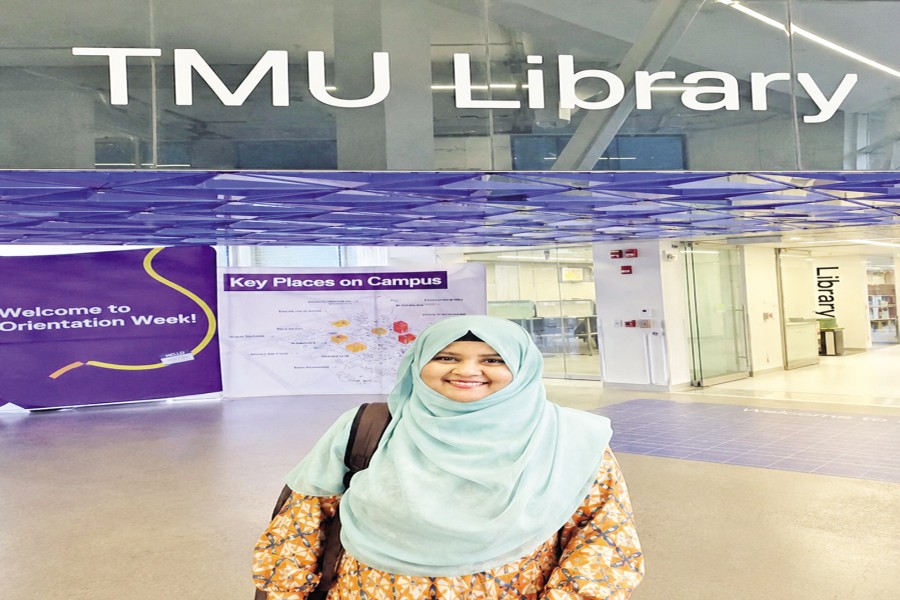
What helped most was people. Early on, I reached out to potential supervisors at Toronto Metropolitan University, and the majority responded with both kindness and candour. Their feedback sharpened my research proposal considerably. I also sought guidance from PhD students based in Canada and from TMU graduates I connected with through LinkedIn and through my husband's professional network. Their advice clarified what committees look for beneath the surface of an application, the things that are difficult to glean from a guidelines document alone.
This process also reminded me of the value of relationships within academia. Former lecturers, mentors, and supervisors often see strengths in you that you cannot see yourself. Their support shaped how I presented my background and ensured that my application spoke directly to what funding bodies prioritise.
So, is it possible to secure funding in the arts and social sciences? Yes, absolutely! Nevertheless, this path requires intention, patience, and an honest narrative that ties your experiences to the impact you hope to create. It requires preparation long before deadlines appear, a willingness to revise your ideas, and the humility to learn from those who have walked the road before you. For those willing to begin early, reflect honestly, and build the connections that sharpen both their thinking and their applications, the opportunities do exist, and those door do open.
Barrister Tazeen Nuwari Anwar is pursuing her doctorate in Policy Studies at Toronto Metropolitan University, Canada, and a recipient of the Bridging Divides Scholarship.
ms.tazeeen@gmail.com