
Nagad wallets can now receive remittances thru National Bank
Friday, 6 February 2026
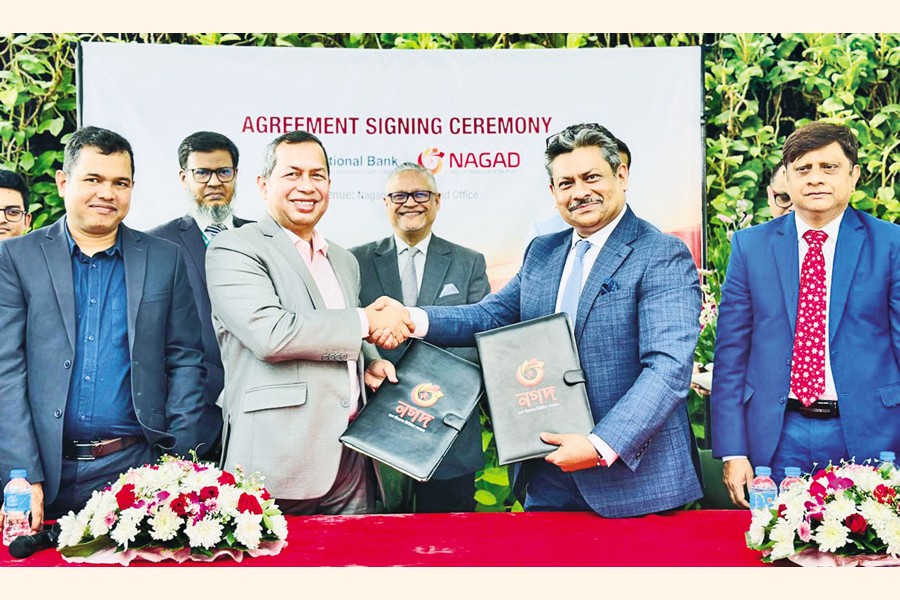
Nagad, the mobile financial service of the Bangladesh Postal Department, and National Bank PLC have jointly introduced a new, convenient channel for expatriates' families to receive remittances in Bangladesh.
Under this initiative, customers sending remittances through National Bank can now have the money delivered directly to their beneficiaries' Nagad mobile wallets, says a press release.
Under the agreement, remittances sent from abroad through the National Bank will be credited straight to beneficiaries' Nagad wallets. As a result, expatriates can remit money using international exchange houses, money transfer operators (MTOs), or banks. Beneficiaries, including those in remote areas of the country, will be able to receive and use the money twenty-four hours a day from anywhere, with minimal cash-out charges.
Remittance recipients will also continue to enjoy the government's 2.5 per cent incentive. In addition, the service is available through more than 60 money transfer operators (MTOs) and over 300,000 Nagad Uddokta points nationwide.
Recently, a remittance payment agreement was signed between National Bank PLC and Nagad at Nagad's head office in Banani, Dhaka. National Bank Managing Director Adil Chowdhury and Nagad's Administrator Md. Motasem Billah signed the agreement on behalf of their respective organisations.
Among those present at the signing ceremony were National Bank's Deputy Managing Director (In-Charge), Md. Meshkat-ul-Anwar Khan, Head of Remittance Division, Milton Roy, Nagad's Senior Associate Administrators, Md. Habibur Rahman and Md. Abu Taleb, Associate Administrator, Anwar Ullah, Chief Commercial Officer, Muhammad Shaheen Sarwar Bhuiyan, Head of Remittance, Md. Ahsanul Haque Bashar, along with other officials from both institutions.
National Bank's Managing Director Adil Chowdhury and Nagad's Administrator Md. Motasem Billah described the initiative as a groundbreaking step towards bringing remittance services to the country's marginal and underserved communities. They expressed optimism that the agreement would not only increase the flow of remittances into Bangladesh but also contribute positively to the national economy.