
Cabinet endorses act, ordinance too soon
Negotiable instruments law lightened to try financial crimes
FE REPORT | Sunday, 25 January 2026
A long-overdue legal upgrading is underway to expand judicial jurisdiction to try financial offences, principally cases of cheque dishonour that undermines trust in non-cash transaction.
The council of advisers of the post-uprising government Thursday approved the Negotiable Instruments Act 2025, paving the way for the law to be enacted through an ordinance during this tenure of the interim government, officials said.
The legislation marks the first major overhaul of the negotiable instruments framework in 144 years -- a move authorities and bankers argue is long overdue amid a surge in cheque-dishonour cases and growing stress in the financial system.
At the heart of the reform is an expansion of judicial authority aimed at accelerating case disposal.
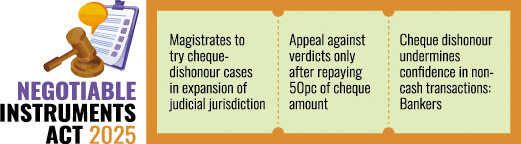
Under the revised law, metropolitan magistrates and magistrates of the first class will be empowered to hear cases related to cheque dishonour, significantly widening the number of courts able to try such offences.
Cases involving amounts exceeding Tk 500,000 will, however, fall under the jurisdiction of joint sessions judges.
"With the jurisdiction now widened, cases are expected to be resolved much faster," a senior official at the Financial Institutions Division of the Ministry of Finance told The Financial Express Saturday.
He added that delays under the existing framework had discouraged aggrieved parties from seeking legal redress.
The Negotiable Instruments Act governs financial instruments such as promissory notes, bills of exchange and cheques.
In practice, however, disputes in the country overwhelmingly stem from cheque dishonour, a problem that bankers say has undermined confidence in non-cash transactions.
Under the new law, cheque dishonour will continue to be treated as a criminal offence, carrying penalties ranging from six months to two years' imprisonment.
The law also introduces stricter conditions for appeal: defendants will only be allowed to challenge verdicts after repaying 50 per cent of the cheque amount, a provision intended to deter frivolous litigation and delatory tactics.
Bankers have broadly welcomed the changes, arguing that weak enforcement of cheque obligations has long distorted credit behaviour on the financial market. Mashrur Arefin, chairman of the Association of Bankers, Bangladesh (ABB), says the updated law would provide relief to those affected by non-payment and improve confidence in formal financial channels.
"We welcome this act as it expands access to courts and allows aggrieved parties to file cases more easily," Mr. Arefin, also managing director and CEO of City Bank, told the FE
"If implemented properly, it should reduce the suffering caused by prolonged legal processes."
The officials indicated that after taking legal opinion from the ministry concerned, the draft law would be sent to the President of Bangladesh for promulgating the ordinance.
jasimharoon@yahoo.com