
New open-ended funds outperform older ones amid market slump
Mohammad Mufazzal | Sunday, 1 March 2026
Many of the mutual funds launched over the past five to seven years have outperformed older funds, supported by what industry insiders describe as diversified investments made after the market had already undergone significant erosion.
Most of these funds were floated by newly licensed asset management companies (AMCs).
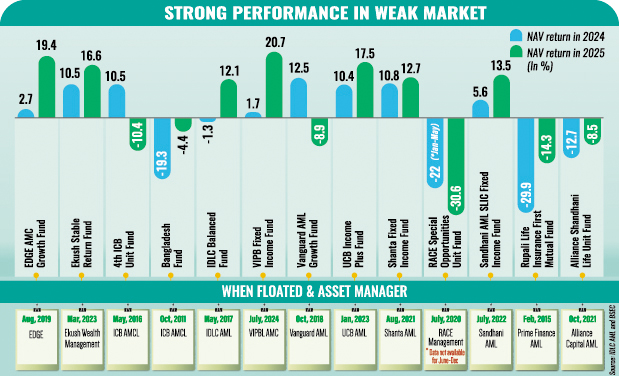
The open-ended funds secured good returns in net asset value (NAV) in 2024 and 2025, although the market remained bearish during the period. Asset managers reaped good profits by injecting a significant portion of the funds into fixed-income securities and other instruments, apart from equity investments.
Take, for example, EDGE AMC Growth Fund, an open-ended fund floated in August 2019. DSEX, the broad index of the Dhaka bourse, experienced a 6.76 per cent erosion in 2025 and closed at 4,865 points on December 30 of that year. Amid such a steep fall in the broad index, the Growth Fund reported a 19.4 per cent return in 2025.
On the other hand, Bangladesh Fund, also an open-ended fund floated in October 2011, experienced negative returns of 4.4 per cent in 2025 and 19.3 per cent in 2024.
The main factor behind the poor performance of Bangladesh Fund is that it could not recover from losses incurred in earlier years. Although the fund entered the secondary market after the 2010-2011 crash, it witnessed further erosion in asset value.
The benchmark index DGEN closed at 5,901 points on October 2, 2011. The index plunged further to 4,171 points by January 27, 2013, marking a loss of 29 per cent or 1,730 points during the period.
The state-run Investment Corporation of Bangladesh (ICB) launched Bangladesh Fund with its initial size set at Tk 50 billion. The objective was to stabilise the capital market following the debacle.
The fund was neither able to fulfil its initial target nor provide good returns to its investors.
Eight state-run companies together purchased subscriptions worth Tk 16 billion in 2011-12. Bangladesh Fund failed to sell significant subscriptions to the public.
Chairman of EDGE Asset Management Asif Khan said their research-based investment decisions had helped the fund generate strong returns even in a year marked by a persistent falling trend in the equity market.
"We took a long time to conduct research to choose and pick the right stocks at the right time. Secondly, we avoided stocks with no prospects," Mr Khan said.
For example, EDGE purchased Beximco Pharma shares at Tk 70 each, which recently rose to Tk 130 per share. EDGE also offloaded some quality stocks before they underwent erosion.
"Such factors helped EDGE AMC Growth Fund achieve significant growth in 2025," Mr Khan added.
New fund managers also secured significant NAV returns by floating special funds meant for investments in fixed-income securities. Such funds were unaffected by equity market erosion; rather, they bagged high returns from government securities.
As a result, VIPB Fixed Income Fund secured a return of 20.7 per cent in 2025.
Other fixed-income funds also performed better in 2025, availing themselves of interest rates above 11 per cent on Treasury bonds.
These funds outperformed the stock market, as most equities endured erosion in 2024 and 2025.
Shahidul Islam, chief executive officer of VIPB Asset Management Company, said their professionalism was reflected in the fund's performance. Even when the overall stock market was in decline, the fund invested in stocks that generated positive returns.
On the other hand, older funds are still carrying the burden of past losses inflicted by scams and financial frauds.
For instance, the securities regulator found many irregularities committed by RACE.
Of the open-ended funds managed by RACE, RACE Special Opportunities Unit Fund experienced a negative return of 30.6 per cent in 2025.
mufazzal.fe@mgail.com