
Beyond readymade garments industry
Next frontier of Bangladesh's export diversification
Serajul I Bhuiyan | Friday, 28 November 2025
There are always points in the economic development of countries where the roadmap for the future becomes distinctly visible once the driving engine, which for so long propelled success to dizzying heights, is no longer commensurate with ambitions born out of success. Bangladesh has finally reached that juncture in its economic development. For over four decades, its success story has remained its readymade garments (RMG) industry, which has emerged as a success saga for so long that it has made Bangladesh into the second-largest supplier to the global fashion stores. However, no country that has ambitions to reach trillion dollars can bank on its second-largest contributor to its export revenue to contribute above 80 per cent to its revenue streams.
A NATION AT AN EXPORT CROSSROADS:
The success in Bangladesh's exports has long had its roots in its RMG industry. Units multiplied exponentially, global buyers poured in, and for countless numbers of countrywomen, doors to empowerment swung wide in welcome. However, it has also created a new kind of vulnerability for Bangladesh vulnerability to overdependence on its RMG industry. The problem with any industry that contributes so greatly to country exports is that any adverse shock whether global recession, supply-chain disruptions, or geopolitical tensions can impact the entire country.
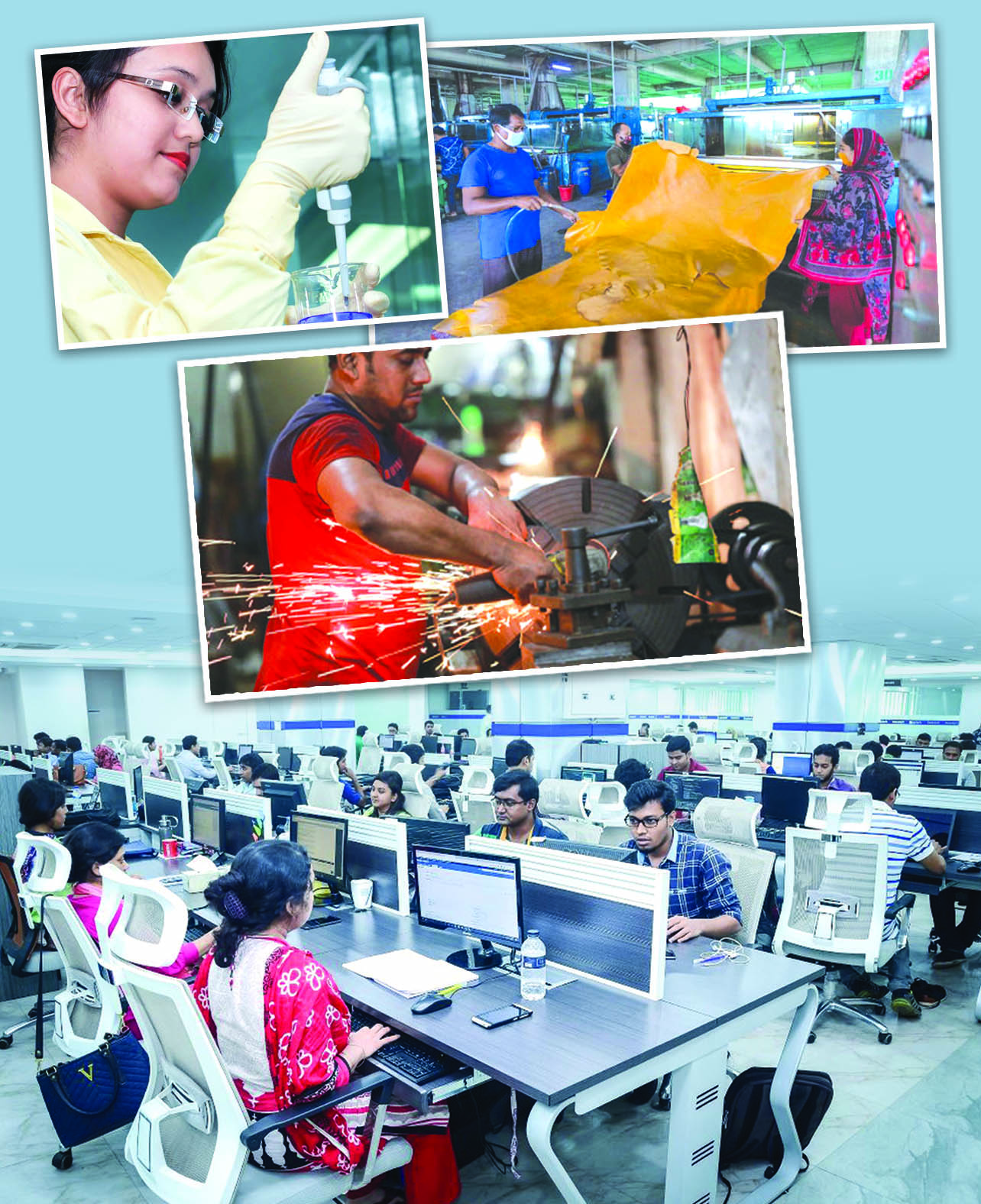
Economists are warning that Bangladesh has now reached the point where single-sector approach growth is no longer possible. The future of the garments industry is undergoing tremendous change due to automation, nearshoring, government regulations on climate change, and sharp competition from other countries such as Vietnam, Turkey, and Ethiopia. It is no longer possible for Bangladesh to fashion its way to middle-class global status.
The opportunity exists. Today, Bangladesh has youth, technology, entrepreneurship, and geographic linkages between South Asia, Southeast Asia, and the Bay of Bengal on its side. Now, the challenge lies in ensuring that these factors are leveraged for Diversified Export on behalf of Bangladesh.
PHARMACEUTICAL SECTOR - THE BEHIND-THE-SCENES GIANT: This industry has remained largely overshadowed by the dominance of garments in public rhetoric but is perhaps second to none in terms of its promise for Bangladesh as a high-value industry since their independence. Currently, local pharmaceutical companies are meeting the entire country's demand, in addition to supplying more than 150 countries in Asia, Africa, and Latin America.
This experience in making generics, taking advantage of the World Trade Organization (WTO) Trade-Related Aspects of Intellectual Property Rights (TRIPS) exemption for Least Developed Countries (LDCs), has provided Bangladesh with a fantastic foundation. With Bangladesh poised to graduate and move out of its LDC status, pharmaceuticals' ability to develop advanced formulation, biologics, vaccine development research, or API manufacturing will provide assistance in upgrading pharmaceuticals to a multi-billion-dollar industry via its global markets.
As observed by industry analysts, with rising demand for cheaper drugs in the global arena, especially within the developing countries, Bangladesh has emerging opportunities for its competitive advantage, which is its ability to provide quality generic drugs at cheaper rates. However, to effectively exploit this opportunity, modifications in regulatory matters and emphasis on global acceptance for quality certification are essential.
The export councils are also of the view that "if a holistic approach can be adopted whereby tax incentives for API production, streamlined approval schedules for drugs, and brand-building campaigns for 'Made in Bangladesh Pharma' are provided, then this industry can emerge as one of its biggest earners of foreign exchange by 2035. This is a new frontier that Bangladesh cannot miss."
LEATHER & LIGHT ENGINEERING -- EXTENDING MANUFACTURING OUTSIDE THE CONVENTION: The leathers industry remains one of the most underrated sectors for exports for Bangladesh. For many years, it has struggled with issues of compliance, environment, and delays in relocation. However, the opportunity in this sector is enormous. One thing that international buyers always mention is that products such as leathers and footwear from Bangladesh are on par with international standards, but environmental certification creates hurdles for entry into higher markets.
Effective and full implementation of the Savar Tannery Industrial Estate could change the face of the industry overnight. With efficient treatment facilities for effluent, common certification, and environmental observance, it will not be difficult for the Bangladesh leather goods industry to rake in additional revenue to the tune of US$5 to $7 billion every year. It is important to ensure that they are confident about the entire observance structure.
Light engineering is also a bright spot. This industry does not get the attention that it deserves, but it has great prospects to emerge as the backbone of a diversified manufacturing economy. The Bangladeshi companies are already making parts for bicycles, automobiles, agricultural machinery, and home appliances. With proper policy assistance in terms of lower import duties on basic materials, special zones for precision engineering, and technical education in precision machining, this country can emerge as a Tier-2 supplier to global companies.
Vietnam, Thailand, and Malaysia exploit this approach to the fullest. Bangladesh has every opportunity to pursue this approach too by creating avenues for SMEs to innovate, grow, and gain access to international buyers.
INFORMATION TECHNOLOGY SERVICES -- THE DIGITAL FRONTIER THAT AWAITS TAKEOFF: One of the most underutilised national resources for Bangladesh is its ICT talent. With over 650,000 freelance ICT professionals, coupled with thousands of new ICT graduates annually, Bangladesh has emerged as one of the top providers of online talents in the global marketplace. This is only a fraction of its full potential.
Information technology services relating to software development, security, cloud services, AI services, and BPO services have emerged as new areas for global exports. Nations such as Vietnam and the Philippines are banking on their youth to generate billions in revenue in terms of information technology exports. Bangladesh has this opportunity too, but for that, right investments are required.
Three are always emphasised. First, the country needs to develop its national approach to skills acceleration to teach children the skills that are most needed by the global environment, including cloud technology, AI, mobile development, and data analytics.
Second, Bangladesh must develop top-class global technology infrastructure to include always-on broadband and qualified data centers that give global clients assurance and confidence in terms of security and reliability.
Third, Bangladesh must develop its global brand to enable it to emerge as a secure outsourcing location, which entails both publicity and improvement in standards.If this happens, IT services can emerge as one of the country's biggest earners of foreign exchange within a decade, making not only its economy but also its workforce diverse.
AGRO-PROCESSING -- WHERE RURAL PROSPERITY AND WORLD DEMAND MEET: Agricultural products are key to Bangladesh, but its agricultural export growth has remained well below its actual potential. Agro-processing acts as a 'connecting link' between local farmers and global supply chains. Various products including shrimp, ice-cubed fish, processed fruits, spices, juice, 'ready to eat' products, and 'halal products' also find substantial markets abroad.
However, inconsistencies in supply chains restrict its ability to participate effectively in niche markets. Cold storage facilities are insufficient, certification for food safety is distributed over various government agencies, and its inability to provide integrated logistics increases its reliance on costly exports. This makes Bangladesh sell their products raw or processed to only tap into a very limited portion of international value addition.
Agricultural economists recommend that for Bangladesh, it is essential to develop countrywide cold chains between farmers, processors, and exporters. This will itself decrease post-harvest losses to a substantial extent and enhance overall exports. Moreover, contract farming arrangements where input supplies and training are also provided to farmers can ensure quality.
The demand for halal, organic, and sustainably produced food products is escalating exponentially. Bangladesh, with its original fit in this domain, ought to be at the forefront in the global halal food market. It has tremendous potential to emerge as a multi-billion-dollar industry for agro-processing, concurrently lifting up agricultural livelihoods and countrywide food industries.
THE POLICY IMPERATIVE: No industry can grow in an environment where policies are not favorable. Economists repeatedly stress that Bangladesh needs to introduce a new type of incentive structure one that favors added-value, R&D, and adherence rather than added numbers.
The incentives for cash support need to focus on research, development skills, green manufacturing, and sophistication in exports. An enterprise into biologics (a broad category of medicines derived from living organisms that are used to treat a variety of diseases, including cancer, autoimmune disorders, and diabetes) or AI or engaged with global environmental standards in its leather manufacturing practices needs to be treated separately in terms of incentives rather than on par with other traders in low-value goods.
Infrastructural deficiencies are also important areas where Bangladesh needs to fill its gaps. The World Bank estimates that Bangladesh is losing between 7-8 per cent of its probable export value in terms of delays in ports, customs, and expensive logistics. It has become essential to opt for modernization. Automated customs and inland container depots, roads, and port management technology are essential areas where Bangladesh needs to focus on making these priorities for the country.
Finally, it is essential for Bangladesh to integrate into regional trade thoroughly. The BBIN Initiative, BIMSTEC, and BCIM corridors are massive opportunities for reducing costs and getting new markets. In addition to this, countries like South Korea, Singapore, and Indonesia are also interested in investments in sectors including energy and agriculture.
Picture this: Bangladeshi drugs are quickly distributed to Nepal, agro-processed products are delivered to India within hours, not days, and IT firms are able to work in perfect synergy with Bhutan and Sri Lanka. This is no fanciful notion but rather the reality that will soon greet our wake-up calls.
THE NEXT DECADE WILL DEFINE BANGLADESH'S ECONOMIC DESTINY: The era of single-engine growth is coming to an end. RMG will always remain a pivot for the country's exporting economy, but it must not continue to remain its only pivot. The global economy is undergoing transition, and so must Bangladesh. It is a moment in history for the country where its demography, technology, entrepreneurship, and cooperation in the region are aligning in favor of our growth trajectory.
If Bangladesh is to take advantage of this opportunity, it needs to act with boldness, with certainty, and with relentless efforts on reform. Export diversification is not just a policy or an approach it is a and a catalyst for sustained.
As Bangladesh seizes this opportunity, it has every chance to develop its own export environment, which is broader, smarter, greener, and more innovative than anything that has ever existed in this country or anywhere else in its history. The next installment in the Bangladesh growth saga must be written not by one industry but by many that are on the rise.
The day to emerge out from RMG is not in the far-off distance.It is now.
Dr Serajul I Bhuiyan is a professor of journalism and mass communications at Savannah State University, Savannah, Georgia, USA. sibhuiyan@yahoo.com