
No second \\\'green revolution\\\': Go for organic agriculture
Yasir Wardad | Thursday, 27 November 2014
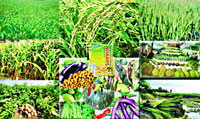
Bangladesh has gone through a revolution in farming since the mid-sixties. This was the first 'green revolution'. Nowadays, there have been musings over a second green revolution, attuned to the environmental concerns. But it has also but its inbuilt harms.
We, the Bangladeshis, have seven thousand years of agricultural heritage (Man and Environment: The Ecological History of India--Irfan Habib). Even then, we went through the first green revolution. The chemical-based agricultural revolution was introduced in the world in the 1940s. But its signs and symptoms began to be felt from the mid-sixties in our geographic location (Development of a Rural Community--Akhtar Hameed Khan).
Before the beginning of the revolution, however, our peasantry had already developed a very scientific and eco-friendly agriculture after going through field-research processes of thousands of years. Through this process, nearly 28,000 rice varieties, 200 varieties of potato, few thousand varieties of vegetables (Khonar Bachan: Krishi O Krishti--Dr Ali Newaj) were developed.
These varieties were developed by our farmers in a very selective manner---every village has her own specific seed varieties.
The introducers of the chemical-based farming in this country, most of who--consciously or unconsciously--worked for the chemical pesticide or fertiliser and seed companies, inaugurated new agricultural method: the more fertiliser and pesticide you use the more production you reap.
Multinational companies and many of their allied research organisations came to our country hand in hand. Donor partners encouraged chemical fertiliser-pesticide-groundwater-based farming in the country.
Between the 1970s and 2000s, the country's water table dropped by seven metres, soil lost more than 80 per cent of her organic matters, more than 20 fish, 20 frog, 25 species of birds witnessed extinction, farmers lost 95 per cent of their seeds while crops became totally chemicals-dependent.
The green revolutionists advocated, barked, aired, telecast and spoke that the production of food increased due to adopting the synthetic agriculture escaping those losses.
Coincidentally, the Bangladesh Agricultural University (BAU) was established at a time (in 1961) when the first green revolution had reached our doors. Advocates of chemical pesticides and fertilisers were born from public universities. The multinational chemical and seed companies got educated sons and daughters of the peasantry who (university graduates) had an easy access to the villages.
The Bangladeshi farmers, one of the most educated and knowledgeable peasantries in the world (based on their practical knowledge on farming and agricultural business), witnessed that all they had achieved for centuries, were worth no more. Without 'appropriating' western technologies in our context, our agricultural intellectuals blindly adapt urea and chemical pesticides and alien seeds.
'The MYTH of chemicals-based agriculture won over the FACTS of indigenous organic farming'.
After the tempestuous waves of change, our 'agricultural intellect' is now moving to another one-'second green revolution'. This one is now focusing on environment, ecology. But it has also opened the door for genetically engineered (GE) crops.
The conscious people in the first world are rejecting the genetically modified organism (GMO) crops. Even the countries of Europe and American continents have imposed hundreds of bars and restrictions on GMO crops following its harmful consequences related both to human health and biodiversity.
Such awareness and protests in Europe and North America forced the GMO promoters to give a look to the third-world countries like India, the Philippines, Bangladesh, Pakistan, Gambia and so.
The subcontinent was the biggest research field for fertiliser, pesticide and seed multinationals from the very beginning of the green revolution. Mr Borlaug, an American agronomist and Nobel Peace Prize laureate, who is considered as founder of the first green revolution, was even given the Padma Vibhushan, India's second-highest civilian honour.
So, the first green revolution found its ground in the subcontinent and now its second edition is set to be applied in the same area by the proponents from the developed hemisphere of the world.
Though the people of India had failed to resist the entry of non-food GMO crop like Bt cotton, they succeeded in forging a strong protest against GMO food crop---Bt Brinjal. The scientific committee under the Indian court has imposed indefinite ban on release of the Bt Brinjal at farmers' level.
Karnataka state government imposed a ban on marketing Bt Cotton seeds by MAHYCO Company Ltd following random crop failure. The Philippine court banned the BT Brinjal crop in 2013 for an indefinite period.
But the Bangladeshi government accepted it.
Even Agriculture Minister Begum Matia Chowdhury went to the extent of saying at a programme that the future food security of Bangladesh is depending on adopting GMO crops (New Age, The Daily Star, The Financial Express, January 23, 2014).
Despite the failure of Bt Brinjal at farmers' level, the government is giving its seeds to 106 farmers (Dhaka Tribune, November 3, 2014) this winter. Bacillus thuringiensis (Bt) bacteria gene is being injected into local varieties of brinjal to make the hybrid vegetable seed.
The seed can protect the brinjal from fruit and shoot borer. But besides the fruit and shoot borer, another 35 categories of insects attacked brinjal and the Bt Brinjal promoters in the country-- the Bangladesh Agricultural Research Institute (BARI)--in its direction for cultivation of Bt crop has advocated for few pesticides in fields.
At a programme, organised by BARI to make public the outcome of Bt Brinjal cultivation at farm level, farmers showed strong protest by saying that most of them incurred huge losses by cultivating Bt Brinjal. They demanded compensation.
Eleven out of the sixteen farmers present at the meeting claimed that all of their plants had died highest in two months when Brinjal plant normally gives fruits for six months (New Age, Dhaka Tribune, Kalerkantha, September 8, 2014).
In line with brinjal, GMO variety of golden rice is also in the pipeline. After a failure in 2013-14 even at research level, the government is considering growing golden rice again in the Bangladesh Rice Research Institute (BRRI) field this financial year (Dhaka Tribune, October 30, 2014).
A Dhaka Tribune report, published on September 8, 2014, said that the government had acknowledged that before releasing four varieties of genetically modified Bt brinjal - patented by US seed giant Monsanto - at the farmers' level, it had not conducted any laboratory test itself regarding the possible negative impacts on human health.
Dr Rafiqul Islam Mondol, director-general of BARI, said, "We could not carry out any test regarding human health hazards of Bt brinjal in Bangladesh due to the absence of necessary laboratories". He, however, claims Maharashtra Hybrid Seeds Company (Mahyco), in which Monsanto has 26 per cent stake, assured the government that the GM varieties would not pose any hazard to public health and the ecosystem.
His statement came only a day after BARI in a circular published in dailies claimed that they had released the varieties after several local and international laboratories had confirmed that there were no health and environmental hazards.
However, without mentioning integrated pest management (IPM) or organic farming methods, the promoters of Bt Brinjal always said that GMO brinjal is the solution and it is the only way to reduce use of pesticides. Appropriating integrated pest management in rice and vegetable fields, pesticide use got reduced by nearly 20 per cent in recent years, said the Department of Agriculture Extension (DAE).
BARI is promoting GMO brinjal in Bangladesh although research of the same organisation revealed that organic farming methods can deduct production cost and increase both output and rate of micronutrients in the crop compared to that of the synthetic production methods (Financial Express, December 2012).
The report published in the Financial Express said nearly 90 per cent of the farmers in the country were familiar with bio-farming until mid-eighties. Later, most of the farmers adopted chemical-based cropping in the name of 'modern agriculture'.
The Vegetable Department of BARI developed the new model of bio-farming through which farmers can get same quantity of crops without using chemical fertilisers and pesticides.
"BARI's bio-model helps to increase organic matters significantly in the soil and push up the presence of antioxidant", an official at the vegetable division under the national research organisation said. He said that vegetable and paddy were produced experimentally in BARI farms following the model where rate of organic matters was only 1.14 per cent in 2006, which scaled up to 2.70 in 2011 appropriating the natural farming.
BARI-produced beans were experimented at Dhaka University's Biology Laboratory where scientists found that the rate of antioxidant was 39 DPPH (a common abbreviation for an organic chemical compound) which was 37 DPPH in the beans produced by presently used method dependent on chemical fertilisers and pesticides.
Continued to page 9
Continued from page 8
BARI Vegetable Division scientist Dr Md Najim Uddin said applying this method, farmers can grow 16 to 18 varieties of vegetables on one bigha (33 decimal) and can earn at least Tk 45,000 in winter season alone. "Earlier, we believed that production through bio-farming was less but we were wrong, as applying the organic method farmers even got more crops producing vegetables like cabbage, cauliflower, beet, red amaranth, tomato and brinjal," he recognised.
The farmers also have succeeded in growing earlier variety of paddy in 80 days by growing both local varieties and modern ones, such as BR-57, in same land, he further said. Dr Najim Uddin informed the FE that BARI-developed natural manure, compost, useful beetle and pesticides were used in this method. Pesticides were made from the liquefied fruits of Neem, Mahogany, Pitraj, and tamarind trees.
However, considering the business prospects, president of the International Federation of Organic Agriculture Movements (IFOAM) Andre Leu, who visited BARI experimental farms early November 2012, said that demand and market of organic food items has been increasing gradually. "The farmers of Bangladesh have a rich heritage of bio-farming which can help the country grab a portion of the global market by reintroducing the methods," he said.
Echoing Mr Leu, President of Bangladesh Organic Products Manufacturers' Association (BOPMA) Abdus Salam said that presently the country exports agricultural products worth more than US $690 million. He said: "We can easily cash three to four times more than the present figure if same volume of organic produce is exported. The government should increase export subsidy for organic product export."
Bangladesh Agro-based Product Producers and Merchants' Association president Md Ruhul Amin said apart from the research organisations and private sector, the state-run Export Promotion Bureau (EPB) and Hortex Foundation should come forward to motivate the exporters. IFOAM statistics showed that organic products market expanded to $ 138 billion globally in 2011. Global demand for organic products remains robust, with sales increasing by over $5.0 billion a year, according to the UK-based web-portal 'Organic Monitor'.
In chemical-or GMO-based agriculture, the farmers gradually lose the hold over seeds. Owner of seed can control overall agriculture of a country. Seed scientist Dr MA Sobhan said: "SEED is the key to agriculture. Control the seed, and you control a nation's agriculture. Given the size of the agriculture sector in countries like Bangladesh, that effectively lets you control the nation as well. We cannot allow this control pass so easily to another country, in this case America, through Monsanto (Dhaka Courier, August 22, 2013)."
Our research organisations are showing that organic farming can give additional crops with higher food value containing more micronutrients compared to that of chemical- based farming. Fertiliser or pesticide cost is almost half as it cuts use of chemical fertilisers and pesticides.
So, the myth of multinational companies' synthetic agriculture no more can engrave the facts of natural or organic farming. Agricultural activist Vandana Shiva observed that reports trying to create doubts about organic agriculture are suddenly flooding the media. "There are two reasons. Firstly, people are fed-up over the corporate assault with toxics and GMOs. Secondly, people are turning to organic agriculture and organic food as a way to end the toxic war against the earth and our bodies."
At a time when industry has set its sights on the super profits to be harvested from seed monopolies through patented seeds and seeds engineered with toxic genes and genes for making crops resistant to herbicides, people are seeking food freedom through organic, non-industrial food.
The food revolution is the biggest revolution of our times, and the industry is panicking. So it spins propaganda, hoping that in the footsteps of Goebbels, a lie told a hundred times will become truth. But food is different.
"We are what we eat. We are our own barometers. Our farms and our bodies are our labs, and every farmer and every citizen is a scientist who knows best how bad farming and bad food hurts the land and our health, and how good farming and good food heals the planet and people (Myths about industrial agriculture, 23 Sep 2012, Shiva)".
However, our hundreds of rice varieties of Aus season (the season was major rice season before the green revolution, now minor), which are now in the Bangladesh Rice Research Institute (BRRI)'s Gene Bank, were very short-durative and climate-friendly. Thousands of farmers are now looking for their lost seeds to cope with the climate changes as the present agricultural method is not giving any solution (Financial Express, September 19, 2014).
Appropriating organic farming in the twenty-first century will be the smartest and time-befitting method and we have to release our seed varieties from the Gene Bank. In the science fictional novels or cinemas, we see astronauts go to the cryonics capsule and pass centuries and then come out of the capsule in necessity.
The necessity of our lost seeds to remain in frozen rooms has ended and our scientists should bring out our seeds from the Gene Bank because we have no alternative now but to use our eco-friendly seeds.
The writer is FE Staff Reporter. He can be reached at: tonmoy.wardad@gmail.com