
No sign of immediate Rohingya return: USAID
FE Report | Thursday, 12 May 2022
USAID Deputy Administrator Isobel Coleman said on Wednesday there is no sign of repatriation of Rohingyas in near future despite their eagerness to go back to their homeland Myanmar.
"Unless a safe environment is in place for a dignified, voluntary and peaceful return that secures their (Rohingya) rights, I don't think we are going see any movement in that direction (repatriation) soon," she said at a media briefing organised at the American Center Auditorium of U.S. Embassy in the capital.
She said these while wrapping up her five-day visit to Bangladesh from May 7-11 to observe U.S. humanitarian assistance programmes in response to the Rohingya refugee crisis.
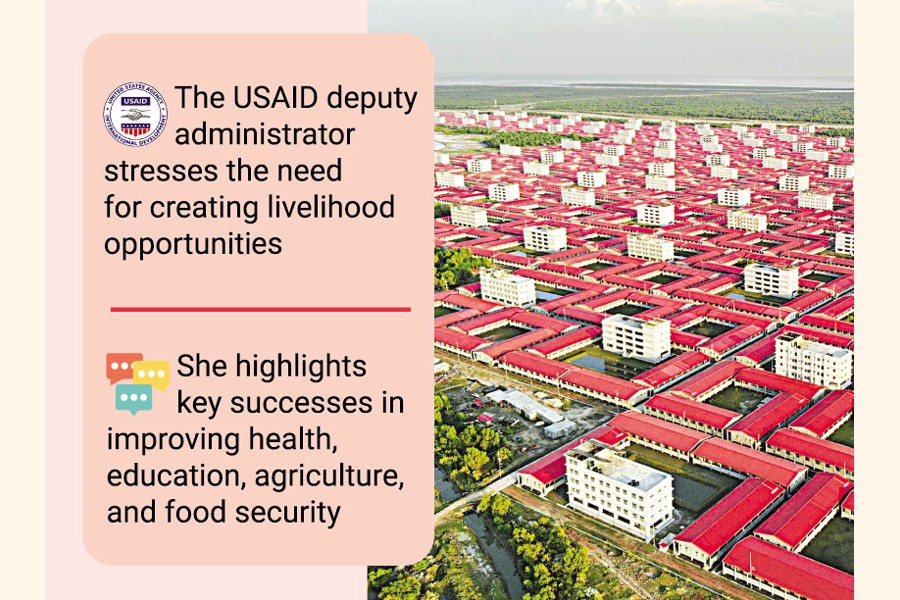
The US delegate also highlighted key successes from USAID's 50 years of partnership with Bangladesh in improving health, education, agriculture, and food security at the media briefing where USAID Mission Director Kathryn Davis was also present.
As part of her visit, she went to Cox's Bazar and Bhasan Char to see the Rohingya situation first-hand.
Delivering her views about Rohingya repatriation, she said, "We (the US) have off course sanctioned individuals of Myanmar, designated the atrocities (on Rohingyas) as genocide, and working with the ASEAN member states to push for peaceful resolution to the conflict of Myanmar."
"Every single Rohingya I had a chance to speak with want to go home but of course they can't go now and they will not because they recognise that it is not a safe environment now."
The tragedy that they have experienced was brutal and really horrific that the US government few months ago has designated as genocide, she said, adding: "This is a longstanding issue and we must be hopeful because there may be a day for voluntary return but currently it is not in the horizon."
Evaluating her perception about the relocation of Rohingyas to Bhasan Char, an island at Hatiya upazila of Noakhali district, the USAID deputy administrator said there are some "structural issues" that need to be addressed at Bhasan Char before more people move to the island.
Emphasising on creating livelihood opportunity for the Rohingyas at Bhasan Char, she said housing facility at Bhasan Char is definitely an improvement comparing to the camps in Cox's Bazar but those who are already in the new location need help to meet their basic needs with more livelihood opportunities.
Besides, Ms Coleman stressed the government's efforts to protect Bhasan Char from flooding through embankments as it is a "fragile and vulnerable" area though as per the government of Bangladesh the efficacy and strength of the infrastructure at Bhasan Char was tested during the deadly cyclone Amphan.
Appreciating Bangladesh for hosting over a million Rohingyas from Myanmar, she also stressed the need for improving provision of basic education, livelihood, communication, and transportation facilities at Bhasan Char.
Responding to a question about uncertainty over getting funds for Rohingyas, she said the ongoing war in Ukraine has put an enormous strain on global humanitarian assistance scenario.
Terming the Ukraine-Russia conflict an unprecedented event, she said the crisis has been responsible for global food price increase as well as making humanitarian efforts vulnerable all over the world.
However, expressing her hope for peaceful repatriation of Rohingyas in future, she said, "The US is committed to continuing its support for the Rohingya response making sure that the refugees who are here receive what they need and their basic needs are met as it is a priority for us."
She also mentioned that the US government has provided around US$ 1.7 billion to Rohingya responses so far.
ahb_mcj2009@yahoo.com