
No specialist docs at mkts
Jubair Hasan | Friday, 3 October 2014
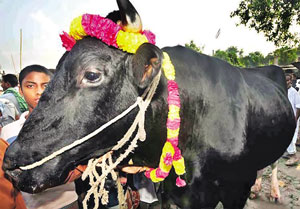
Buyers' concern over artificially fattened cattle continues to grow in the absence of any specialised team at the capital's cattle markets to examine health condition of sacrificial animals.
Although the Ministry of Fisheries and Livestock had announced that they would assign a dozen of medical teams at the city's major markets to check health condition of cattle to remove panic of the buyers in respect of unscientifically fattened cattle which poses posing a serious health hazards.
But in the capital's Kamalapur, Banasree and Armanitola makeshift cattle markets, veterinary doctors were found Thursday administering first aid to the cattleheads.
Talking to the FE, veterinary doctor Md. Rafiqul Islam placed on duty at Kamalapur Cattle Market said they just give preliminary treatment to the cattle having problems like diarrhoea, unwillingness to eat and traumatic injuryies.
"We're not assigned here to check whether the cattleheads were fattened artificially or unscientifically. It's a big task. We will require lab facilities to examine samples of the animals before taking any decision," he said.
A buyer, Delwar Hossain, came to the booth of the veterinary doctor to inquire health condition of the cattle he bought while the doctor was talking with the FE correspondent. In response, the doctor observed the cow from a distance and gave green signal.
However, the treatment process did contribute a little to remove the buyers' concern about artificially cow-fattening ingredients as Mr. Delwar, who bought a medium-sized Ox at Tk 75,000, said that he approached the booth for steroid test of the animal as informed by the government earlier.
"But, the doctor has okayed it without having any test or check up," he said adding that the government should set up specialized teams with all kinds of logistics for the sake of public safety.
The scenario was almost the same at other makeshift cattle markets.
When contacted, Director General of Department of Livestock Service, Ajay Kumar Ray, said it becomes very difficult for anyone to do such types of examination of all the cattleheads with limited manpower and logistics.
It is learned that a section of dishonest cattle traders and farmers ignore scientific method and push steroid and hormone injections to the cattle's body indiscriminately and feed them urea to fatten those.
According to the experts, steroids cause accumulation of fluid in cattle and make them look fatter. But this fluid attacks their immune system, making them vulnerable to deadly diseases.
They said if anybody consumes meat of such cattle for long, he may get kidney problem, liver failure, gastric ulcer, diabetes, pancreas diseases, uncontrolled high pressure, skin diseases and other ailments that may eventually lead to the person's death.
Meanwhile, traders in the city's different cattle markets are disappointed as sales are yet to gain momentum with three days left for Eid-ul-Azha.
Unlike traders, customers seem to be happy being able to buy their sacrificial animals for a comparatively cheap price than that of the previous year from different cattle markets which have sprung up across the capital ahead of the Eid festival.
The cattle traders are a bit frustrated with the poor sales they have made so far.
"We have failed to sell a single animal over the last five days at the market for not getting any reasonable price from the buyers," said Nannu Hossian Talukder, a Sirajganj-based trader who brought 15 cattle to Banasree Cattle Market.
A hasil collector, Anik at Kamalapur Cattle Market, said nearly 15 cattle heads have been sold out till 3:30pm Thursday.
The sale of sacrificial animals would start in full swing from today (Friday), according to the traders and market operators.
jubairfe1980@gmail.com