
Non-conventional energy and solar inverters
Jibon Krishna Modak | Thursday, 24 April 2014
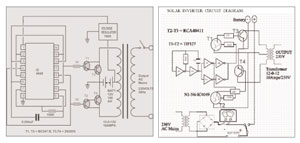
The article focuses on the use of solar power in a particular and effective way. These days we find many people using solar inverters. Among other things, it amply proves that the necessity and acceptability of this solar power-run device is on the increase. A solar inverter is similar to a normal electric inverter, but it uses energy from the sun i.e. solar energy.
A solar inverter helps in converting Direct Current (DC) into Alternating Current (AC) with the help of solar power. Direct power is that power which runs in one direction inside the circuit, and helps in supplying current when there is no electricity. Direct current is used for small appliances like mobile e-phones, MP3 players, iPods etc. where there is power stored in the form of a battery. In case of alternating current, it is the power that runs back and forth inside the circuit. The alternating power is generally used for household appliances. A solar inverter enables the devices that run on DC power to run on AC power, so that the user can make use of the AC power. If you are thinking why one should use the solar inverter instead of the normal electric one, the answer lies in the fact that the solar inverter makes use of the solar energy, which is available in abundance from the sun and is clean and pollution-free.
Solar inverters are also called photovoltaic solar inverters. These devices can help you save a lot of money. The small-scale grid has just two components i.e. the panels and the inverter, while the off-grid system is complicated and consists of batteries, which allows the interested people to use the appliances during the night when there is no sunlight available. The solar panel and the batteries that are placed on rooftops attract sun rays, and then convert the sunlight into electricity. The batteries also grab the extra electricity so that it can be used to run appliances at night.
WORKING OF SOLAR INVERTERS: Solar panels produce direct electricity with the help of electrons that are moving from negative to positive direction. Most of the appliances that we use at home work on Alternating Current (AC). This AC power is created by the constant back-and-forth movement of the electrons from negative to positive. In AC electricity, the voltage can be adjusted according to the use of the appliances. As solar panels produce Direct Current (DC) only, the solar inverter is used to convert the DC into AC.
An inverter produces square waves or a sine wave which can be used for operating lights, televisions, motors etc. However, these inverters also produce harmonic distortions. Expensive inverters make use of lots of steps to produce a sine wave, and thus are found in residential solar inverters. Basically, inverters should be a large one so that it can supply enough power to all the necessary appliances.
An inverter is easy to buy, but choosing the right solar inverter for one's appliances is also quite important. Thus you must always consult a solar power professional before buying one. We know that the energy derived from the sun is solar energy, which is one of the cleanest sources of power. Also it can be used to provide lighting to houses.
You can make use of the photovoltaic tiles that attract energy from the sun and convert it into a clean form of electricity which can be used to light houses, industries and offices. The cells of photovoltaic pieces consist of positive and negative silicon that is placed underneath a slice of glass. When the protons of the sunlight hit the PV cells, they knock the neutrons present in the silicon. Now the negatively charged neutrons get attracted to the silicon, but then are held inside a magnetic field. The wires attached to the silicon catch hold of these neutrons, and while being connected to the circuit, the current is formed. This then gives space for direct electricity and for converting that into alternating electricity. An inverter is used so that the house appliances can operate. As mentioned before, majority of the house appliances work on Alternating Current, hence an inverter is used for converting DC to AC.
The solar power, apart from making your home appliances work, can also be used to heat water and swimming pools.
A solar panel is capable enough to convert the heat or energy of the sun into direct current.
SOLAR INVERTER DESIGN: To easily understand the construction of a solar inverter, let us look into the following construction model:
1. According to the circuit diagram, initially one has to complete the assembling of the oscillator part, which consists of small components and IC. It is finely done by inter-relating the part leads, and fusing the joints.
2. Now place the power transistors into the acutely pierced aluminium heat sinks. This is crafted by cutting aluminium sheets into specified sizes and bending their sides, so that they can be held tightly.
3. Make use of mica isolation kit to fix transistors in the aluminium heat sink, evade short-circuiting and direct contact of the transistors from ground and each other.
4. Fasten the heat sink congregation to the bottom of a properly ventilated, strong and thick gauge-metal enclosed space.
5. Also fasten the power transformer next to the aluminium heat sinks by making use of screw and bolts.
6. Now join the suitable points of the assembled circuit boards and power transistors on the aluminium heat sinks.
7. At last connect the power transistor's productions to the subsequent winding of the power transformer.
8. End the assembly by fastening and interlocking the outer electrical fittings such as switches, mains cords, fuses, sockets, and the battery inputs.
9. A voluntary solar power supply circuit and a transformer may be added within to charge the battery, when necessary (check diagram).
To understand well how to construct a solar inverter, it is vital to study how the circuit operates:
* N1 & N2 gates of IC 4049 are employed as an oscillator. It carries out the key role of providing square waves to the inverter division.
* N3 to N6 gates are employed as buffers so that the circuit is not dependent on load.
* Continuously changing voltage from the buffer phase is useful to the bottom of the current amplifier transistors T1 & T2. These transistors perform in harmony with the practical changing voltage and boost it to the bottom of the output transistors T3 & T4.
* These producing power transistors swing at a full oscillation, providing total battery voltage.
* This energy produced is from solar panels and is employed to power the output load.
SOLAR INVERTER ADVANTAGES: A solar inverter has many advantages:
* Solar energy helps in reducing global warming and green house effect.
* As use of solar energy helps in saving money many people have started using solar-based devices.
* A solar inverter helps in converting the Direct Current into batteries or Alternative Current. This helps the people, who use limited amount of electricity.
* There is this synchronous solar inverter that helps small home-owners and power companies.
* Then there is this multifunction solar inverter, which is the best among all and works efficiently. It converts the DC power to AC smoothly which is perfect for commercial establishments.
* This inverter is cost-effective i.e. less expensive than generators.
* Apart from solar inverters, there are other devices too that make use of solar energy, namely, solar cookers, heaters etc.
* Solar inverters have been proved to be the best of options, and they are better than the normal electrical ones. Their maintenance does not cost much.
The writer teaches at the Dept of Applied Physics & Electronic Engineering, Bangabandhu Sheikh Mujibur Rahman Science and Technology University, Gopalganj. jibon09apee@gmail.com