
NSU partners with Chinese think-tank to boost bilateral economic research
FE EDUCATION DESK | Sunday, 21 September 2025
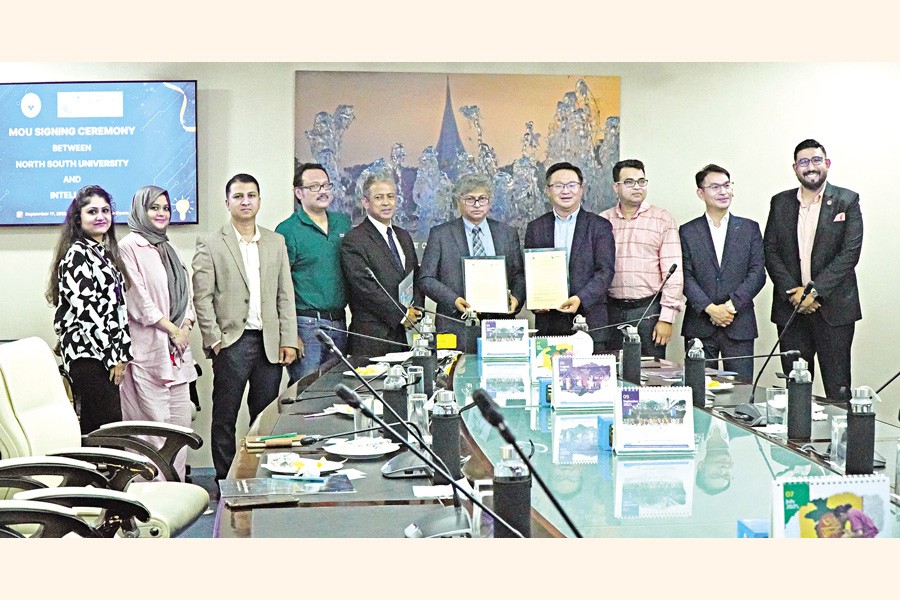
North South University has signed a five-year partnership with Guangzhou-based research institute Intellisia to establish a specialised centre focusing on China-Bangladesh economic cooperation, addressing growing demand for systematic analysis of bilateral trade and investment opportunities.
The memorandum of understanding, signed recently, creates the Center for Chinese Economy, Innovation and Cooperation at NSU with combined funding of US$ 100,000 over five years. Intellisia will contribute US$ 50,000 in ten semi-annual instalments, whilst NSU will provide matching support through facilities, faculty expertise, and operational resources.
The partnership comes as Bangladesh's economic relationship with China has deepened significantly, with China now serving as the country's largest trading partner in goods and a major source of development financing. Despite this growing economic interdependence, systematic research on bilateral cooperation mechanisms has remained limited.
Professor Abdul Hannan Chowdhury, NSU vice-chancellor, and Professor Dingding Chen, Intellisia's CEO and vice dean of the BRI and GBA Institute, formalised the agreement during a ceremony at the university campus in Dhaka.
The new centre will produce intelligence reports and policy analysis targeting businesses, investors, and government agencies involved in China-Bangladesh economic relations. Research priorities include sustainable trade mechanisms, technology transfer processes, and policy frameworks supporting bilateral investment flows.
"This collaboration addresses a critical gap in understanding how Bangladesh can optimise its economic partnership with China," said a university spokesperson. The centre will operate under oversight from a joint steering committee comprising representatives from both institutions.
Beyond research output, the partnership creates opportunities for academic exchanges and joint projects between Bangladeshi and Chinese researchers. NSU students will gain access to specialised training in Chinese economic analysis, whilst faculty members will collaborate on policy-focused research with Intellisia experts.
The initiative positions Dhaka as a regional hub for China-focused economic research, complementing the government's efforts to diversify trade relationships and attract foreign investment. Research outputs will include policy briefs for government agencies, market intelligence reports for businesses, and academic publications.
Intellisia brings expertise in Belt and Road Initiative analysis and Greater Bay Area development studies to the partnership. The institute has previously worked with academic institutions and policy organisations across Asia on economic cooperation research.
For NSU, the partnership represents part of a broader strategy to establish specialised research centres addressing regional economic challenges. The university has previously launched initiatives focusing on South Asian integration and sustainable development.
The centre's work is expected to inform government policy decisions on trade facilitation, support private sector investment strategies in the Chinese market, and contribute to academic understanding of South-South cooperation models.
Operations will commence in October 2025, with initial research projects examining trade facilitation mechanisms and sustainable business practice adoption. The centre plans to publish quarterly intelligence reports and host annual conferences bringing together researchers, policymakers, and business leaders from both countries.
The partnership reflects broader trends in Bangladesh's academic sector, where universities are increasingly establishing international collaborations to strengthen research capacity and provide students with global perspectives on economic development challenges.
China's growing economic presence in Bangladesh, through both trade and investment in infrastructure projects, has created demand for deeper analysis of bilateral economic dynamics. The new centre aims to meet this need through rigorous, data-driven research that can guide decision-making in both public and private sectors.
outreachfe@gmail.com