
Obama-Modi: chai pe charcha
Muhammad Zamir | Monday, 9 February 2015
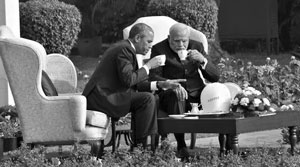
Sipping tea in the garden of Hyderabad House in New Delhi, Obama and Modi resolved some outstanding issues that had affected bilateral relations between the USA and India.
Obama's unprecedented second visit to India helped to reduce mistrust and facilitated rapprochement at least on paper. It reflected symbolic resurgence in political will to move together towards a constructive engagement. It was also historic as Obama was the first US president to attend India's Republic Day parade as chief guest. It was symbolical and demonstrated that the US-India relationship is picking up speed after several years of inertia. It indicated that this relationship is being built on something more solid than the sand of shifting world events.
As observed by Indian columnist Ajai Shukla "the trip essentially meant that the post-Cold War situation has been re-ordered and crystallised, and given the emerging rivalry between America and China, the US has decided that India is a crucial swing state that needs to be cultivated as a close security and economic partner and as a representative of US interests in South Asia".
It is understood that the two leaders discussed not only bilateral issues but also the prospects for Afghanistan's unity government and US troop level there; the increasingly confident administration of Chinese President Xi Jinping and the future of the US' so-called "rebalancing" towards Asia; and the progress of the military coalition fighting ISIL in Iraq and Syria, which affects India's energy security and counterterrorism.
The Obama visit from January 25-27, 2015 assumed significance because of the growing curve in the bilateral engagement between these two countries: (i) US-India bilateral trade has expanded from $19 billion in 2000 to $ 95 billion in 2013, with US goods exports to India totalling $33 billion, supporting an estimated 168,000 jobs; (ii) cumulative Indian investment in the USA totalled US $ 9.0 billion in 2012, supporting 100,000 jobs; (iii) more than 850,000 Indians visited the USA in 2013 and more than one million Americans visited India (the largest group of international tourists to visit India), and (iv) approximately 100,000 Indian students, the second largest group of foreign students, studied in the USA during the 2012-13 academic year, contributing more than $3.0 billion to the US economy.
Consequently, the Joint Statement, issued during the visit, stated that their multifaceted partnership was rooted in shared values of democracy and aimed at advancing mutual prosperity, a clean and healthy environment, greater economic cooperation, regional peace, security and stability in the Asia-Pacific and Indian Ocean region. It recalled the significant steps taken since September 2014 by the Modi government in consultation with the relevant US authorities in the following areas:
(a) Pursuing of strategic and expanded bilateral defence cooperation. In earlier times Russia accounted for three-quarters of all Indian arms imports and the US a paltry seven per cent. The scenario changed after 2011. In 2013, in fact, the US became India's largest arms supplier, surpassing Russia, France, and Israel. The present US lead is likely to grow with sales of key aircraft and helicopters. The real question, however, is whether both sides can go further - even developing new technologies and weapons together. The media reported that US Undersecretary of Defence for acquisition, technology, and logistics, Frank Kendall has already offered to work with India in making a new generation of the Javelin anti-tank weapons, naval guns, unmanned systems, mine-scattering vehicles, and helicopters.
India has however responded cautiously. Nevertheless, defence analysts think that there is likely to be agreements to build the RQ-11 "Raven" surveillance drone, and roll-on/roll-off modules for the C-130 transport aircraft in India. It can only be termed as ironic that only a few decades ago, the US was sailing aircraft carriers into the Indian Ocean to intimidate India, a Soviet ally. Today, it is considering helping India to develop its own carriers and grow its firepower. The transformation is nothing short of remarkable; b) Resolving commercial impediments in the markets of both countries to promote investment and manufacturing; (c) Promoting enhanced market access and financing to increase US industry participation in the growth and development of Indian infrastructure; (d) Facilitating capital market development conducive to financing investment; (e) Furthering the implementation of the Digital India programme through bilateral commercial ICT cooperation; (f) Sharing of expertise and best practices that may encourage greater trade, technology, manufacturing and investment linkages as envisaged through the Post-Bali Work Programme in the spirit of the Doha mandate; (g) Collaborating towards skill development and human capacity building; (h) Undertaking further research associated with challenges being faced in the health sector through the emergence of Ebola; (i) Deepening cooperation in the field of maritime security through more intensive maritime cooperation, and (j) Ensuring greater cooperation between respective law-enforcement agencies, particularly in the areas of extradition and in the countering of trans-national crime, terrorist financing and eliminating terrorist safe havens and infrastructure.
It would be fitting to note here that in addition to stressing on India embracing cleaner fuels to fight climate change, Obama took the opportunity to remind Modi of the responsibility of the government and of every person with regard to religious tolerance and safeguarding of women's safety and dignity.
In the area of foreign policy, the US-India Joint Strategic Vision for the Asia-Pacific and Indian Ocean region indicated their support for regional economic integration between South, Southeast and Central Asia by accelerating promotion of infrastructural connectivity and economic development. The importance of safeguarding maritime security and ensuring freedom of navigation and overflight throughout the region, especially in the sensitive South China Sea area, was also underscored. In this regard both parties reiterated the need to avoid the threat or use of force and to pursue resolution of territorial and maritime disputes through peaceful means. This last aspect, quite obviously was meant for Japan, South Korea, Taiwan, the Philippines and Vietnam.
The two sides also sprang a surprise with the revelation that Obama had reaffirmed his support for a reformed UN Security Council with India as a permanent member. This promise will have its own connotations for Japan and Pakistan, both serious contenders for such a position from Asia.
It would be appropriate at this point to refer to the implications related to the US-India nuclear deal arrived at during this visit. It may be recalled that India has not signed the Non-Proliferation Treaty (NPT) and exploded its first nuclear weapon in 1974. This led the USA stopping supply of nuclear materials to India in 1978.
However, in 2008, the US signed a historic deal with India to resume supply of nuclear technology and materials. This agreement remained inoperative for more than six years because of US insistence on tracking of nuclear materials and the liability of suppliers in the event of a nuclear accident. This log-jam has now been cleared during this visit. It has now been decided that the USA will not track nuclear materials in India. Instead the International Atomic Energy Agency (IAEA) will supply safeguards to all of its civilian nuclear installations. Another difficulty regarding accountability related to nuclear accidents was also resolved satisfactorily. Under the new deal, the USA has agreed to provide insurance coverage for nuclear damages to the US suppliers of nuclear power plants to India. Both have been vital steps for future commercial cooperation in this field between the two countries.
This tilt towards the USA by India has, as expected, come under close scrutiny by China, Pakistan and Russia.
Chinese views were reflected in the sceptical analysis carried out by Xinhua, their state-run news agency, which suggested that Obama's efforts were far too broad ranging and more of a public relations exercise required by the Obama Administration to woo supporters within the Democratic Party ahead of the 2016 US Presidential election. To counter Chinese anxiety, Modi has taken the initiative of sending Indian Foreign Minister Sushma Swaraj to Beijing. She has tried to explain the nuances to the Chinese leadership. Modi will also be visiting China in May. The Indian Foreign Minister is expected to visit Moscow later on. It is being hoped that these steps will reduce disquiet in these two capitals.
In the case of Pakistan, the Indian High Commissioner was summoned for urgent consultation by the Pakistan Prime Minister to explain the strategic implications of the US-India nuclear deal for South Asia. The US State Department is also understood to have briefed the Pakistan authorities about the denotations of the Obama visit.
It is clear that Modi and Swaraj's diplomatic skill on the high wire will be tested to the limit.
India under Modi is very clearly trying to adjust with the idea of being a friend of the West in this unipolar world. He is doing so to further India's economic ambitions of 'Make in India' and create a better environment and trust required for more foreign investment. It will not be an easy task.
There are still many barriers, including the question of retrospective taxation (the Vodafone case) and other regulatory regimes. Hopefully, these will be ironed out so that business-inclined Modi can move India up the ladder of the World Bank's "Ease of Doing Business" ranking. It may be mentioned that India last year was 142 out of 189 countries ranking.
Developments within the India-U.S. paradigm will be monitored very carefully for the next two years. It will involve facilitating difficult steps and broad-ranging coordination. It will not be an easy exercise for India's new Foreign Secretary S. Jaishankar.
The writer, a former Ambassador, is an analyst specialised in foreign affairs, right to information and good governance.
mzamir@dhaka.net