
Obama\'s parting shot at Netanyahu
M. Serajul Islam | Wednesday, 28 December 2016
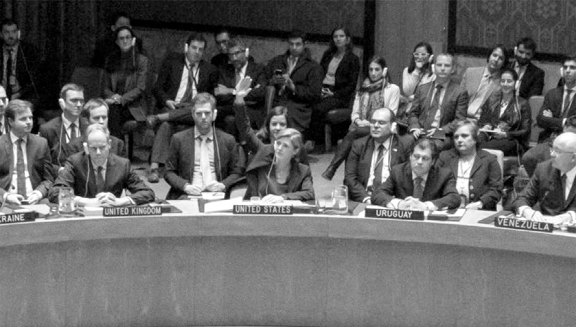
The UN Security Council adopted a historic resolution last Friday, December 23. It was on the illegal Israeli settlements on occupied Palestine territories during the 1967 Arab-Israeli War. The UN Security Council passed the resolution that was drafted by Egypt with the 14 members supporting it and the United States abstaining that allowed the resolution to be adopted.
In the past, since the Israel-Palestine conflict became full-blown following the 1967 war, the United States had used its powers as a permanent member of the Security Council to ensure that no resolution was ever passed in the Security Council against any issue of interest to Israel. Whenever such a possibility arose, the United States used its veto power to protect the interests of Israel fully at the expense of sacrificing the legitimate interests of the Palestinians.
The construction of settlements on Palestinian lands that Israel occupied following the 1967 war is unequivocally and explicitly illegal under international law. In fact, in the various laws in international affairs relating to the conduct of relations between states, even the expression of intent of a country to do what Israel has done on occupied Palestinian land let alone execute it, is totally and completely unacceptable.
It has been possible for Israel to continue the illegal acts of construction of settlements on occupied Palestinian land by giving a damn to international law and the rest of the world as the US exercises veto power in its favour at the UN Security Council that has the power of adjudicating on such illegal acts and recommend remedial measures. The Israelis have so far constructed settlements in the West Bank to settle 430,000 Israeli citizens. In addition, 200,000 more Israeli citizens now live in East Jerusalem as settlers that the Palestinians want to be the capital of their state when it becomes a reality.
The Security Council resolution and more importantly, the US abstention that allowed it to be adopted are therefore extremely important. The resolution states unequivocally that the settlements that Israel established in the occupied Palestinian territories have "no legal validity and constitute a flagrant violation of international law". The resolution thus demands that Israel "immediately and completely cease all settlement activities in the occupied Palestinian territory, including East Jerusalem."
The Palestinians and the Arab world welcomed the dramatic resolution with great enthusiasm. Saeb Erakat, the Chief Palestinian negotiator, said that the resolution "was a victory for the justice of the Palestinian cause." He added that as President, Donald Trump would be required to choose between "international legitimacy" and "settlers and extremists."
It will be much more that the new US President would be required to deal with. Donald Trump had started his presidential campaign with views on Israel that had concerned the Israelis. Later he changed towards Israel disparagingly calling the Palestinians as captives in the hands of the militants. Thus before the resolution was adopted last Friday, he had strongly urged President Obama to ensure the US veto to defeat the resolution aware that the support of Israel would be necessary for his administration. Israel had expected that President Obama would keep the President-elect's request.
Thus when it did not happen, Prime Minister Netanyahu was furious and called the US abstention as "betrayal." He took a few steps immediately. First, he stopped Israel's contribution to five UN bodies; second, he recalled Israel's Ambassadors to New Zealand and Senegal as the two countries had voted for the resolution. He also threatened that Israel would consider seriously leaving the UN.
The UN resolution also took the Democrats by surprise as they did expect President Obama would ask the US delegation at the UN to veto the resolution. The Republicans, too aware about the power of the Israeli lobby in the US, are upset and angry over the adoption of the resolution.
After the resolution was adopted, President-elect Donald Trump tweeted that it would "make it much harder to negotiate peace". In a separate tweet, he stated that the resolution was "too bad but we will get it done anyway." He did not elaborate leaving it unclear what he would do as the President to undo any damage that the resolution could cause to Israel. Notwithstanding the fact that Donald Trump had changed his position on Israel from a desire to be "very neutral" to a decidedly pro-Israel one by accusing the Palestinians to be in the hands of the militants during the campaign, there are people that he has taken in his administration who have serious and well-established anti-Semitic views. However, the US Ambassador to Israel chosen by Donald Trump is a known pro-Israeli who supports the settlements.
What role these people would play in international politics, in particular in the context of US foreign policy in the Middle East, is yet to be seen. Nevertheless, for the first time, the Israelis would be talking with a new administration in Washington that would have people close to the President who would not be as forthcoming in supporting the Israeli causes vis-a-vis the Palestinians in the United Nations as both the Democratic and Republican administrations have done thus far. It is true that President Obama has had an "icy" relationship with Prime Minister Netanyahu but until this final act on his part in instructing the UN delegation at the United Nations to abstain on the resolution at the Security Council, he had not lifted even a finger to help Palestine in their just struggle, unwilling to upset and annoy the Israelis because of the power of the Jewish lobby.
The Israeli Prime Minister had insulted President Obama to the extent that on a visit to Washington to address the Joint Session of the US Congress in March 2015, he had arrogantly declined to meet him. Even such an arrogant act on his part had not motivated President Obama to do anything against Israel.
Although the developments following the adoption of the UNSC resolution on Israeli settlements are still in a flux, it would nevertheless weaken an already weak and illegal Israeli position on the settlements even further. President Obama may have taken the decision to place Israel Prime Minister in a difficult predicament as his payback for all the insults that the latter had hurled at him. He may have further been encouraged in his decision to set for the new President his first major test in international affairs and not one he would feel happy to deal with.
The writer is a former Ambassador.
serajul7@gmail.com