
Odd climate hits Aus farming
Rice output falls in two seasons
YASIR WARDAD | Sunday, 28 May 2023
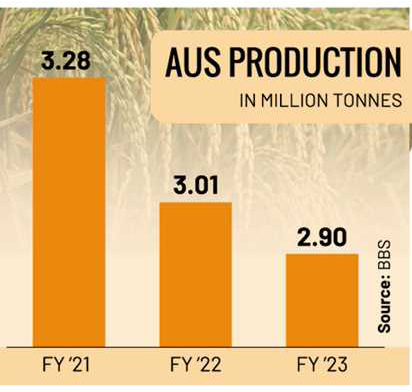
The decline in rice output in the Aus season has continued for the last two consecutive fiscal years and experts have attributed this fall to the changing climatic conditions of the country.
Production of the rice dropped further to 2.90 million tonnes in the outgoing fiscal year of 2022-23 (FY ’23) from 3.00 million tonnes in FY ’22. The production was 3.28 million tonnes in FY ’21.
The area under Aus farming also shrank to 1.01 million hectares in FY ’23 from 1.30 million hectares in FY ’21.
The gradual decline in rice production in a specific season is alarming for the country’s overall food security, opined value chain expert Prof Dr Jahangir Alam.
He said the production of rice in the Aman and Boro seasons is also not increasing at a desired rate.
The newly developed high-yielding as well as stress-tolerant rice varieties should be given to farmers to get expected growth in rice production, he observed.
Dr Alam said the decline in output of the grain could further raise the staple’s price, which already has hit a record high.
While explaining the reasons behind declining Aus production, agronomist Prof Dr Moshiur Rahman of Bangladesh Agricultural University (BAU) said the random drought in March-April adding to flooding in April to August and creeping salinity have come as a blow to the Aus crop.
He said Aus crop is now produced in few specific regions, which are vulnerable to odd weather events.
Both drought and flood have hit Aus crop in Sylhet and Mymensingh regions for the last few years, said Dr Rahman.
On the other hand, Rajshahi and Rangpur witnessed a severe drought in the last three consecutive years, he said. “Even the country witnessed above 66 per cent lower rain in April 2023 compared to that of normal raining.”
In addition, Khulna, Barishal and some parts of Chattogram divisions are struggling with salinity, he said.
Therefore, supplementary irrigation should be boosted by the state-run agencies in Rajshahi, Rangpur and Khulna regions to motivate the farmers in Aus farming, Dr Rahman observed.
As the new high-yielding varieties have almost replaced all old Aus varieties, farmer- and weather-friendly rice varieties should be introduced in the coastal belt, he added.
The government has a target to get 40 million tonnes of rice in FY ’23 – the target was 38.01 million tonnes in FY ’22.
Rice prices in the city retails, however, remained static at its previous highs as coarse rice was retailed at Tk 48-54 a kg, medium Tk 58-65 a kg and finer Tk 75-100 a kg on Saturday, according to the city groceries.
tonmoy.wardad@gmail.com