
Oil seepage to cause huge fiscal loss, hit biodiversity
Jubair Hasan and Yasir Wardad | Friday, 12 December 2014
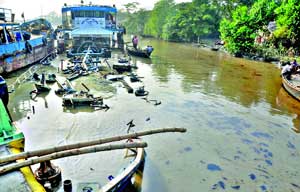
Seepage of oil from the sunken oil tanker in Shela River near Mrigamari in the Sundarbans spread to more than 60 kilometres on Thursday, posing a serious threat to biodiversity in the world's largest mangrove forest, officials and experts said.
Biodiversity experts have expressed their fear about a catastrophic impact on total ecosystem of the Sundarbans and its surrounding areas, as the spill of furnace oil will kill phytoplankton and zooplankton - the forest's primary food producers.
Besides the aquatic life, it will also make an adverse impact on trees, animals and reptiles there.
The vessel owner - Ms Harun & Co - with the help of four rescue vessels managed to salvage the tanker to Joymoni area on Thursday afternoon after nearly 55 hours of the incident, but leakage oil still continues to spread.
Earlier, the government on Wednesday banned plying of all kinds of vessels through the Shela River route of the Sundarbans until further notice. The decision was taken at an emergency inter-ministerial meeting, following the oil tanker capsize.
The oil tanker (OT), Southern Star-7, carrying eight crews sank near Mongla at around 5:00am on Tuesday, spilling oil on both sides of the river and the canals flowing through the Sundarbans, affecting at least 24,000 hectares of the world's largest mangrove forest, forest officials said.
The tanker with 350,000 litres of furnace oil went down after a cargo vessel hit it from behind. Of the tanker crews, Master Mokhlesur Rahman remains missing, while seven others swam ashore.
There were eight inter-connected tankers in OT Southern Star-7, of which six cracked, following the cargo vessel's hit. As the tankers were interconnected, most of the 357,000 litres of oil spilled out of the tanker into the river stretching over around 60 kilometres.
Talking to the FE, chief conservator (Khulna Circle) of Forest Department Kartik Chandra Sarker said the sunken tanker has been lifted up, but most of the furnace oil in it has already spread into the rivers and canals of the Sundarbans.
"Our primary estimates show that about 24,000 hectares of the Sundarban's East Division has been badly affected, and we estimated the damage caused to the Sunderban's biodiversity at over Tk 1.0 billion," he said.
The estimation was also mentioned in the general diary lodged with Mongla Police Station on Tuesday night.
He said the Ministry of Environment and Forest (MoEF) has formed a 9-member probe committee, led by its additional secretary Nurul Kabir, to calculate the loss to the biodiversity.
"The team will visit the area on Friday," he said, adding that the forest department never dealt with oil spills, and it has no technology to clean up or check the spread of spilled oil.
Divisional Forest Officer (Sundarbans East Zone) Amir Hossain Chowdhury said the Forest Department has always opposed plying of heavy vessels on this route, fearing major disasters like this.
He said several other government bodies have also recommended to ban plying vessels on the route.
In a desperate attempt, the department some time ago announced that no vessel would be allowed to ply these waters at night. They would have to anchor in a local jetty for night. That instruction has never been followed, the forest official also said.
"We've tried on several occasions to enforce the restriction. But people involved with transport business are very powerful. Such an accident was inevitable," he added.
Department of Shipping chief engineer Fakrul Islam said Kandari-10, a vessel with chemical dispersant machine, is on its way to reach the spot. But it will take more than two weeks to remove the oil from water.
Dispersants are chemicals that are sprayed on a surface oil slick to break down the oil into smaller droplets that more readily mix with water. Dispersants do not reduce the amount of oil entering environment, but push effects of the spill underwater, he informed.
Experts said spread of petroleum products in the Sundarban will directly affect the aquatic ecosystem - phytoplankton, zooplankton, dolphins, crocodiles, fisheries, crabs and kuchia.
They said the secondary effect will be visible over trees, mammals and reptiles of the mangrove, including Royal Bengal Tiger, deer and so on.
Biodiversity expert and ethno-biologist Pavel Partho said the alarming thing is that the spillage of petroleum products will kill phytoplankton and zooplankton.
"Destruction of the primary food producers of a food chain means gradual collapse of the total system."
He also pointed out that the mangrove trees take oxygen through their 'Pneumataphores'. The Pneumataphores are made of Xylem and Phloem tissues, but a layer of oil may close those tissues, which can bring dire consequences over the trees' physiological development.
Dolphin expert and Bangladesh Cetacean Diversity Project (BCDP) principal researcher Rubaiyat Mansur Mowgli said the area, where the incident took place, is a sanctuary of Ganges Dolphin (Shushuk), where Irrawaddy dolphin is also found when saline water increases.
"If the species come in contact with the oil, they will not take breathe and will ultimately die," he further said.
Professor Monirul H Khan, a tiger expert from Department of Zoology, Jahangirnagar University, told the FE that this seepage may pollute water of the internal canals surrounding the forest. Royal Bengal Tiger and deers might be forced to drink the water if it enters internal canals.
"If they do so, it will be very dangerous for the population of the rare species, as it could cerate diseases like gastro-internal disorder or kidney failure," said Prof Khan, who led the population of tigers in the Sundarbans survey (Bangladesh part) in 2006.
The experts also urged the government for taking immediate steps to stop plying of vessels in and around the Sundarbans area permanently to protect the biodiversity there.
UNB adds, Expressing concern over the oil tanker capsize, UNDP Bangladesh Country Director Pauline Tamesis on Thursday said this accident once again highlights the need for a complete ban on the movement of all commercial vessels through the Sundarbans.
"Global experience shows that this kind of incident has long-term environmental consequences, and it requires coordinated and multi-sectoral efforts to restore the affected areas," she said in a statement.
Pauline Tamesis said it may also affect the people dependent on the water-bodies in and around the forest.
"We're consulting with the government as well as national and international partners to explore ways we can help the government to minimise the damage and rehabilitate this globally significant natural heritage."
UNDP Bangladesh is concerned about the recent developments in the Sundarbans following the oil spill, she also said.
UNDP, however, appreciates the decision taken by the government to temporary shut down the Shale River route to all modes of vessels, as reported in the newspapers.
"This, I believe, will contribute positively to the restoration efforts," she added.
tonmoy.wardad@gmail.com, jubairfe1980@gmail.com