
Oil spill taking its toll on Sundarbans\\\' aquatic animals
Monday, 22 December 2014
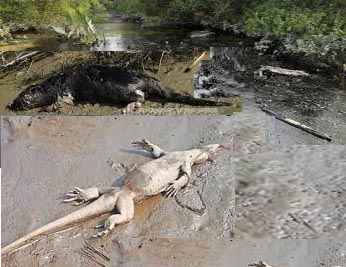
The oil spill in Shela River and its canals following the sinking of a tanker with a large quantity of fuel oil on December 9 have seriously threatened wildlife in Sundarbans. Environmentalists say the sinking of the oil-tanker in the world’s largest mangrove has made them deeply worried. The capsize of ‘OT Southern Star 7’ with 358,000 litres of furnace oil on Dec 9 started to take its toll on animals of Sundarbans about 10 days after the incident. Two otters have been found dead in the oil-infested waters of Shela River in Chandpai Range. Forest officials recovered the bodies floating near Andharmanik, 9 days after the tanker went down in the river. The Wildlife Management and Nature Preservation Division had been working to find the extent of the damage, official Md Jahidul Kabir said on Sunday. He said a team headed by Jahangirnagar University Zoology Professor Monirul H Khan went to Sundarbans on Dec 18. The dead otters, he said, were covered in furnace oil. They had died two to three days before their bodies were discovered. The otters are mentioned as ‘near threatened’ in the International Union for Conservation of Nature’s red list. Their populations are now limited to the Sundarbans, but they were once widely seen living in rivers of south and western regions of Bangladesh. Experts also acknowledged that the oil slick has seriously threatened the Irrawaddy dolphins in different rivers of the forest. The mangrove delta is home of this increasingly endangered species that is found in discontinuous subpopulations near sea coasts and in estuaries and rivers in parts of the Bay of Bengal and Southeast Asia. The Chandpai range in southern Sundarbans is where they are mostly found -- which is why the area along with two others in the Sundarbans was declared as Dolphin Reserve in 2011. ‘Due to the twice-daily cycle of tide and ebb in the Sundarbans, the oil has spread out dangerously in all directions from north and south. Photographs taken from the area after the disaster showed a north-south oil line. Then it would spread from east to west,’ said Rubaiyat Mansur of the Bangladesh Wildlife Conservation Society. ‘This is simply disastrous for Irrawaddy dolphins in the area.’ The Sundarbans is home to several species of dolphins -- Indo-Pacific hump-back dolphins, finless dolphins, Indo-Pacific bottle-nose dolphins, Spinner dolphins, Porpoise dolphins, spotted dolphins and Gangetic river dolphins. The Brides variety of whales are also found in the area. Dolphins are close to whales. Wildlife diversity specialist Pavel Partha fears a sharp drop of oxygen in the waters of Sundarbans due to the oil spill will harm all aquatic animals specially dolphins and crocodiles. ‘All aquatic animals especially dolphins and crocs will face a huge crisis. Wildlife Trust Bangladesh's Chief Executive Anwarul Islam fears the oil spill could endanger the entire eco-system of Sundarbans. I fear it will cause huge damage to the entire eco-system of the forest -- fish, deer, monkeys and aquatic plants will all be affected,’ he said. ‘As it is, the Sundarbans eco-system is fragile and this oil spill has started to cause huge damage. The impact will linger for long,’ the experts warned, according to a news agency.