
Old is gold: Its never-ending appeal
Shihab Sarkar | Friday, 6 March 2015
Dust gathers on objects even if they are kept within covers. As time passes, they perhaps emit an invisible glow. In spite of their being encased, and kept away from the wear and tear wrought by the elements, they become valuable. Some turn out to be precious, sacrosanct and timeless.
Whatever survives its similar types, and exists for a period of time beyond normal expectation, is invaluable. There is the saying: old is gold. Proverbs like this are an integral part of human civilisations. Adages survive through ages, are passed down from one era or generation to another, and finally attain the glory of immortality. The older a saying is the longer its chance of being in circulation.
The same principle applies to the persons as well -- who may have uttered these words at some point of time in the past. In the case of folklore, the proverbs play a dominant role. They echo the wisdom, inborn knowledge and the treasure of experience that belong to communities. Here, the individual becomes a part of collective selves.
Mundane objects follow the similar course. They may range from a tool, once used in day-to-day life, to the weapons wielded by warring communities to musical instruments from the bygone days. Reading materials retrieved from historical ruins occupy a major place here. These include writing mediums, manuscripts, books, and also the printing technology of a particular era. In fact, the list of inanimate objects becomes longer than ideas and observations.
However, the human mind remains at work when the value of an object witnesses increases through the passage of time. When it comes to historical or archaeological sites the point merits added focus. This is what has happened to the ruins of the past human achievements. We define them as civilisations.
Antiques are an integral part of life. To some, they may be the sources of aesthetic pleasure. At the homes of urban educated people, historical mementos are said to add to their sophistication and exclusiveness. Some would like to call them a fad, but a lot of people might nurture an unalloyed passion for rare antiques. Their true importance lies in the historical perspectives out of which they have emerged. It's due to this that we keep them in a gloried position.
Mankind has been demonstrating this trait, i.e. the admiration for things and lives old, since the initial phase of the modern era. Let's presume it to be the post-Industrial Revolution times. In the following centuries, man has discovered many previously unknown recesses of his psyche. One of them undoubtedly is the love for the ideas and things past. As time wore on, this passion kept getting intensified, with the fast-changing man discovering newer outlets for showing his penchant for delving deep into the past. This odyssey of the human mind continued unhindered until the 1980s. And then something terrible, an aversion for the past, or a monstrosity grown out of hatred for things from other times, had possessed a section of mankind. In the eastern part of the world, which had long been witness to the rise of the oldest civilisations and beliefs, historical relics were pulled down in frenzied glee. Dozens of centuries-honoured milestones in the eventful journey of mankind underwent bouts of destruction, and thus wiped out, in a short-lived orgy of triumphalism. A decade later, at another site not far from it, we witnessed the recurrence of the same barbarity. The place, the ancient city of Baghdad, and its museums, fell to the hands of virtually deranged people ostensibly celebrating the fall of a brutal and ambitious ruler. What had worked here was a sudden feat of jubilation, though irrational, laced with greed. The museum artifacts were priceless. They amply spoke of the magnificent history of the vast Mesopotamian region including Babylon. To speak symbolically and keeping the city's cultural richness in mind, the swoop on the historic city's museums could be compared with the brutal 'Sack of Baghdad' in 1401. It was carried out by the Turko-Mongol conqueror Tamerlane. On the other hand, the earlier bout of destruction in the Bamiyan province in Afghanistan was driven by an urge to accomplish religio-cultural cleansing. It was no military assault.
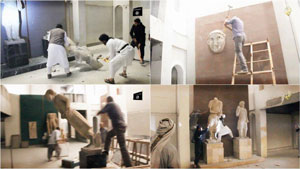
Once the bigotry-prompted rage for annihilating beliefs other than one's own overtakes a community, it is hard to come free of it. It eats away at the finer feelings of the persons involved in the act. The medieval Palestine and the late-medieval Europe too experienced similar atrocities as the regions had been swept by the rage of Crusade and the inquisition. Meanwhile, after the two dark episodes that unfolded in the south and middle-eastern Asia in the late 20th century, yet another is tearing places apart in the latter region. In the span of a few days, countless antiques bearing the history of the entire area have been destroyed. As part of a normal reflex, sensible people across the world shuddered as they watched the TV footage showing the sacrilege of mankind.
Humans in general are averse to everything old. They love the new and fresh in fellow humans, in objects and in ideas and experiences. However, extolling the virtues of old should not require one to turn away from new. True, embracing something new instills into people the vigour and spirit that help them live a full life. Yet a mad craze for new and the stupid dumping of everything old lead many to become veritable morons. But, then, in human history there are instances where man stood up against new ideas, and persecuted the proponents of new thoughts. They found it hard to come out of the clutches of traditionally orthodox thoughts ingrained in them. Socrates, Galileo and a lot of great people became victims of this human trait.
On another plain, newly-built and completely overhauled societies were welcomed by nations in different parts of the 20th century world. Thus socialism had spurred people to dream of new times free of the age-old curses of exploitation and deprivation. However, yet another dream sent out its root into the new societies at one point of time. The remodelled societies began feeling stifled with the omnipresent weight of the state, prompting them to demand freedom they had enjoyed in the earlier system. The behemoth-type state finally gave in to popular upsurges letting people grow in their individual, unfettered styles. Here the concept of new is made to coalesce into the universal mystique of old.
The love for old nurtured by many amid the pervasive paeans to new speaks of a distinct human feature; it sounds strange though. But it's a basic trait. Or else, people would not have gone miles to buy an old book, watch an old movie or collect an antique.
shihabskr@ymail.com