
One city: Two tales
Zeenat Khan | Thursday, 27 November 2014
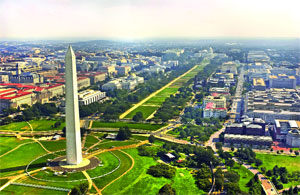
On October 25, while driving down the Embassy Row in NW Washington, D.C. on the car radio I was listening to president Barrack Obama's weekly address to the nation. In his speech he discussed the various measures that are going to be taken to respond to the Ebola cases here in the Stateside. He also gave an outline that contained detailed information about how to contain the epidemic in its source -- which is West Africa.
After the weekly address another news report followed where I learnt that after beating Ebola, a nurse named Nina Pham came to the White House to share a hug with the president.
It is a constant surprise to me how significant decisions are taken in this tiny beautiful city on the Potomac River. It is astounding how lives across the globe, in Liberia to Kandahar to Tokyo, in Beijing -- are transformed by these decisions.
Having lived in this city for five years in the late Nineties, and the D.C., Metro area for almost two decades, I have come to appreciate the roles played by Washington, D.C., folks from the president of the United States all the way down to the bureaucrats toiling in the city, and across the river at the Pentagon.
Unless you live in Washington, D.C., it is hard to believe what treasures are hidden away in the nooks and crannies of this city. Tourists from all over the world, and the USA, are pouring in throughout the year, to explore the city and its hidden treasures. To the city folks - this city is a place to work, to live, or go to school. Several prominent US universities and top notch hospitals are located within this city.
In NW Washington, D. C., with late night buzz there is a cosmopolitan feeling because of the presence of multinational, multi-lingual residents. The diversity undoubtedly gives NW D.C., a distinct international feel. People find commonality in their mixture.
About a month ago, sitting in a seafood restaurant in the city - I could hear people speaking in five different languages. I felt a unique sense of affinity as if we indeed are living in "one world," as members of one single community.
The nation's history breathes constantly in the buildings, monuments, museums, parks and the environment of Washington, D.C. At lunch time, if you take a walk down the Embassy Row where most of the foreign embassies are located - you see people from across the globe coming in and out. This sense of identifying as one with all of humanity is a feeling only exclusive to Washington, D.C. During my travel throughout the US, I never experienced this feeling in any other city.
In Washington the world comes together to represent their respective nations. The goal is to put forward the nations' point of view to the politicians and policy makers here. There is a sense of unity. Looking at the flags of each nation, one feels a certain sense of hope that the world can unite to solve its problems instead of dividing.
A few miles south of the Embassy Row, the historic Georgetown is a place of wonder and amazement, and is full of history. President John F Kennedy came up with his election strategy in a beautiful mansion in Georgetown. Some of the mansions here still harbour the moneyed elites, and famous diplomats, and politicians. Lavish parties are thrown here where the powerful and the wealthy socialites mingle under well-lit hand cut crystal chandeliers -over champagne and caviar.
In contrast, if you drive down a few miles Southeast or Southwest, you see a different face of this same city. This particular part can be a shock to anyone's system. People from the affluent parts of the town tend to avoid these parts because they don't want to face or admit that such disparity remains hidden in the heart of the US capital.
You find homeless people, drug dealers, prostitutes, and addicts looming in every street corner in the evening - trying to make a quick deal. Here the roads with innumerable potholes are not well paved. The street lights are often broken.
In the pitch dark alleys you will hear hush voices as the shadows of the night get prepared to take control of the streets. You will see the rundown shadowy houses with peeled off paints where perhaps a third generation is living. In such low-income households power companies often cut off utility services, and water supply for non-payment.
The night scene in this part of the nation's capital carries a sad testimony to poverty and despair. One can almost touch the hopelessness that makes the air heavy with sighs of anguish, and utter misery.
Will these people ever know what it feels to be full citizens in the new millennium? What have they done wrong to deserve such a fate while living in the capital of the richest country in the world?
For starters, they did not get a decent education to change their lives around. For generations they have been trapped in a social system that is very harsh, and do not know how to break the cycle and start anew. They hardly venture out of their own neighbourhoods to see if there are opportunities available for them, or for their children.
A lot of the mothers in single family households with multiple children depend on the government's Welfare check every month. That amount is nearly not enough to feed a family a well-balanced meal. Many children suffer from diseases and malnourishment. Some families also heavily rely on the weekly food stamps that are allocated for them. With those stamps one can only get basic supplies of staple food items.
A lot of the area schools feed the poorest children three meals a day, because of a new policy introduced since Obama became President. The poor families do not go to the shopping malls to buy new clothes for themselves, or for their children. They buy used clothes from thrift shops, or at the church yard sale, when they can afford it. Mostly they depend on hand me downs from other relatives, neighbours, and on the kindness of the strangers.
The children in these communities go to public schools where they learn very little. The schools often run on a very tight budget. Highly qualified college fresh graduates do not want to teach the challenged kids of Washington, D.C. They simply refuse to work in the schools in such areas because of lack of facilities.
In addition to that the dread of lack of adequate safety in these crime ridden areas discourages them to take a job in such schools. The students' test scores are way behind the average national score. High school dropout rate is high, and those who remain in school, struggle through to maintain a minimum score in their achievement tests.
Some of the schools do not have the right gymnasium equipment for the students to play sports. Frustrated high school kids join gangs because often they have no role models at home in the absence of a father figure. Some of their fathers are serving hard time in a federal penitentiary for crimes they perhaps had committed out of desperation.
There is no one to teach these kids the ways of the world.
In some families a mother often fall prey to horrible drug habits, and cannot take care of her children. Unable to cope with the responsibilities that come with parenthood -- usually the drug addict parents abandon the children. Then the department of Social Service places some of them with foster parents where they are often neglected and abused.
Some of the abandoned kids obtain illegal guns from the black market and become trigger happy. Is it any surprise that these kids turn to violence, and guns become their best friend?
No, not at all!
On the weekends instead of going to a movie with friends, or play sports the lost kids of Washington, D.C., roam the dark back streets to look for a target to rob at gun point. Sometimes they use violence for hijacking another kid's $375 pair of Kobe Bryant NIKE sneakers, or for the latest $229 trendy classic Patagonia retro winter jacket.
A lot of these kids are from minority communities. Some are first generation immigrants from all over the world. Their parents are not educated, and do not speak English, who are usually working multiple jobs to make ends meet.
In these parts of Washington, D.C., drug dealers often engage in shootouts even in broad daylight. Some high school kids at times bring guns to the school -- somehow bypassing the metal detectors, or by bribing the guards. At the end of the day such guns are sometimes used on a fellow student belonging to a different clique, or gang, or just to score a point.
Though the situation seems bleak -- all hope is not lost. Some of the city churches play a significant role in the lives of these families. There are many youth programmes, like Boys & Girls Club of America -- who offers an outlet to these confused and lost kids. After school they can come to such facilities, and use computers, or get private tutoring that are offered by the good Samaritans and volunteers.
More often than not the area churches also play the role of a surrogate parent in terms of feeding, clothing, and providing shelter for some of the very poor families of Washington, D.C. They make sure that during Christmas -- Santa Claus brings each child a new toy.
Volunteers and community organizers try to raise money to help the needy families. From private donation money they buy food, clothing and other basic necessities for the poorest people of Washington, D.C.
When I lived in D.C., my family and I went to the city soup kitchen one very other Saturdays, to make sandwiches to be distributed to the homeless shelters in the dismal parts of D.C.
Every November on Thanksgiving Day, we had volunteered in homeless shelters -- and saw poverty, and hunger up close as the homeless people had lined up to get a free warm meal. Volunteers on this day go the extra mile with their generosity.
Some of the homeless people might have gone without food for days at a time. There are flurries of Vietnam veterans who roam the streets of the city who are too weak, and sick to go and get assistance from the VA hospital which is not far away. Without food and shelter they walk around like zombies.
Come December on cold nights, hundreds of homeless people will freeze to stupor, and sometimes to death. They do sleep in cardboard boxes, under the overpass of a bridge, or in some cases, in the woods. Two years ago a group of homeless people, who had made makeshift homes deep in the woods, were evicted by the park police in the suburb of D.C.
As I write this article I wonder where these people are now. Perhaps some had found new places to sleep at night, or some might have died alone on a roadside.
How is it possible that such misery exists side by side with so much wealth, and extravagant lifestyle in gated communities of Georgetown, Kalorama, and Foxhall?
Let's not forget that the poor who live in Southeast D.C., under horrible conditions are part of the minority community without much education or means to support them.
Since Washington, D.C., is not a state; US Congress does not authorize funds for the city as it does for the other 50 states. Delegate Eleanor Holmes Norton and other advocates of D.C., statehood have been fighting for years to have recognition of D.C., as a state, all to no avail because of the obstinacy and guile of some Congressmen. It is indeed a shame, and needs to be addressed in a just and humane manner.
Despite all of the above, Washington, D.C., remains an attraction to millions every year. Visitors are happy with the guided tours of monuments, national museums, and just sight-seeing. The double-decker tour buses take them to the good parts of the city -- and only highlight its rich history and tradition.
The tourists pause to snap a picture under the busts of an FDR, or a Lincoln.
The only horror they may see is at the National Holocaust Museum on the 14th street, remaining totally oblivious of the fact that thousands are in utter desolation only a few miles south. Tomorrow will not bring a better day for those who are living there.
....................................................................................
Zeenat Khan is a freelance writer and a newspaper columnist. She lives in Maryland, USA. She can be reached at: zeenat.khan1983@gmail.com