
World Health Day
Our planet, our health
Samir Kumar Saha | Thursday, 7 April 2022
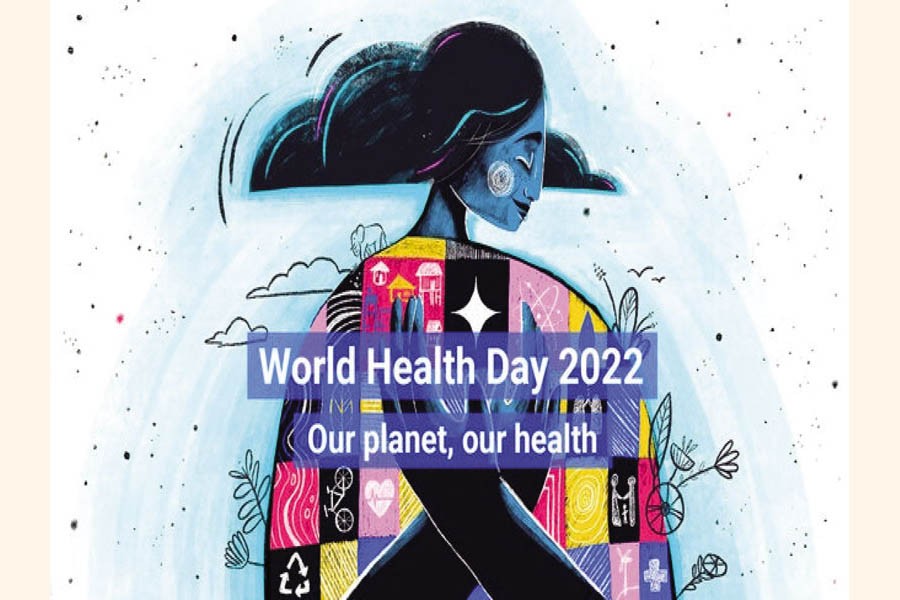
Since the introduction of the World Health Day, World Health Organisation (WHO) has been launching awareness campaign on health-related problems and urging for ensuring proper health care across the world. On the occasion of the World Health Day on April 7, different programmes are held at educational and medical institutions and other forums to highlight the significance of the day. The day reminds us of our duties to be careful to our health along with raising awareness on health issues.
The World Health Day is being observed since 1950, though it was decided to observe it on April 7, 1948, marking the first health conference of WHO.
The day provides us an opportunity to focus our attention to important public health issues. Our political, social and commercial decisions have influenced climate and health crisis. Extreme weather conditions, depletion of land and scarcity of water have displaced people from their habitats and seriously influenced their health. Over 90 per cent people inhale unhealthy air due to burning of fossil fuel. Diseases like cancer and cardiovascular disorders are spreading due to emission of greenhouse gas worldwide. Mosquitoes are spreading more diseases quickly than in the past. According to an estimate of WHO, over 13 million people die of problems caused by environmental pollution every year around the world.
Now time has come to take necessary steps regarding healthcare for the welfare of our present and future generations towards building a sustainable society without violating environmental rules. The main objective of health economics is to ensure required health care for people with tolerable expenditure from service seekers.
The WHO has drawn the attention of people around the globe for taking urgent steps for keeping our dear earth and people healthy. The theme for the day this year is 'Our Planet, Our Health'.
About 15 per cent of our country's people suffered financially and 64 lakh people are becoming poorer every year due to high medical expenditure. According to a report titled Building Awareness of Universal Health Coverage: Advancing the Agenda Forward, 2019, per head personal health-related expenditure is 69.3 per cent in Bangladesh, which is the highest in the South Asian region.
According to that information, inadequate spending, lack of control in government spending, poor allocation in budget, unequal distribution, unregulated private health sector, lack of interest in health insurance, reduction of funding by donor agencies and inadequate participation of private organisations are among the challenges in the country's health sector. According to research findings, about 60 per cent people get health related services from unregulated sector. Only about 14 per cent service comes from the government sector, while 26 per cent from the private sector.
Most of our people are from lower and lower-middle background. It is very tough for many of them to seek treatment for complex diseases by spending huge amount of money. However, one can avail of medicare facilities for complex diseases in traditional system of treatment known as 'Ayurveda-Yunani' at far lesser cost than the allopathic system of treatment. Ayurved and Naturapathy Association of Bangladesh (AYUNS) has been striving since the last one decade towards improving the traditional system of treatment. AYUNS attaches importance on carrying out intensive and large-scale research on the methods of treatment. At the moment, there is very little research which needs to be undretaken with all earnestness.
The need for research in general was emphasised by the Prime Minister Sheikh Hasina recently while addressing a programme at Osmani Memorial Auditorium in the capital.
Recently, a group of Bangladeshi scientists following intensive research succeeded in unearthing some unknown facts regarding diabetes. Dr. Madhu S Mallo, visiting professor of BIRDEM and former Assistant Professor of Harvard Medical School, USA, headed the research team. While publishing the research finding at a press conference at BIRDEM in Dhaka, the team hoped that their finding will help to a large extent in finding out measures aimed at checking diabetes and in its treatment.
If all concerned come forward and play their due role in conducting research on medical science, their research findings will help play a significant role in improving the condition of the country's health sector, including facing complex diseases.
Dr Samir Kumar Saha is former Executive Director of Public Health Foundation, Bangladesh. ayusamir@gmail.com