
Pahela Baishakh: Cultural links cut across the divide
Muhammad Zamir | Monday, 20 April 2015
Although delayed by a few days, 'Shuvo nabo barsho' to the readers as we step into Baishakh and the Bangla Year - 1422.
An important festival, it has become a cultural icon and assumed a special place in the hearts and minds of nearly 250 million Bangla-speaking people scattered all over the world. It has acquired special importance for everyone, especially the younger generation. Baishakh underlines for us every year that festivals tell us a lot about a nation - its history and tradition, religious beliefs and cultural patterns, ways of life and aesthetic development.
We live in a country with a long historical past. Our history goes back to over three millennia. This delta has been home over the centuries for people with different religious faiths. We have seen the Buddhist civilisation rise and being overtaken by the Hindu and subsequently, the Islamic faiths. The presence of the British Empire brought with it Christianity and a different set of values.
Nevertheless, despite the diversity and various ethnic origins, we have lived together in harmony and enjoyed certain cultural high-points and events endowed with universal appeal. Both sacred and secular festivals have inter-woven and created a rich tapestry that is now considered to be a widely acceptable meeting-point. Pahela Baishakh and the beginning of the Bangla New Year is just such an example.
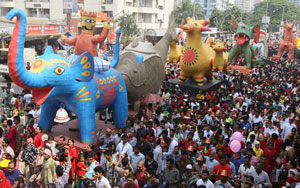
Due to evolving circumstances, the traditional focal point of the colourful Bangla New Year's Day has been Dhaka. It is probably so because it is the capital and better facilities exist here. Large numbers of people gather early in the morning under the banyan tree at Ramna Park. They welcome the New Year with Tagore's song 'Esho hey Baishakh, esho' (Come O Baishakh, come) and innovations like 'Panta bhaat and elish'. A similar welcoming ceremony is also held at the Institute of Fine Arts, University of Dhaka. Students and teachers of the Institute take out a colorful procession and parade round the campus, with some wearing giant papier-mâché masks, representing birds and animal faces. Newspapers bring out special supplements and the electronic media give special coverage to cultural functions.
All these are good. Such festivity should replicated at all administrative levels - all the way down to each police station. After all, this day has now become the symbol of Bangla resurgence.
Although this New Year in the Bangla calendar has been enumerated as 1422, the history of the Bangla New Year is not very old. Mughal Emperor Akbar started this calendar year on March 10, 1585, but it came into effect from March 16, 1586 - the day of his ascension to the throne. The introduction of this calendar was based on an earlier format that was modified to streamline the collection of agricultural taxes. Under the Mughals, such taxes were collected according to the Hijri calendar. However, as this was lunar in nature, it did not necessarily coincide with the fiscal. As a result, farmers were hard pressed to pay taxes out of season. This persuaded Emperor Akbar, a pragmatic person, to seek reforms. A renowned scholar and astronomer, Fatehullah Shirazi, was entrusted with the task of creating the new Bangla year. His efforts resulted in the juxtaposition of the Hijri calendar and the Bangla solar calendar. This New Year subsequently became known as 'Bangabda' or Bengali year.
Since Akbar's reign, it became customary to clear up all dues during the last day of Chaitra, the last month of the Bangla year. On the next day, or the first day of the New Year, landlords would entertain their tenants with traditional sweets. The occasion was also given an air of gaiety through the holding of fairs in villages along with other festivities. Dressed in new clothes, Bangalees exchanged visits and generally enjoyed themselves. In due course, over time, the occasion evolved, and became for all Bangla-speaking people, a part of their domestic and social life - marked with merriment.
The financial implications of Chaitra and Baishakh have now receded in the overall context of the State. However, even now, the main event of this, the first day of the Bangla Year, is associated with the opening of a 'Halkhata' or new book of accounts. This financial tradition has continued in our rural areas as well as in mufassil towns and in some of the Hindu-dominated older sections of urban areas e.g. Sankharipatti, Chawkbazar etc. in Dhaka. Jewelers specially follow this cultural practice. They invite the customers to share sweets on this day and renew their business relationship.
A secular cultural festival like Pahela Baishakh is a good least common denominator to bring forth greater understanding among communities. It is a good antidote against the spreading scourge of fundamentalism. The sociological aspects of this day also hold a significant place, particularly in the growth of neighbourhood-related activities. Cultural links cut across the divide.
The artistic and intellectual aspects of this day are also used for promoting economic activities and folk musical entertainment. This is achieved through performances of Jatra, Palagan, Kavigan, Jarigan, Gambhiragan, Gazirgan and Alkapgan. In addition, relevant authorities try to encourage greater attention towards our rich folk heritage by sponsoring competitions in urban areas where folk-singers compete in singing Baul, Marfati, Murshidi and Bhatiali songs. The selective process, through elimination, tries to identify eventual group winners at the national level.
This constructive engagement could be taken another step forward. There could be collective and competitive performances in the stadiums of important cities. That could then raise money for charity. Why not? CDs and DVDs of these performances could then be sent abroad for sale among the expatriate Bangla-speaking communities. We are talking here of a potential market of six million.
Economic activities could also include competitions in cooking, baking and preparing traditional pickles. Handicrafts, terracotta pieces, papier-mâché figures and toys prepared in villages could also be the focus of Baishakhi fairs.
The winners in these competitions could be accorded national recognition and later supported with loans on soft terms if they want venture capital for setting up their own businesses. Such economic activity will not only generate employment but will also provide gender empowerment. Micro-finance institutions need to consider this possibility with seriousness. Some of this is already taking place, but more needs to be done.
Many old festivals connected with Bangla New Year's day have all but disappeared in the past sixty years. New festivals have been added in their place. With the abolition of the Zamindari system, 'Punnya', connected with the closing of land revenue accounts has disappeared. Similarly, we hardly see kite-flying rivalries in neighborhoods, as was the custom in our childhood. The famous colourful bull racing carnivals has also, most sadly, all but disappeared in Munshiganj. Some other popular events like cockfights, pigeon racing and boat races still continue, but most rarely. They are no longer included in the fold of mass sporting activity. 'Bali' or wrestling is practiced in Chittagong and 'Gambhira' is still nurtured in Rajshahi, but fans of both are on the decline.
It is important that plans are urgently undertaken and implemented by the Ministries of Foreign Affairs, Education and Culture to foster, revive and eventually spread these festivals associated with the Bangla New Year. Funds must be found for this purpose.
In Bangladesh, celebration of this day began as a part of the cultural movement of the 1960s that adopted Bengali nationalism as its theme. It added a new dimension to the political movement. As such, it is important that we expand the emphasis of this festival to the grassroots level. We should also try to find a place for it in the international calendar of festivals, as has been done so successfully by Thailand for its own ethnic festivals. It can be used to promote tourism not only for non- Bangladeshis but also for expatriate Bangalees.
It is a popular event that needs to be nurtured. Handled carefully, it will also add to the image of Ekushey and the observance of the International Mother Language Day all over the world. The economic context also needs to be carefully coordinated and organised so that rural micro-entrepreneurs can participate gainfully in this branding process. That will then create a win-win situation.
The writer, a former Ambassador, is an analyst specialised in foreign affairs, right to information and good governance.
muhammadzamir0@gmail.com