
Pahela Baishakh: Harbinger of Bengali spirit
Rana Dutta | Tuesday, 14 April 2015
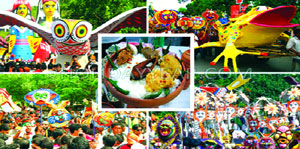
Festivals are universal to all societies. Some festivals are so deep-rooted in the collective life that they continue to amuse us from generation to generation. Pahela Baishakh is such kind of a Bengali festival that has enriched and embellished Bengali cultural heritage with its uniqueness.
The word "Pahela" in Bengali stands for "first" and "Baishakh" is the first month of Bengali calendar. Every year people of varied interest celebrate the day with great enthusiasm. Everything wears a festive look with the magic touch of Pahela Baishakh and also becomes an integral part of our culture epitomising the cultural traits and solidarity of the common people.
As Pahela Baishakh is our cultural heritage, it is very important to know about its unique history. It was then Mughal rule in the then Indian sub-continent. Under the Mughals, agricultural taxes were collected according to the Hijri calendar. But it is a lunar calendar and for that reason it does not match to the harvest. As a result, farmers were hard-pressed to pay taxes out of season. In order to make more efficient tax collection, the Mughal Emperor Akbar ordered to reform the calendar. Accordingly, Fatehullah Shirazi, a renowned scholar and astronomer, formulated the Bengali year on the basis of the Hijri lunar and the prevailing solar calendars. The new Fasli Sal (agricultural year) was introduced on 10/11 March, 1584, but was dated from Akbar's ascension to the throne in 1556. It subsequently came to be known as Bengali year.
Celebrations of Pahela Baishakh started from Akbar's reign. It was customary to clear up all dues on the last day of Choitro. On the next day, or the first day of the New Year, landlords would entertain their tenants with sweets. Since then Pahela Baishakh is observed as the Bengali New Year.
But more history is there behind the event that signifies the profundity of our cultural heritage. In an attempt to suppress Bengali culture, the Pakistani rulers banned songs by Rabindranath Tagore. This was protested by the people of the then East Pakistan, now Bangladesh. The cultural organisation, Chhayanaut opened their Pahela Baishakh celebration at the Ramna Park with Tagore's songs welcoming the new year in 1965. The day continued to be celebrated in then East Pakistan as a symbol of Bengali culture. After 1972 it became a national festival, a symbol of the Bangladesh nationalist movement and an integral part of the people's cultural heritage. Later, in the mid-1980s the Institute of Fine Arts added colour to the day by initiating the Baishakhi parade, which is much like a carnival parade.
Festival is an integral part of our culture. The day's most colourful event is the "Mongol Shovajatra", a peace rally, brought out by the students of Charukala Institute of Dhaka University, with a wish to sweep away all evils from society and to keep peace and happiness all the year round. The cultural-minded people also celebrate Pahela Baishakh by observing different social festivals with a keen interest.
Usually, people start celebrating Pahela Baishakh from early in the morning. They wake up very early and have their traditional Pahela Baishakh breakfast with fermented rice and fried Hilsa fish. Then they put on their special traditional Bengali attire. Men wear Payejama, Dhuti, Lungi and Panjabi. Young women wear white saris with red borders, and adorn themselves with tip, bangles and flowers, and then they pay visit to their dear and near ones. Various ceremonies are held throughout the country, especially in the capital Dhaka to welcome the New Year. Country's prominent and young talented singers and dancers from Chhayanaut and many other cultural organisations perform songs at Ramna Botomul.
As part of this, Baishakhi fairs are organised in many parts of the country. The lifestyle of rural Bengal is reflected in almost all these fairs. Various traditional handicrafts, toys, cosmetics, agricultural products as well as various kinds of food and sweets are sold in these fairs. The fairs also provide entertainment, with singers and dancers staging jatra (traditional plays), pala gan, kobigan, jarigan, gambhira gan and gazir gan. They perform folk songs, baul, marfati, murshidi and bhatiali songs. Narrative plays like Laila-Majnu, Yusuf-Zulekha and Radha-Krishna are also staged. Among other attractions of these fairs are puppet shows, merry-go-round and so on.
The tribal people also celebrate the day with their own thinking and belief. They believe that they will be able to pass the whole year in peace and prosperity if they can pass the day in joy and happiness. The 'Marma' community organises 'Panikhela' (water games) on that day to welcome the new year as well as to wipe out the grief and exhaustion of the earlier period.
Pahela Baishakh has played a unique role in the country's economy. Shopping malls and departmental stores offer attractive promotional activities, such as discounts that increase their sale volume as well their profit. Therefore, this event is becoming more and more important for retailers.
The celebration of 'Halkhata' (opening of new books of account) is a common tradition of businessmen. On this day, they offer sweets to their clients, get the opportunity to collect outstanding debts. Sending or receiving gifts, exchanging greetings to each other are also a common tradition that is promoted by the Bengali new year.
It is time to highlight Pahela Baishakh as representing the innate spirit of the people of this land, a spirit that is not just limited to festivities but one that encompasses the very existence of our people.
The writer is senior assistant secretary, BKMEA.
ranaduttabkmea@gmail.com