
Pakistan negotiates with the militant Taliban
Monday, 24 February 2014
Pakistan Prime Minister Nawaz Sharif surprised most political analysts and national security strategists when he decided in January to start a dialogue with the Pakistan Tehreek-e-Taliban (PTT). Nawaz Sharif explained that the current situation was unbearable and unacceptable and pointed out that terrorism had to be defeated either through talks or force. In this context, he also noted that he was giving peace a last chance. He also announced the formation of a four-member committee of non-parliamentarians to facilitate the process.
This prompted the PTT to take a rather unusual step. They invited the cricketer-turned-politician Imran Khan, leader of the Tehrik-e-Insaf Party (TIP), to be part of the Taliban team. This was probably done because TIP presently plays a significant role in the North-West Frontier Province and the adjoining tribal regions bordering Afghanistan. As analysts watched the evolving scenario, Imran and his colleagues hastened to keep out themselves from such an option. They did so to avert a possible debate about Imran's association with violence and fundamentalism that have been the stigma of the PTT.
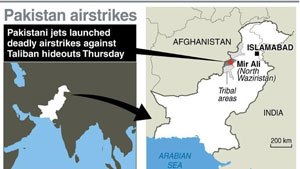
The decision to engage in discussion ended speculation that the government might opt for a large-scale military offensive against militants based in the north-western bordering districts of Pakistan. Such a move was being advocated after the first days of January this year witnessed the death of more than 100 people, most of them soldiers, in Taliban attacks on military and civilian targets across Pakistan.
The Taliban team which eventually participated in the discussion to fix the parameters of a possible dialogue included several hard-line religious leaders like Maulana Sami-ul-Haq, Abdul Aziz, Mufti Kifayatullah and Professor Ibrahim Khan. The team nominated by the Prime Minister included veteran journalists Rahimullah Yousufzai and Irfan Siddiqui, former Ambassador Rustam Shah Mohammad and retired Major Amir Shah, formerly of the Inter-Services Intelligence.
The composition of the two teams was however received with scepticism. Analysts who had been following earlier attempts to work out agreements between the government and the Taliban noted that the negotiating teams unfortunately had no real power. There were no members of the government or the Taliban central command in the negotiating groups; they were just representatives of the two sides. This was interpreted as the two sides only having the ability to chart out a 'roadmap' for further talks and not having the power to agree on any binding solution. It appears that this apprehension eventually
came true.
It would be pertinent at this juncture to understand the complexity of the PTT. With its roots in the Afghan Taliban movement, the PTT came to the fore in 2007 by unleashing a wave of violence in certain areas of Pakistan. Its leaders are traditionally based in Pakistan's tribal areas but it is really a loose affiliation of militant groups, some based in Punjab and some located in Karachi. These groups have different attitudes about carrying out any dialogue with the government. This has led to divisions within that movement. Collectively the various groups have been responsible for more than two thousand deaths over the last six years. Two of their past leaders - Baitullah Mehsud and Hakimullah Mehsud - as well as many of their senior commanders have been killed through drone strikes and in armed engagements. The equation has assumed greater difficulty because their present leader Maulana Faizullah, who has a reputation for ruthlessness and comes from outside the tribal belt, is known to be personally against dialogue.
This division within the Taliban component and their disparate nature cast its own shadow on the attempt to agree on a roadmap.
It is understood that the government representatives sought, as a first step, a ceasefire and respect for the present Constitution of Pakistan. The Taliban representatives demanded the release of the Taliban detainees. They also sought the withdrawal of the Pakistan army and paramilitaries from the tribal areas, including the Swat valley. They wanted security in the tribal areas taken out of the hands of the army and given to local security agents and administrative officials. Pakistan's intelligence authorities interpreted this as a move that was meant to eventually strengthen the control of militants belonging to the PTT. These could not be agreed to by the Pakistani Administration.
The Taliban side reiterated the need to impose Shariah (Islamic) law throughout Pakistan. This demand was countered by the Pakistan government representatives through the following arguments. It was pointed out by Sharif's representatives that the Objectives Resolution of 1948 was a substantive part of the Preamble of Pakistan's Constitution. Attention was also drawn to Article 2 (which mentions that Islam shall be the State religion), to Article 31 (which spells out in detail the expected Islamic way of life, including the promotion of the Arabic language), to sub-clause 2 of Article 41 (that specifies that only a Muslim is eligible to be a President), to sub-clause 3 of Article 91 that specifies that only a Muslim member of the National Assembly can be elected Prime Minister, to Article 203 which spells out in detail the status of the Federal Shariat Court, to Articles 227 through 231 which provide for all laws to be brought into conformity with the injunctions of Islam (as laid down in the Quran and the Sunnah) and also to the Blasphemy Law and the Hudood Ordinance.
It is understood that despite these explanations, the Talibans refused to drop their demand in this regard.
Past efforts in engaging with the Taliban in Pakistan has not been very encouraging. Previous peace deals entered with them have all failed. There have been three major sets of peace talks over the last decade. Military leaders reneged on agreements made in the Shakai peace accord after a less than effective military operation in Waziristan. The Sarorogha peace deal agreed with Baitullah Mehsud in 2005, aimed at reducing conflict between the army and Taliban factions, also failed, with confrontations increasing in the following months. The 2008 Swat agreement between the provincial government and militants was aimed at ending violence in the region but within days of the agreement violence increased and the Taliban effectively took control of the Swat valley. They had to be forcibly driven out through a military operation the next year.
The level of uncertainty in any negotiation between the two sides is being watched very carefully and with great interest by the US Administration. It has, for quite some time been urging the Pakistan government to launch a comprehensive operation in North Waziristan, targeting both the TTP and other groups such as the Haqqani network (which is pro-active in Taliban efforts to destabilise the regime in Afghanistan). Some US analysts have also gone to the extent of hoping that such peace talks as have taken place in February would fail and that this would then give the Pakistan government the excuse to start a strong military campaign against the Taliban militants. They believe that there would then be no opposition but unified public support for such a measure.
On the other side of the coin, there are also some strategists who believe that the Pakistani authorities are not very sincere in their efforts to come to an agreement with the Taliban. They think that the government is simply buying time and actually waiting for the withdrawal of the US forces from Afghanistan so that the militants on this side of the border in Pakistan could then spill over into Afghanistan. That would, according to them, destabilise Afghanistan and also impact on India's growing level of influence in that
country.
The crisis evoked from militancy in Pakistan is however not restricted to NWFP only and that continues to be a source of anxiety for the United States ahead of their disengagement from Afghanistan by the end of this year. Another province of Pakistan, Balochistan, neighbouring Afghanistan, is proving to be a headache for the Pakistani Administration. Recently Baloch separatists blew up three gas pipelines, cutting supplies to millions of households, located in Punjab. A spokesperson of these militants subsequently stated that the attack was in response to the discovery of dead bodies of Baloch activists in Balochistan.
In any case, Nawaz Sharif has a difficult task. His overtures have not received support of the Pakistan People's Party (PPP) and some sectarian sections in Karachi. That has created its own twist. One can only hope that the coming months will see more constructive engagement rather than violence. Continued instability in Pakistan is something, the rest of South Asia can do without.
Muhammad Zamir, a former Ambassador, is specialised in foreign affairs, right to information and good governance.
mzamir@dhaka.net