
Permanent system sought for fair, participatory polls
FE Report | Sunday, 2 February 2014
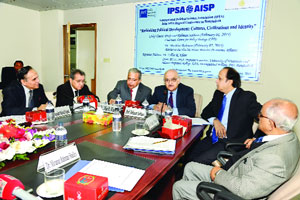
Political analysts at an international conference Saturday underscored the need for an immediate initiative for evolving a permanent system that would ensure fair and participatory national polls.
They also made some proposals that might help achieve the goals of good governance and better parliamentary process.
Noted economist Professor Rehman Sobhan speaking at the conference regretted that even 43 years after the independence, the country was forced to rethink an appropriate format for overseeing elections reconciling constitutional provisions with historical experience.
"Any such rethinking will also have to take cognisance of our practice of caretaker governance and the various ways in which our fertile political minds can misuse the system for political gain.
"Our melancholy experience from the 1960s up to the end of 1990 inspired the quest for elections supervised by a non-partisan caretaker regime which, by definition, was unelected. By chance, coincidence or perhaps design, four such elections held in 1991, 1996, 2001 and 2008 under a non-partisan caretaker government resulted in the incumbent regime being displaced by a party previously in opposition," he said.
The Policy Research Institute (PRI) and the Bangladesh Enterprise Institute (BEI) jointly hosted the two-day International Political Science Association (IPSA) regional conference in Bangladesh at the PRI head office in the city.
The chair of the IPSA research committee on 'Rethinking Political Development' Dr Zillur R. Khan presented the keynote paper at the conference. Political analysts from Bangladesh, India, Qatar, and the USA participated.
Mr Sobhan, also the chairman of the Centre for Policy Dialogue (CPD), said a government 'by the people' through a system of free and fair elections does not ensure that the elected government will be made up 'of the people'.
"We have much research evidence that our parliaments are increasingly dominated by business people who buy their way into the legislature or use their tenure in parliament to transform themselves into business persons," he added.
He went on: "We need to rethink the implications of constructing a democratic society where our principal political parties remain undemocratic in their representation, leadership and practices."
Regarding the emergence of violence as an instrument of political expression, Mr Sobhan said: "We need to learn not just from regional experience but from the experiences around the world as to whether such violence can be averted through a more inclusive political process or has to be fought to a bloody end."
In his keynote presentation, Dr Zillur R Khan gave some suggestions for practising of real democracy.
He said for institutional checks and balances in power, the parliament should have two houses, with one checking any excesses of the other.
"If so, tenure of a parliament should be reduced, say to four years for members of the Upper House and two for the Lower House. The general elections will take place every two years instead of five in which the Upper House members will be elected every two years along with all members of the Lower House," he suggested.
Regarding the size of representation in parliament, Mr Khan said considering the size of the population, seventh largest in the world, Bangladesh should increase the size of representation, say 500 in the Lower House (Assembly) and 100 in the Upper House.
Considering deep mistrust between the two largest political parties, the next general election should be conducted under an elected interim government, he said. Such a government is to be composed of elected leaders from two largest parties with their top leaders serving as co-chairs.
Mr Khan said: "The Anti-Corruption Commission should be given special powers to uncover corruption at different societal levels and incarcerate suspects for interrogation for a stipulated time without due process."
To ensure unobstructed communication between public and private sectors, he said partnership between the two should be instituted with representatives of government, non-government and business organisations at different levels.
About trial of war criminals, Mr Khan said those who worked against the freedom struggle and public interest must be held accountable and appropriate punishment meted out through due process of law.
Former UN chief mission in Kosovo Ambassador Rashed Ahmed spoke at the opening session with President of the BEI Ambassador Farooq Sobhan in the chair.
Senior Transatlantic Fellow of German Marshall Fund, Washington DC Hassan Mneimneh presented a paper on 'Schisms in Christianity and Islam in Comparative Perspectives: Impact on Political Development', visiting professor at Georgetown University from the School of Foreign Service, Qatar Mark Farha on 'The Arab Variant of Democracy: Islam and Secularism', and former vice-chancellor of Kumaun University of India professor CP Barthwal on 'Secularism and Political Development in India'. Dhaka University professors Dr Ataur Rahman, Dr Ameena Mohsin and Centre for Development Research and Cooperation (DRC-Global) official Dr Tazeen Murshid spoke at the session with PRI vice-chairman Dr Sadiq Ahmed moderating.
Chairman of Centre for Development Research, Bangladesh (CDRB) Dr Mizanur Rahman Shelley and Dr Meghna Guhathakurta moderated the second session of the conference.