
PKB faces hurdles in rehab loans due to data gap
ARAFAT ARA | Tuesday, 12 September 2023
Probashi Kallyan Bank (PKB) is facing hurdles in finding the right beneficiaries for rehabilitation loans, which is one of the key schemes of the bank, due to a lack of a database of returnee migrant workers, officials said.
They said that due to a lack of data on returnee migrant workers, they faced problems in finding the right candidates. It is difficult to understand what kind of funds a worker needs and whether they can utilise it or not.
The statistics available with the state-owned specialised bank for non-resident Bangladeshis showed that 6,535 returnee workers received rehabilitation loans of Tk 1.81 billion for income-generating activities since the inception of the specialised bank in 2011.
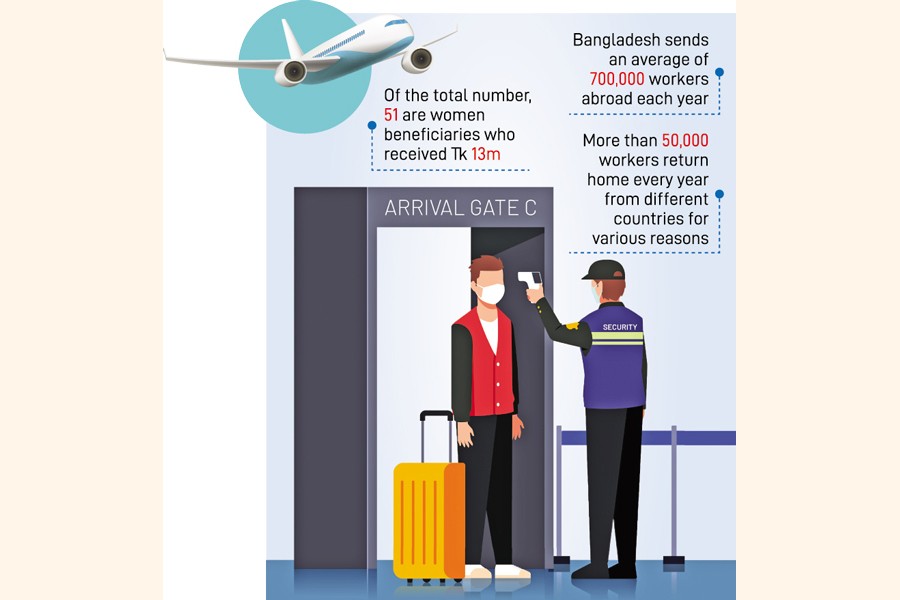
Of the total number, 51 are women beneficiaries who received Tk 13 million.
The bank was established with the aim of providing collateral-free loans for migration and rehabilitation, specifically for income-generating activities for migrant workers.
Although the government maintains a databank of outbound workers, there is no data on how many workers are returning home. For this reason, there is no information available regarding the experiences they have gathered from their workplaces abroad.
Bangladesh sends an average of 700,000 workers abroad each year. However, migrant rights activists assert that more than 50,000 workers return home every year from different countries for various reasons, including unemployment, job losses and workplace harassment.
Bank officials said the workers who receive rehabilitation loans often lack experience in managing business projects, where they are investing funds for income-generating activities.
As a result, many of them struggle, ultimately failing to generate income from the business and being unable to meet instalment payments.
The recovery rate of rehabilitation loans is not satisfactory, standing at about 40 per cent annually. Probashi Kallyan Bank has managed to recover Tk 539.9 million from rehabilitation loans as of August in this financial year.
Many times, workers are forced to return home after losing their jobs due to various reasons, including political unrest, workplace harassment and fraud. These circumstances often lead these workers into economic crises.
The bank's rehabilitation loan scheme is designed to create employment opportunities for these workers.
The upper ceiling of the fund is Tk 5.0 million and the lower is Tk 0.3 million, while its interest rate is 9.0 per cent.
The collateral-free limit is 0.3 million and the co-collateral limit ranges from above Tk 0.3 million to 0.5 million.
If the amount exceeds Tk 0.5 million, the immovable property owned by the borrower or the guarantor should be mortgaged against the loan.
Md Mazibur Rahman, managing director of Probashi Kallyan Bank, said their loan disbursement has increased overall compared to before.
"The number of beneficiaries and the amount of rehabilitation loans have increased in the last two financial years as compared to previous years. Hopefully, it will continue to rise in the coming days," he added.
"However, due to a lack of a database of returnee workers, we are having trouble reaching the right clients," noted the top banker.
He said a comprehensive databank of returning workers would make it easier to understand who has what kind of experience and loans could be tailored accordingly.
For example, if someone has been working abroad as a car driver, the bank can provide him with a loan for a car, which can boost his income.
However, most of the workers who come to take a loan do not have a good understanding of the business they are applying for a loan. As a result, the business does not perform well, Mazibur Rahman said.
Addressing the shortage of manpower, he acknowledged it as a significant challenge for the bank. He, however, said some manpower has been recruited and efforts are underway to hire more.
Jasiya Khatoon, Director of WARBE Development Foundation, highlighted that unsuccessful workers returning home from abroad are often in dire straits. Additionally, many people accumulate debt to cover migration costs. In such circumstances, it becomes difficult for them to meet the conditions set by PKB, particularly in providing documents like trade licenses and property-related papers.
Jasiya Khatoon, director of the Welfare Association for the Rights of Bangladeshi Emigrants (WARBE) Development Foundation, highlighted that unsuccessful workers returning home from abroad are often in dire straits.
Besides, many people accumulate debt to cover migration costs. In such circumstances, it becomes difficult for them to meet the conditions set by Probashi Kallyan Bank, particularly in providing documents like trade licences and property-related papers. She believes every branch of the bank should have a cell dedicated to loan counselling services.
Jasiya Khatoon also called for a comprehensive central database, which would facilitate the rehabilitation loan packages.
arafataradhaka@gmail.com