
PM pledges 'peaceful Bangladesh' for people of all faiths
Monthly allowances launched for religious instt leaders
Sunday, 15 March 2026
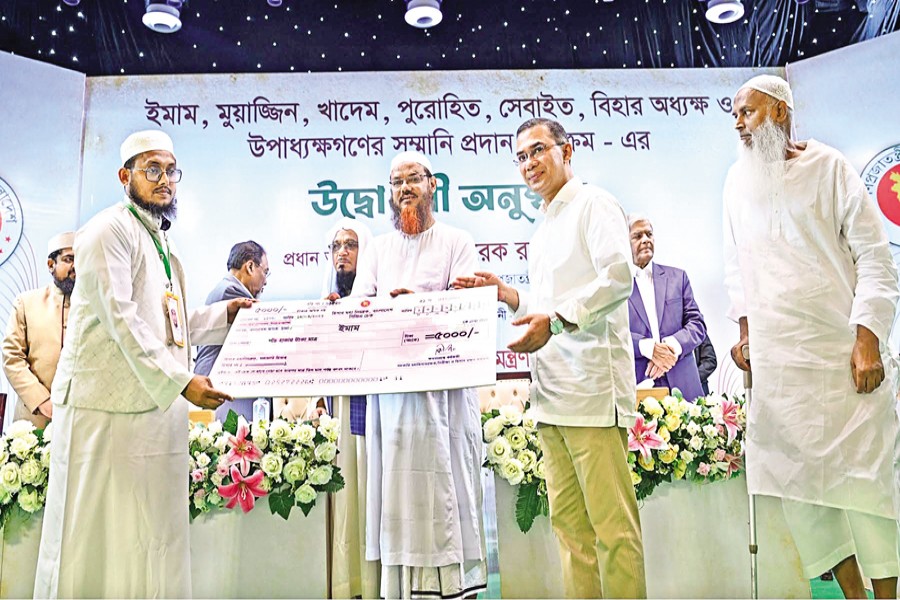
Prime Minister Tarique Rahman has underscored his commitment to building a "peaceful Bangladesh" with people of all religions, urging citizens not to let anyone sow divisions among them, reports bdnews24.com.
"Today, people of all faiths are sitting together, in the same row. This is part of Bangladesh's age-old tradition. No one should be allowed to create divisions among us," he said at an event on Saturday.
"Muslims, Hindus, Buddhists and Christians -- together, we will build a peaceful Bangladesh. We will build a safe state and a safe society for all, which is what people from every class and profession aspire to."
The premier was speaking at the Osmani Memorial Auditorium, where the Ministry of Religious Affairs launched a pilot scheme for monthly honorariums for imams, muazzins and khadems of mosques, priests and caretakers of temples, and heads and deputy heads of Buddhist monasteries.
Tarique said the programme had initially brought 4,908 mosques, 990 temples and 144 Buddhist monasteries under coverage.
"From today, a total of 16,992 people have started receiving this monthly honorarium. Gradually, everyone will be brought under this programme," he said.
He said the broader aim of such economic initiatives was to help people from different walks of life become financially self-reliant.
Centres of Moral Education
The prime minister said the government wanted to turn mosques and other religious institutions into centres of religious, social and moral education.
He referred to past BNP governments, saying the Imam Training Academy was first introduced during the rule of his father and former president Ziaur Rahman, while the mosque-based children's and mass education programme was launched during his mother Khaleda Zia's government in 1993.
He said the current administration had also started work on plans to strengthen the role of clerics and other religious leaders, both through honorarium support and by finding ways to involve them more effectively in national development.
Addressing religious leaders, Tarique said the government would support them if they wanted to take part in wider social and economic activities alongside their duties at places of worship.
He also said the government had decided to include one imam, khatib or a religious leader from another faith as a member of law and order committees in every district and Upazila.