
Political economy of deaths in road accident
Matiur Rahman | Friday, 3 April 2026
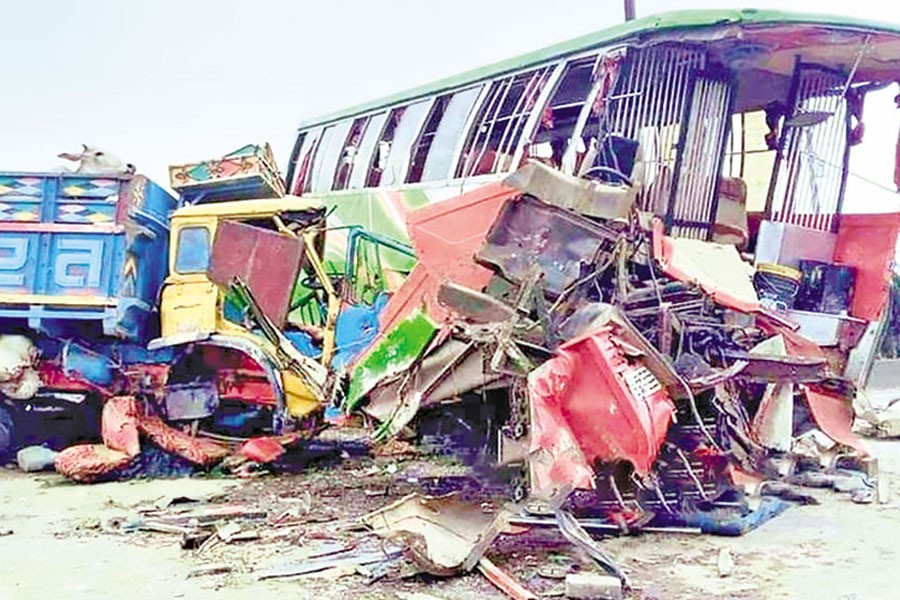
In Bangladesh, every road accident is often reported as an unfortunate tragedy. Yet, when examined sociologically, each crash is also a signal of a deeper institutional failure. The growing number of deaths on the country's roads cannot be explained simply by driver error, bad luck, or momentary negligence. Rather, these deaths form a pattern-one that reflects systemic weaknesses in governance, regulatory enforcement, and public accountability. The road has become a space where structural failures of the state manifest in the most tragic way possible: the routine loss of human life.
The scale of the crisis is staggering. According to reports compiled by the Bangladesh Jatri Kalyan Samiti and other road safety monitoring organisations, approximately 7,584 road accidents occurred in Bangladesh in 2025, leading to thousands of deaths and injuries. These incidents imposed an estimated economic loss of Tk 25,550 crore, a figure that reflects medical expenses, lost productivity, property damage, and long-term social consequences for affected families. The tragedy intensified during the Eid travel season in 2026, when 274 people were reportedly killed within just ten days during the nationwide holiday movement. These numbers represent not merely accidents but a persistent pattern of governance failure.
Recent incidents illustrate the depth of the problem. On March 25, 2026, a passenger bus plunged into the Padma River near Daulatdia, killing 26 people, including women and children. Investigations suggested a combination of factors such as poor infrastructure, weak safety enforcement, and inadequate vehicle standards. Just days earlier, a collision between a mail train and a bus at an unmanned railway level crossing in Cumilla claimed 12 more lives. Such incidents are often treated as isolated events, yet they occur within a recurring national pattern.
Understanding this crisis requires moving beyond the language of accident and towards the analytical frameworks of sociology. One of the most useful theoretical perspectives is the concept of structural violence, developed by Norwegian sociologist Johan Galtung. Structural violence refers to harm caused not by direct physical aggression but by the organisation of social, political, and economic systems that systematically disadvantage certain groups. According to Galtung, violence occurs whenever social structures prevent individuals from reaching their full potential or expose them to preventable harm.
Applied to Bangladesh's road system, structural violence becomes visible in the institutional arrangements that allow unsafe vehicles, untrained drivers, and weak enforcement mechanisms to persist. When vehicle fitness certificates are issued to mechanically unfit buses, when driving licences are obtained through informal payments rather than competency tests. When traffic enforcement agencies operate with a limited workforce across a vast road network, the resulting deaths cannot be dismissed as random accidents. They are the predictable outcome of institutional arrangements that permit risk to remain embedded in the system.
One striking example is the disproportionate mortality associated with motorcycles. Data cited by road safety organisations indicate that Bangladesh has one of the highest ratios of motorcycle fatalities relative to vehicle numbers globally, with approximately 28 deaths per 10,000 registered motorcycles. At the same time, the rapid expansion of motorcycle ownership has not been matched by adequate investment in rider training, road design, or enforcement of helmet laws. From the perspective of structural violence, the system effectively exposes certain road users to higher risk while protecting others who possess greater economic or social privilege.
Another theoretical framework that illuminates this phenomenon is the concept of the precariat, developed by British economist and sociologist Guy Standing. Standing describes the precariat as a social class characterised by insecure employment, unstable income, and lack of social protection. Members of this class often rely on informal or precarious forms of work, which frequently involve risky mobility patterns.
In Bangladesh, the road has increasingly become the workspace of the precariat. Delivery riders, informal transport operators, day labourers commuting long distances, and small traders transporting goods all depend on motorcycles or overcrowded buses. Statistics suggest that approximately 78 per cent of those killed in road accidents in 2025 were working-age individuals between 18 and 65, many of whom were primary income earners for their families. Motorcycle riders alone accounted for a large share of fatalities, representing around 36 per cent of road deaths in some recent analyses by the Road Safety Foundation.
From the standpoint of the precariat theory, these deaths are not random. They disproportionately affect individuals whose economic circumstances compel them to use the most hazardous transport options. In other words, risk on the road mirrors broader inequalities in the labour market. Those with stable incomes and private vehicles enjoy relatively safer mobility, while the economically vulnerable face the highest exposure to danger.
A further conceptual lens can be drawn from Italian philosopher Giorgio Agamben, particularly his theory of the state of exception. Agamben argues that modern governance sometimes normalises emergency conditions, suspending ordinary rules while presenting the situation as temporary. Over time, however, the exceptional condition becomes permanent.
In Bangladesh's road governance, a similar pattern can be observed. After major accidents, authorities typically form investigation committees, announce safety campaigns, and promise reforms. Yet these measures often remain symbolic. Reports are rarely made public, recommendations are seldom implemented, and enforcement mechanisms remain weak. The repeated cycle of tragedy, investigation, and inaction effectively normalises the crisis. The road becomes a permanent "state of exception," where safety regulations exist in law but not in practice.
The persistence of the problem can also be understood through the sociological theory of social fields, developed by French sociologist Pierre Bourdieu. Bourdieu argued that society consists of various fields-structured arenas where individuals and institutions compete for power using different forms of capital, such as economic capital, social capital, and symbolic capital.
Bangladesh's transport sector functions as such a field. Bus owners, transport syndicates, labour unions, and regulatory authorities all operate within this competitive environment. Transport associations possess not only economic resources but also significant political connections. These networks can influence regulatory decisions, route allocations, and enforcement practices. As a result, attempts to implement strict safety regulations often encounter resistance from actors whose economic interests depend on maintaining the status quo.
Within this field, civil society organisations advocating road safety-such as the Road Safety Foundation, Bangladesh Jatri Kalyan Samiti, and the Nirapad Sarak Chai movement-possess substantial symbolic capital in the form of public credibility and moral authority. However, they lack the political capital required to reshape the rules of the field. Consequently, their recommendations-ranging from improved digital traffic monitoring to stricter licensing procedures-often remain unimplemented.
Road accident data in Bangladesh indicate that certain groups face distinctive risks. Studies have shown that children constitute roughly 15 per cent of road fatalities, often as pedestrians or passengers on school-related journeys. Women represent around 12 per cent of fatalities, frequently dying as passengers in overcrowded vehicles where they have little control over safety conditions. These patterns highlight how mobility risks intersect with social inequalities.
Bangladesh's Road Transport Act of 2018 introduced strong penalties for traffic violations and sought to modernise road governance. However, enforcement has remained inconsistent. Awareness campaigns, policy statements, and institutional committees create the appearance of reform while leaving underlying power structures largely intact.
The economic consequences of this crisis are equally significant. The estimated Tk 25,550 crore annual loss attributed to road accidents, cited by safety organisations using economic impact assessments, represents a major drain on national development. This figure reflects lost productivity, healthcare costs, and the long-term socioeconomic consequences for families who lose their primary income earners.
Ultimately, Bangladesh's road safety crisis is not merely a transportation problem; it is a governance problem. The road system reflects broader institutional weaknesses-fragmented regulation, inadequate enforcement, and the influence of powerful interest groups. Until these structural issues are addressed, road accidents will continue to reproduce themselves as a routine feature of everyday life.
The road, in this sense, functions as a mirror of society. It reveals who benefits from safety and who bears the burden of risk. It exposes the hierarchy of protection embedded in social and economic structures. And it raises a fundamental question about governance: whether the preventable deaths of thousands of citizens each year will continue to be treated as unfortunate statistics, or whether they will finally be recognised as a systemic failure demanding transformative reform.
Dr. Matiur Rahman is a researcher and development professional
matiurrahman588@gmail.com