
Political stability needed to attract investments
FE Report | Sunday, 26 January 2014
The private think-tank Centre for Policy Dialogue (CPD) said Saturday a conducive political environment aiding democratic governance was needed for taking the level of investments to a higher plane.
"Although various economic factors might contribute to the emergent scenario, it is the political factor which appeared to be the critically important determinant," said the CPD in the second edition of its review report on Bangladesh's Macroeconomic Performance released on the day.
CPD executive director Professor Mustafizur Rahman and distinguished fellow Dr Debapriya Bhattacharya briefed the media Saturday on the review report.
Private and public investments in the country had been severely affected by the political impasse over the last few months as registration of investment proposals from local enterprises declined by 27 per cent and those from foreign entrepreneurs fell by 10 per cent during the last calendar year (CY).
Dr Debapriya said until or unless a free, fair and participatory national election was held, the political uncertainty would linger and would affect long-term investments.
"Discussions with all groups outside the government and the major political party are imperative to rebuild business confidence and restore operational efficiency of economic capabilities," he said.
CPD executive director Prof Mustafiz suggested rebuilding the image of the country for attracting more investments and laying emphasis on allocation of higher funds to priority projects for the sake of quality public expenditure.
The local think-tank in the report has forecasted that the growth in Gross Domestic Product (GDP) will range from 5.6 to 5.8 per cent in the current fiscal year (FY) due to the political turmoil during the past few months.
"In view of available information on various sectors and assuming that there will be no major supply-side disruption and uncertainty arising out of political turmoil during the remaining part of the FY 2014, it is likely that the GDP growth rate in the FY 2014 will be between 5.6-5.8 per cent," said the CPD analysis.
"Bangladesh has lost its momentum to move to the higher growth trajectory following a record 6.7 per cent GDP growth in 2010-11. So, it will be a major challenge for the government to return to such a higher growth rate," Prof Mustafizur said.
The CPD in its macroeconomic review suggested four things -- restructuring the fiscal framework, support to Boro farming and rural economy, compensatory measures for the affected sectors and ensuring policy predictability to achieve the economic growth.
Dr Bhattacharya said the government should not support only the ready-made garment sector, it should provide some fiscal benefits to the small and agriculture sector which was also broadly affected by the political turmoil.
"The RMG owners can raise their voice. So they can obtain the fiscal benefit from the government. The small industries and sub-sectors in the rural economy which couldn't raise their voice but were affected severely by the recent political violence should be taken into consideration by the government immediately," he added.
He also said there was a big gap in vegetable prices between the growers' level and the retail level and suggested restoration of the interest of farmers by providing agricultural credit on easy terms and conditions on an urgent basis.
The CPD distinguished fellow said agricultural activities and agro-based industries were worst-affected areas during the political turmoil in the last few months followed by the transport and export-oriented manufacturing sectors.
Quoting the CPD's macroeconomic review, Professor Mustafizur Rahman said some of the strong areas including export earnings and balance of payments (BoP) saw a good trend in the first half of the current fiscal while some of the other areas including import payment showed signs of recovery.
"Economic performance of a number of indicators continued to deteriorate in the first half of the FY 2014 including inflation, ADP (Annual Development Programme) implementation, remittance inflow and foreign aid utilisation," he said.
The analysis for the first half of the current fiscal also confirmed that the economy in the FY 2014 did not manage to make any significant shift from arrested growth towards a higher growth trajectory, Prof Mustafiz said.
The CPD has cautioned the government about lower food stocks in the country. The stock in December 2013 was 0.951 million tonnes, 31 per cent lower than that in December 2012 and 38 per cent down from that in December 2011.
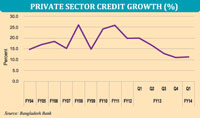
The local think-tank has seen the soaring volume of non-performing loans with the commercial banks, downward capital adequacy, high excess liquidity and the low private sector credit growth as bad indicators of the economy.
It said excess liquidity in the banks has risen by 73.8 percent at the end of November 2013 over the corresponding period of November 2012; however, in case of DFIs a negative growth is observed for the same period as regards excess liquidity situation.
"Low private sector demand for credit due to political uncertainties and also the ceiling imposed on banks' investment in the share market by Bangladesh Bank have contributed to high liquidity in the banking system. Though credit to the public sector has increased by 15.56 percent in November 2013 compared to 8.9 percent in Fy2012, credit to the private sector in creased by 11 percent as of November 2013 as opposed to the target of 16.5 percent for FY2014," the report said.
Lower credit to the private sector is a reflection of low appetite on the part of the private sector which is the result of both recent political turmoil and long standing problems of weak infrastructure and other bottlenecks, the CPD report said.
The CPD, however, sees an impressive performance in the area of export earnings. The growth in shipment of Bangladeshi products might be static in near future as the external demand was increasing due to the economic rebounding in the US and in the European countries.
The CPD finds the level of private and public sector investments poor and suggested rebuilding the country's image for attracting investors and laying emphasis on high priority projects in the area of infrastructure development.
It also recommended restructuring the government's fiscal income and expenditure in the current fiscal as the revenue collection recorded a shortfall of Tk 85 billion in the July-November period from the actual target and the net foreign aid inflow to the country was lower.
Prof Mustafizur Rahman found the negative remittance growth as the big challenge for the economy, as it usually helps boost consumption in the rural economy.
The rural economy which was the worst affected area during the last political turmoil across the country should have been in more focus of the government so that it could recoup the losses, he said adding the current Boro crop farming should be given the highest priority.
Dr Debapriya said: "The macro-economy is enjoying stability, as there are no major ups or downs in the economy. The budget deficit is acceptable and within the control, which will give the opportunity to increase expenditure. But we will have to ensure quality expenditure."
"The surplus US$ 2.0 billion in the current account balance will give the opportunity to the government to raise imports. The exchange rate is stable and the prices of food, fertiliser and fuel are stable or on the declining trend in the global market."
So, it would not be impossible for the government to utilise the opportunity and take the country forward until the next budget, he said.
The economist called for a rethink on subsidy spending so that the expenditure remains within control.
Dr Debapriya said it was important to expand the social safety net programmes. "But we have to ensure efficient use of resources and check leakage."
The CPD in its review has estimated the losses caused by the political turmoil in some major areas of the economy. The total loss is estimated at Tk 490.18 billion which is equivalent to 4.7 per cent of the GDP.
The land transport sub-sector incurred the highest loss of Tk 166.88 billion, followed by the agriculture and agro-based industries with Tk 158.29 billion, export-oriented clothing and textile sector Tk 137.50 billion and the tourism sector Tk 27.50 billion, it said.